
Anniversary Grief Explained
Anniversary grief explained clearly. Why it resurfaces, how it manifests, and why structural approaches matter.
GRIEF
Marc Cooper
2/23/20266 min read
Anniversary Grief
Anniversary grief is the predictable reactivation of loss-related distress around meaningful dates connected to a death or significant loss. The term anniversary grief refers to the emotional, cognitive, and physiological resurgence that often occurs near birthdays, death dates, holidays, or shared milestones.
It is not random. It is patterned.
Why Anniversary Grief Happens
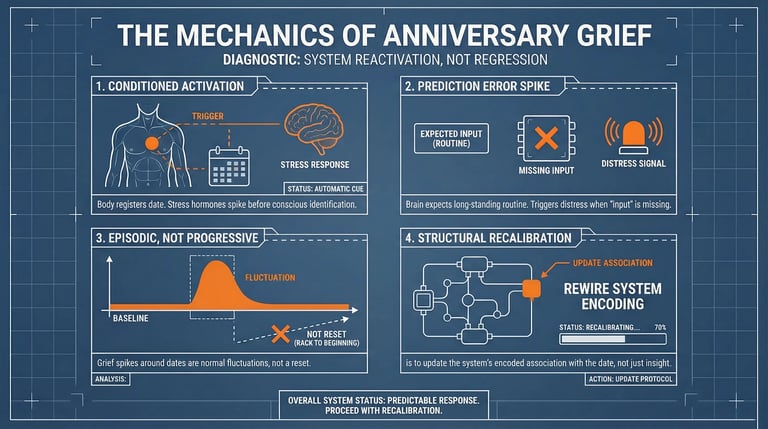
Anniversary grief is driven by associative memory networks. The human nervous system encodes emotionally significant experiences with contextual markers, dates, seasons, smells, locations, music, routines. When the calendar approaches a marked date, those cues reactivate the original neural network linked to the loss.
This process is largely implicit. The body registers the date before conscious awareness does.
From a cognitive perspective, episodic memory is state-dependent. Research in grief psychology shows that emotionally intense experiences are consolidated in ways that make later retrieval more likely when environmental conditions resemble the original context. The anniversary becomes a contextual match trigger.
From a behavioral standpoint, routines reinforce this pattern. If a specific day historically involved shared rituals, conversations, or traditions, the absence of those behaviors now amplifies contrast. The brain detects discrepancy. Discrepancy activates distress.
Physiologically, stress hormones can rise before conscious thought identifies why. Sleep disruption, irritability, or sudden sadness may precede recognition of the date itself.
This is not regression. It is conditioned activation.
Longitudinal bereavement research, including work summarized by the American Psychological Association, demonstrates that grief responses often show temporal spikes around significant dates rather than following a smooth linear decline. The pattern is episodic, not progressive. See overview of grief research from the American Psychological Association: https://www.apa.org/monitor/2019/11/ce-corner-grief
Anniversary grief is therefore structural. The system is responding to encoded signals.
How Anniversary Grief Feels Internally
People often notice a shift days or weeks before the actual date.
Energy changes first. Focus narrows. Sleep becomes lighter. There may be a subtle sense of tension without identifiable cause.
This usually feels like heaviness without narrative. Not active rumination, but lowered baseline mood.
Some experience irritability rather than sadness. Others report emotional numbness, which later breaks abruptly.
This tends to show up when daily routines are disrupted by anticipation. The mind may repeatedly check the calendar. Thoughts of “I should be past this” or “Why is this coming back?” are common.
There is often a split experience. One part of the person recognizes the date logically. Another part reacts as if the loss is current.
Physically, people often notice:
Tightness in the chest or throat
Reduced appetite
Increased fatigue
Heightened sensitivity to small stressors
The reaction can be brief and intense, or diffuse and lingering.
Importantly, anniversary grief does not necessarily mirror the original grief. It may be quieter. It may be sharper. It may be more existential than emotional.
The key feature is recurrence tied to time.
Anniversary Grief and the Brain’s Predictive Model
The brain operates on prediction. It constantly anticipates what should happen next based on past experience.
If, for twenty years, a birthday meant calling someone, buying a gift, sharing a meal, that prediction is deeply encoded. When the date arrives and the expected interaction does not occur, the prediction error is stark.
Prediction error amplifies emotional salience.
The mind attempts reconciliation. It searches for the missing input. This is why intrusive memories or vivid imagery may intensify near anniversaries.
The system is not malfunctioning. It is attempting coherence.
However, when the loss was traumatic, anniversary grief can also reactivate trauma networks. In those cases, the response may include hypervigilance, avoidance, or somatic distress beyond sadness.
When the loss involves a pet, anniversary reactions can be especially isolating. Social structures often fail to validate the intensity of attachment. I address the structural aspects of that type of loss in more depth here: https://www.marccooperhypnosis.com/pet-loss
Why Talking About It Often Does Not Shift It
Anniversary grief is not primarily a narrative problem.
People usually already understand why they feel worse on that date. They know the reason. They know the history. Insight is present.
The difficulty lies in conditioned activation.
Talking can clarify meaning. It rarely alters the encoded association between date and physiological response.
If the nervous system has paired a calendar cue with distress, insight does not dissolve the pairing.
Additionally, anniversary grief often includes pre-verbal elements. The original moment of loss may have involved shock, dissociation, or overwhelming emotion. Those states are stored somatically.
When the anniversary arrives, the body replays fragments that may not be fully linguistic. Conversation engages cognitive layers. The reactivation may sit beneath them.
This is why people can articulate their grief clearly and still feel blindsided every year.
It is not a failure of understanding. It is a conditioning loop.
A Structural Orientation to Anniversary Grief
When a pattern is conditioned, addressing the pattern structurally matters more than analyzing the content repeatedly.
The details of the loss do not need to be dissected each year in order for the nervous system to shift its response.
What matters is how the system encodes and re-encodes temporal cues.
I outline the broader structural model behind this approach in the Content-Free Hypnosis Guide: https://www.marccooperhypnosis.com/content-free-hypnosis-guide
The principle is simple. The pattern is time-linked. The work addresses the pattern at the level where it is encoded, not at the level of storytelling.
No rehashing. No forced catharsis. No revisiting scenes for the sake of revisiting them.
The focus is structural recalibration.
Micro-Anchors of Anniversary Grief
On the morning of the date, a person wakes earlier than usual. There is no clear thought. The body feels alert and uneasy. Only later does the calendar register.
At a grocery store, someone sees a product associated with the person who died. The reaction is disproportionate to the stimulus. The date is two days away.
A week before the anniversary, motivation drops. Work tasks feel heavier. There is no identifiable external stressor.
On the anniversary itself, the day passes quietly. There are no tears. The following day brings unexpected emotional release.
These are not dramatic episodes. They are patterned fluctuations.
Chronification of the Pattern
If anniversary grief remains unaddressed structurally, the nervous system continues to anticipate distress each year.
Anticipation itself becomes conditioned.
This can create a secondary layer. Not only does the date trigger grief, but the approach of the date triggers anxiety about the grief.
Over time, individuals may begin avoiding the calendar, social events, or certain months entirely.
In some cases, the anniversary reaction broadens. It spreads from a single day to an entire season.
Behaviorally, people may plan distractions rather than engagement. Avoidance reinforces sensitivity.
Neurologically, repeated activation without recalibration strengthens the associative pathway.
This does not mean the grief is worsening. It means the loop is stable.
Stable loops do not dissolve spontaneously.
Anniversary Grief and Identity Shifts
Loss reorganizes identity. Roles change. Relational maps change.
Anniversaries often highlight that reorganization. They mark not only time since loss, but time lived in a new configuration.
For some, this triggers existential questioning. “Who am I now?” becomes more prominent near anniversaries.
This layer is distinct from sadness. It is structural recalibration of identity.
When the anniversary passes, this questioning often recedes.
Until the next cycle.
When Anniversary Grief Intersects With Anxiety
If baseline anxiety is already elevated, anniversary cues can amplify it.
The nervous system may generalize from the specific date to broader uncertainty.
Physical symptoms can intensify. Heart rate variability decreases. Sleep disturbances increase.
In those cases, the anniversary reaction may look less like grief and more like generalized agitation.
The structural pattern is similar. A cue triggers a stored network.
I address anxiety patterns more broadly here: https://www.marccooperhypnosis.com/hypnotherapy-for-anxiety
The intersection between grief and anxiety is often underestimated. Anniversary grief can function as a seasonal spike within an otherwise stable year.
What Anniversary Grief Is Not
It is not evidence that someone is “back at the beginning.”
It is not a sign that previous processing failed.
It is not proof that attachment was unhealthy.
It is a temporal activation pattern.
The difference matters. Mislabeling the pattern as regression increases secondary distress.
Understanding it as conditioned recurrence changes the frame.
FAQ: Anniversary Grief
What triggers anniversary grief?
Calendar dates, seasonal cues, shared rituals, and contextual reminders linked to the original loss can reactivate stored emotional networks.
How long does anniversary grief last?
The intensity and duration vary. Some experience brief spikes lasting hours or days. Others notice a gradual increase and decline over several weeks surrounding the date.
Is anniversary grief normal years after a loss?
Yes. Temporal reactivation can occur many years later because associative memory does not expire. The pattern can persist even when daily functioning is stable.
Can anniversary grief become a disorder?
Anniversary grief itself is not a disorder. However, if reactions are severe, prolonged, or impair functioning consistently, professional evaluation may be appropriate.
Does avoiding the anniversary help?
Avoidance can reduce immediate distress but often reinforces the associative loop, increasing sensitivity over time.
When this pattern is active, this is the work I do.
This article is informational only and not medical or psychological advice.
Address
Based in Los Angeles, CA
Online sessions available worldwide
Contacts

