
Avoidance and Privacy Are Not the Same Thing
Most people who call themselves private are not. Avoidance is a procedural pattern. Privacy is a preference. Therapy routinely confuses them.
SELF IMPROVEMENT
Marc Cooper
4/30/20265 min read
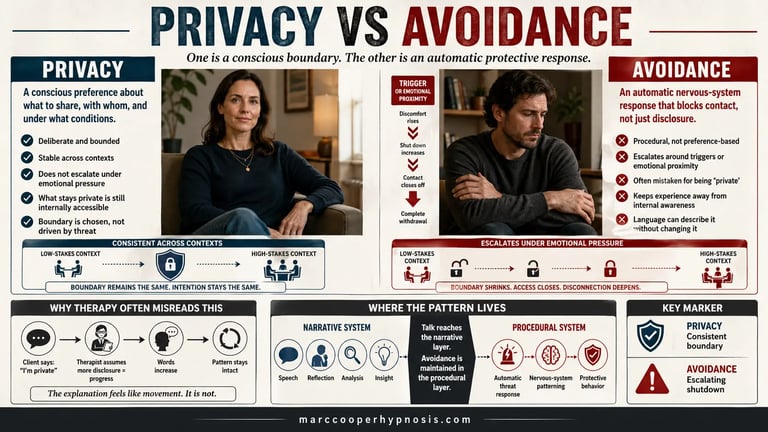

There Is a Difference Between Avoidance and Privacy. Therapy Confuses Them.
Most people who describe themselves as private are not private. They are avoidant. The distinction matters more than therapy currently acknowledges.
Privacy is a structural preference about information. A person who is private decides what they share, with whom, and under what conditions. The decision is conscious. It is bounded. It does not leak into behavior in uncontrolled ways, and it does not require ongoing energy to maintain. Privacy is stable. It does not escalate. It does not become more pronounced under emotional pressure or shift depending on who is in the room.
Avoidance is a pattern in the nervous system. It is not a preference. It is a response. Something is being kept away from internal awareness, not just from other people. The person is not deciding what to share. They are preventing themselves from contacting something that the procedural system has already marked as threatening. That process runs automatically. It does not require a decision. It runs whether the person wants it to or not.
These are not variations of the same thing. They are structurally different.
Therapy, in most of its forms, is built on the premise that talking about something constitutes engaging with it. That premise holds when the block is informational. It fails when the block is procedural. And when avoidance gets misclassified as privacy, the therapeutic response moves in entirely the wrong direction.
I have watched this happen repeatedly. A person arrives at therapy describing themselves as someone who "just doesn't open up easily." The therapist, operating from the reasonable assumption that more disclosure equals more progress, spends months trying to create conditions for that disclosure. The person may eventually comply. They may say more words about more experiences. But the underlying pattern does not shift. The avoidance does not lift. What happens instead is that the person gets better at describing their avoidance. They learn its vocabulary. They can explain why they are the way they are.
The explanation feels like movement. It is not.
This is not a failure of the therapist's skill. It is a failure of the model.
The confusion has a specific cost. When avoidance is treated as privacy, the therapeutic intervention respects what it should be questioning. The clinician holds space for the person's right not to disclose. That is entirely appropriate for actual privacy. For avoidance, it reinforces the wall. The treatment ends up protecting the pattern rather than resolving it. Months pass. The person reports that they feel understood. The behavior is unchanged.
People who operate this way often feel genuinely confused by their own behavior. They do not experience themselves as avoidant. They experience themselves as private, selective, self-contained. The distinction between those self-descriptions and what is actually happening is not accessible through language, because the mechanism producing the avoidance is not a language-level process. It sits below that. It operates through the same system that controls automatic threat responses, through the same architecture that handles physical safety, through pattern-recognition structures that predate verbal cognition entirely.
That is why talking about it rarely resolves it. Not because the person refuses to engage. Because language is not the medium where the pattern lives.
There is a particular marker that separates avoidance from privacy when I am paying attention. Privacy is consistent across contexts. A person who is genuinely private is equally closed in low-stakes situations and high-stakes ones. They do not become more closed when emotional proximity increases. They are simply closed, uniformly, as a settled preference. There is no escalation. No reaction to specific triggers. The boundary is flat and stable.
Avoidance escalates. It gets more pronounced when certain subjects arise, when certain people are nearby, when the environment carries particular cues. The escalation is not volitional. The person did not decide to become less accessible in that moment. Something in the pattern recognized a threat and engaged the protective response. They experience this as feeling "less like talking" or "not in the mood" or "just tired." What is actually happening is that the procedural system has overridden the deliberate one.
This is the architecture that talk-based work cannot reach from the outside.
The verbal processing that happens in a standard session, the reflection, the narration, the careful reconstruction of personal history, all of that operates in the narrative system. The narrative system is capable of insight. It can recognize patterns with intellectual precision. It can generate descriptions of experience that are accurate and nuanced. But it does not have authority over the procedural layer. The procedural layer does not take instructions. It does not update through understanding. It updates through a different mechanism entirely, one that does not run on words. For those who want more on that distinction, the content-free hypnosis guide lays it out structurally.
When a person gains insight in therapy about their avoidance, they now have a more articulate relationship to a pattern they still cannot override. That articulation can feel like progress because the discomfort of not-knowing has been replaced by the relative comfort of having a framework. But the pattern is still running. The escalation still happens in those contexts. The procedural system is unchanged.
This is not a small problem.
For people whose avoidance is organized around earlier experiences, the pattern is often old, layered, and stable in ways that verbal work cannot destabilize. The pattern is not maintained by belief. It is not maintained by a narrative that could be challenged or a story that could be rewritten. It is maintained by the procedural system doing what procedural systems do: enforcing what has been encoded as protective behavior, regardless of whether the original threat still exists or ever existed in the form the system encoded it.
Therapy regularly misses this because the field's primary tool is language, and language looks like contact. If a person is speaking about their experience, the assumption is that they are engaging with it. Sometimes that is true. But for someone whose protective pattern is avoidance, speaking about experience can itself function as a form of avoidance. The speaking substitutes for the contact. The articulation creates distance rather than access. The words operate as a management layer over something the person has still not touched. This shows up consistently in the work I do with chronic anxiety and emotional suppression, which I address here.
There is no resolution available at the level where the pattern does not live.
What changes this is not more accurate self-description. It is not deeper excavation of the past. It is not a more honest account of where the behavior came from or what it cost. Those things can coexist indefinitely with the pattern intact. I have worked with people who could narrate their own avoidance with clinical precision and still found themselves unable to change it. The narration was real. The insight was real. The pattern did not care.
What changes the pattern is work that operates at the level where the pattern is maintained. That level is not verbal. It is not narrative. It does not respond to insight or to intention. It responds to something different, something that functions below the threshold where conscious processing operates, something that the narrative system cannot observe while it is occurring.
I am not describing relaxation. I am not describing suggestion or positive reframing. I am describing a structural operation at the level of the procedural system, where the pattern is encoded, where it is sustained, and where it can be changed in a way that no amount of language-based work is designed to reach.
This is for people who have already been articulate. Who have done the talking. Who can map their own pattern with precision and still find it unchanged after years of effort. Who carry "private" as an identity label but recognize avoidance as the actual operational reality. Who have stopped waiting for one more conversation to be the thing that finally moves it.
It is not for people who want to talk through the experience.
When the label stops fitting, people usually find their way to me.
Address
Based in Los Angeles, CA
Online sessions available worldwide
Contacts

