
Calm Is Not Relaxation. It’s Control Under Load | Marc Cooper Hypnosis
Calm is not a feeling. It is the ability to maintain control and decision quality under pressure. Why insight fails and regulation changes outcomes.
CALM UNDER PRESSURE
2/7/20264 min read
Calm Is Not Relaxation. It’s Control Under Load Function
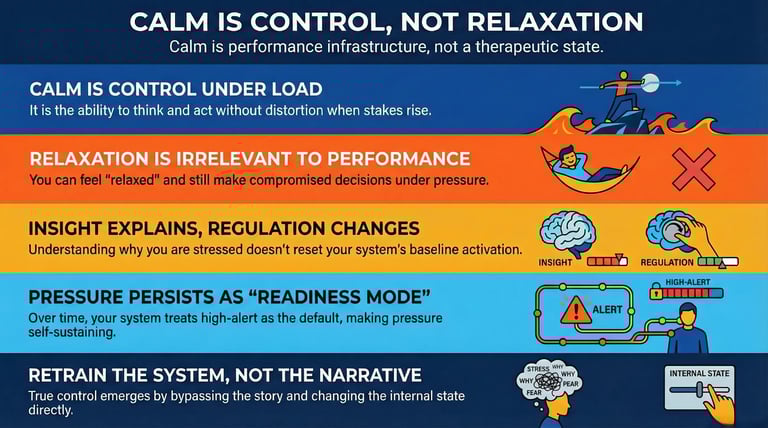
Calm is not the absence of sensation. It is not a pleasant internal state. It is not something you feel when nothing is required of you. Calm is the capacity to remain internally stable while demand increases. It is the ability to think, decide, and act without internal distortion when pressure is present.
This is a functional definition, not a therapeutic one.
When calm is present, decisions remain proportional to reality. Attention stays available. Urgency does not override judgment. When calm is absent, even highly capable people experience narrowing, reactivity, and unnecessary force. The issue is not stress. It is loss of internal control under load.
Relaxation is irrelevant to this problem. You can be relaxed and still unreliable under pressure. You can feel fine and still make compromised decisions when stakes rise. Calm, as used here, is performance infrastructure. It determines whether cognition stays online when it matters.
Calm Is a Performance Variable, Not a Feeling
Performance does not degrade evenly. It degrades in specific ways under internal pressure.
Options collapse. Time feels compressed. Decisions become binary. People move too early or hesitate too long. These are not random failures. They are predictable effects of elevated internal load on the system that governs threat detection, urgency, and readiness.
Many high-functioning adults mistake calm for comfort because comfort is easy to measure. Calm under load is not. It only reveals itself when something meaningful is at stake. Negotiations, leadership decisions, financial exposure, conflict, responsibility for others. These are not moments where relaxation helps. They are moments where stability determines outcome quality.
If calm were simply a feeling, it would be accessible through intention. It is not. The fact that capable, intelligent people repeatedly lose internal stability under pressure tells you something structural is happening.
Why Insight Does Not Reduce Pressure
The dominant response to internal pressure is cognitive. More understanding. More analysis. More explanation. The assumption is that pressure persists because something has not been fully seen, processed, or articulated.
This assumption is incorrect.
Insight operates at the level of interpretation. Internal pressure is generated at the level of activation. When activation is high, cognition does not lead. It follows. The mind explains the state it is in. It does not set the state.
This is why insight reliably increases self-awareness without reliably increasing control. People can describe their internal patterns accurately and still experience the same surge when demand rises. They can know exactly what is happening and still be unable to stop it. That is not a failure of intelligence or effort. It is a category error.
Talking-based approaches depend on conscious attention and narrative coherence. Under real pressure, attention narrows and narrative degrades. The system prioritizes speed over accuracy. Any intervention that requires sustained cognitive effort will fail precisely when it is most needed.
If internal pressure were a thinking problem, thinking would solve it. The persistence of the problem, especially among people who think well, is the evidence that it is not.
Pressure Persists Because the System Never Stands Down
Internal pressure is not caused by events. It is caused by a system that remains in readiness mode long after demand has passed.
Over time, responsibility, repetition, and performance under constraint condition the system to stay elevated. The baseline shifts. What was once a spike becomes normal. The body treats neutral situations as if something is about to go wrong. Readiness becomes default.
This has measurable effects. Sleep becomes lighter. Recovery shortens. The sense of urgency appears without a clear source. Small friction triggers disproportionate response. The mind interprets this as a need to manage, fix, or optimize constantly.
At this point, the pressure is self-sustaining. Monitoring becomes another signal of threat. Control efforts reinforce activation. The system never completes the cycle that would allow it to stand down.
No amount of understanding resolves this, because understanding does not reset baseline activation. It can coexist with it indefinitely.
Regulation Changes Output. Understanding Does Not.
Regulation is the ability to change internal state deliberately and reliably. It determines whether pressure escalates or dissipates. It determines whether cognition remains accessible under load.
A regulated system can experience demand without interpreting it as threat. An unregulated system interprets demand as threat regardless of context. The difference shows up in decision quality, timing, and proportionality.
This is not about reducing intensity. High performers often require intensity. The problem is intensity without control. When pressure automatically produces urgency, cognition becomes subordinate to state. Decisions are made to reduce internal discomfort, not to maximize external outcome.
Understanding can explain this. Regulation can change it.
Any approach that targets insight without altering baseline activation leaves the core mechanism intact. It may improve language, self-concept, or narrative clarity. It does not improve control under load.
Interventions That Bypass Narrative Work Faster
If the generator of pressure is automatic, the intervention must operate at that level.
Content-free hypnotherapy does not depend on disclosure, analysis, or storytelling. It works below narrative, at the level where conditioned responses are stored and triggered. This makes it efficient for people who value privacy, control, and time.
There is no requirement to explain or justify the pressure. The system does not need reasons. It needs retraining. When baseline activation changes, the mind stops compensating. Control emerges without effort because it is no longer fighting an upstream signal.
This is not about relaxation. It is about restoring the capacity to remain stable when load increases.
Control Under Load Is Trainable
Loss of calm under pressure is not a personal flaw. It is not a lack of resilience. It is a predictable outcome of a system that has learned to operate at elevated readiness for too long.
Because it is learned, it is trainable.
Calm, defined as control under load, is not achieved through reassurance or insight. It is achieved by changing the conditions that generate pressure in the first place. When that happens, decision-making improves without force. Attention widens. Timing stabilizes.
This is not a mindset shift. It is a functional change.
This is what Calm Under Pressure is designed to address.
Address
Based in Los Angeles, CA
Online sessions available worldwide
Contacts

