
Calming Panic Without Retelling the Story
Panic surges don't require a narrative to be resolved. Here's what's actually happening and why content-free approaches work when talk doesn't.
CONTENT-FREE HYPNOSIS
Marc Cooper
3/30/20265 min read
Calming Panic Surges Without Retelling the Origin Story
What This Actually Is
A panic surge is a rapid, full-body activation that arrives with urgency and often without a clear narrative trigger. Calming panic surges is not the same thing as understanding them. That distinction matters, and most people treating panic don't make it.
The body fires. The mind scrambles to explain why.
Those are two separate events.
Why the Body Fires Without Permission
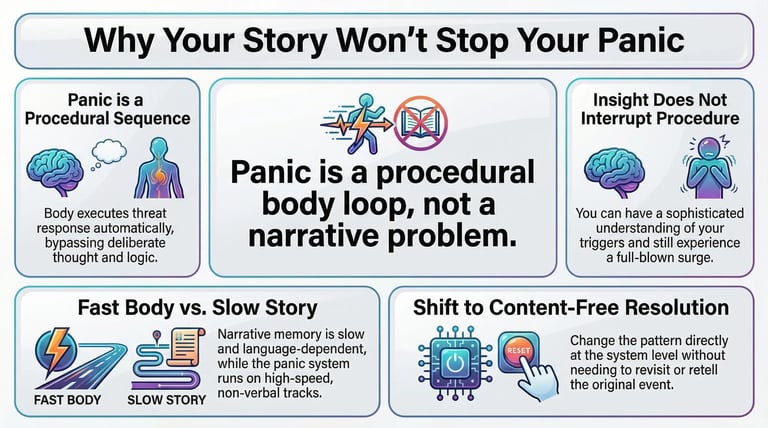
The panic response is not a thinking system. It runs on procedural memory, which operates below conscious access. When a threat signal fires, the body doesn't consult a story. It executes a sequence. Heart rate spikes. Breathing compresses. Threat perception amplifies.
This is fast. It bypasses deliberate cognition.
The origin story, whatever it is, gets assembled after activation. Meaning comes second. The body was already three steps ahead.
Research on fear memory consolidation, including foundational work by Joseph LeDoux on the amygdala's role in emotional processing, confirms that threat responses can persist independently of conscious recall. The body doesn't need the story to keep the pattern running.
How This Shows Up Internally
People often notice that panic arrives before they've had a single coherent thought. There's a sense of wrongness, of something being off, before the mind has finished forming a sentence.
This usually feels like being hijacked.
The person can name their triggers in retrospect. They can trace the logic backwards. They can explain, in some detail, why this started or where it comes from. What they can't do is stop the surge mid-stream using that same logic.
This tends to show up most sharply in situations where the person is ostensibly safe. No external threat is present. The intellect registers that. The body doesn't care.
The gap between knowing and feeling is where panic lives.
Why Retelling the Story Doesn't Stop the Surge
Conventional approaches to panic often involve revisiting the origin. Connecting the present response to its historical root. Building insight.
That's not useless work. But it is the wrong tool for stopping a surge in real time.
Talking about the story engages narrative memory. Narrative memory is slow, contextual, and language-dependent. The panic response is running on a different track. The two systems don't communicate the way people assume they do.
Insight doesn't interrupt procedure.
A person can have a complete, accurate, emotionally sophisticated understanding of why they panic, and still panic. At the moment of surge, the procedural sequence is already in motion. Narrating the origin doesn't interrupt the sequence. It runs alongside it.
Sometimes it makes it worse. Activating the memory of the original threat while already in a heightened state can intensify the response rather than resolve it.
Why Content-Free Orientation Matters Here
If the panic system is procedural, the appropriate intervention isn't narrative. It's also procedural.
Change happens at the level of the pattern. Not at the level of the explanation.
A content-free approach means working directly with the system that runs the panic, without requiring the person to articulate, revisit, or process the origin. The pattern can be updated without surfacing the material that originally encoded it.
This is particularly relevant for people who have done years of work in talk-based settings and have significant insight into their responses but have not seen corresponding change in the actual experience. The insight is accurate. The system hasn't moved.
That's not a failure of the person. It's a mismatch between the level of intervention and the level at which the pattern operates.
If you want to understand how this kind of work is structured, the content-free hypnosis guide gives a clear orientation to the approach.
Practical Anchor: The High-Performer Pattern
The pattern shows up with particular clarity in high-functioning professionals. These are people whose capacity for self-analysis is well-developed. They've often done thorough work on their own psychology.
They can articulate the panic precisely. When it started. What it cost them. What triggers it now.
The surge still happens.
The intellectual precision doesn't translate to pattern interruption, because the system that produces the panic isn't running on intellectual precision. It's running on encoded procedure. Analysis operates in a different register entirely.
Practical Anchor: Anticipatory Panic
One of the more disabling variations is anticipatory panic. The surge arrives not in the moment of threat but in advance of it. A presentation two weeks away. A medical appointment. A difficult conversation.
The procedural sequence fires as if the event is happening now.
The person knows it's not happening yet. That knowledge doesn't stop the sequence from running.
Retelling the origin doesn't change the timing of anticipatory panic. It doesn't interrupt the procedural loop that fires on proximity to the anticipated event.
Practical Anchor: Panic After the Threat Has Passed
Delayed surges are common and often confusing. The person was fine during the event. The surge arrives hours or days later.
This follows the same logic. The procedural sequence can run on a delayed timer. It doesn't require the original threat to be present.
Understanding that this is a delayed procedural response does nothing to interrupt the next instance of it.
What Happens When This Pattern Isn't Addressed
Untreated panic is not static. It spreads.
The procedural sequence generalizes. Triggers that originally activated the pattern in one context begin appearing in adjacent contexts. The activation threshold lowers over time. What once required a significant trigger begins firing on smaller proximity signals.
Avoidance compounds this. When the person limits their behavior to manage exposure to triggers, the nervous system registers each avoidance as confirmation of threat. The pattern reinforces itself.
The story stays the same. The footprint expands.
People at this stage often present with an expanded list of situations they can't enter, relationships they're managing carefully, professional opportunities they've declined. The behavioral contraction is significant, even when the original event was discrete.
If the work here connects to something you're navigating, the anxiety and trauma page gives more context on how I approach it.
FAQ
Why can't understanding the cause of my panic stop it from happening? Because panic runs on procedural memory, which operates below language and narrative. Understanding is a different cognitive system. Insight is generated by narrative memory. The panic sequence doesn't consult it.
What does "content-free" mean in this context? It means working with the panic pattern directly, without requiring the person to revisit or discuss the original event. The pattern can shift without the material being surfaced.
Is it necessary to know what triggered the original panic to resolve it? No. The procedural pattern can be accessed and updated without accurate recall of the origin. Many patterns exist without clear memories attached to them.
Why does panic sometimes arrive after the threat has already passed? The procedural sequence can run on a delay. It doesn't require the original threat to be present in real time. This is a feature of how procedural memory operates, not a sign that something has gone wrong.
Why do high-functioning people often have the most insight and the least relief? Because the system that produces insight and the system that runs the panic pattern are not the same system. High analytical capacity doesn't translate into pattern disruption. It operates on a different track.
When the pattern has reached the point where insight and explanation are no longer enough, that's the kind of work I do.
This article is informational only and not medical or psychological advice.
Address
Based in Los Angeles, CA
Online sessions available worldwide
Contacts

