
Content-Free vs Traditional Hypnotherapy, Explained
A structural comparison of content-free hypnosis and traditional hypnotherapy, what differs, who each fits, and why talk-based insight can stall.
CONTENT-FREE HYPNOSIS
Marc Cooper
1/19/20266 min read
Content-Free vs Traditional Hypnotherapy, Explained
Opening Definition / Clarification
Content-Free Hypnosis vs. Traditional Hypnotherapy is the difference between working with an internal pattern without detailed disclosure, versus working through an identified issue using stated symptoms, narrative context, and targeted suggestions.
Why This Happens (Mechanism)
People assume change follows the sequence: explain the problem, understand it, then resolve it. That sequence is often false.
There are predictable reasons.
Language and pattern do not live at the same level
A pattern can be real and stable without being easily describable. This shows up when:
the reaction is automatic and faster than conscious thought,
the triggering conditions are inconsistent or multi-factor,
memory is fragmented, state-dependent, or contaminated by shame,
the person has spent years building a competent story that still does not change the response.
When language is the primary input, the work depends on the client’s ability to name the correct target, in the correct frame, at the correct depth. That is a narrow channel.
Identification is not the same as access
Many clients can identify what they “have” (anxiety, grief, panic, loops, avoidance) but cannot access the operating layer that keeps it running. They can tell the truth and still not reach the part of the system that is enforcing the response.
That is why some people improve when they find the right words, and others do not improve even when their words are accurate.
Exposure to content can become a stabilizer, not a disruptor
Repeated focus on narrative details can sometimes stabilize a pattern instead of loosening it. Not because narrative is “bad,” but because:
attention reinforces salience,
retelling can become rehearsal,
the system learns: “this is the most important thing,”
the body keeps responding while the mind keeps describing.
If the internal response is maintained by conditioning, threat prediction, or a learned protective strategy, additional description may add information without changing the driver.
The “right target” problem
Traditional approaches often need a well-defined target. That can work well when the client can clearly state:
what they want to change,
when it happens,
what it is connected to,
what success would look like.
But many real-world patterns are not neatly contained. They are diffuse, layered, or masked by performance, functioning, and intellectual control.
Internal Experience Recognition
People often notice a mismatch between what they know and what they feel.
This usually feels like:
“I understand why this happens, but it still happens.”
“I can talk about it clearly, but my body doesn’t follow.”
“The trigger makes no sense, or it changes.”
“If I try to describe it, it either disappears or gets worse.”
“I can perform calm, but the pressure returns later.”
“I don’t want to say certain details out loud, even to a professional.”
“If I go into the story, I lose stability, or I detach.”
This tends to show up when the pattern is maintained by automatic prediction, social threat, unresolved grief pressure, or trauma residue that is not organized as a clean narrative.
In those cases, the obstacle is not motivation. It is access and bandwidth.
Why Talking / Conventional Methods Struggle
Talk-based and insight-based methods can struggle when the work is structurally dependent on content, and the content is unstable, unavailable, or counterproductive to focus on.
The reporting burden is high
If the approach relies on disclosure, you have to decide what to share, how to phrase it, what matters, and what does not. That decision process is not neutral. It recruits control, editing, and self-monitoring.
For many people, the act of choosing words becomes the main event. The system stays protected. The person stays articulate. The pattern stays in place.
Accuracy does not guarantee leverage
You can produce a coherent account and still lack leverage over the response. This is common in high-functioning anxiety, complicated grief, and trauma-adjacent patterns where competence and insight are already strong.
When the person’s conscious mind is already doing its best work, more thinking tends to produce diminishing returns.
Narrative can pull attention into the wrong layer
When someone keeps returning to “why,” they may not be addressing the operational “how.” The result is a loop:
explain,
validate the explanation,
notice nothing changes,
search for a better explanation,
repeat.
That loop is not stupidity. It is a structural mismatch between the tool and the target.
Some content is costly to access
Certain details are costly to speak. The cost can be physiological (activation), interpersonal (shame), or cognitive (fragmentation). If accessing content spikes arousal or triggers collapse, the work becomes about managing the spike, not changing the pattern.
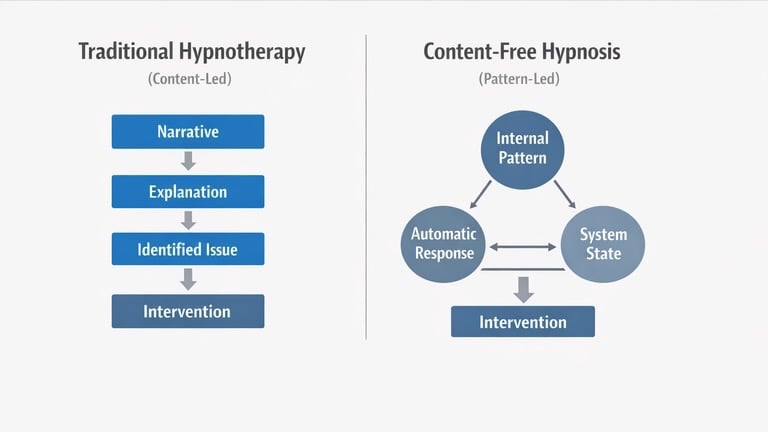
Content-Free Hypnosis vs. Traditional Hypnotherapy: The Structural Difference
I treat “content-free” and “traditional” as two orientations, not two teams.
Traditional hypnotherapy, in many common forms, is content-led: it starts with a stated issue, uses the client’s description to shape the target, and applies suggestions aligned with that target. Content-free work is pattern-led: it does not require detailed narrative disclosure to begin working with the internal structure that is maintaining the response.
This difference matters most when the client cannot, or should not, carry the load of explaining.
What “content-free” changes, structurally
A content-free orientation reduces dependence on:
disclosure,
explicit narrative accuracy,
repeated retelling,
“finding the one true cause,”
the client’s ability to map their own pattern perfectly.
Instead, it prioritizes the internal pattern as the target, even when the person cannot fully describe its origin.
If you want a precise reference point for what I mean by content-free, I keep it consolidated here: Content-Free Hypnosis Guide.
Where each orientation tends to fit better
Content-led approaches tend to fit better when:
the issue is specific and stable,
the client is comfortable sharing details,
the triggers are clear and consistent,
the person wants direct work on a named behavior.
A content-free orientation tends to fit better when:
the person has strong insight but weak leverage,
disclosure feels unsafe or simply unwanted,
the story is unclear, fragmented, or too broad,
the symptoms are downstream of multiple pressures,
the system becomes more reactive when the story is revisited.
This is not a moral statement. It is a bandwidth statement.
Evidence and claims, kept clean
Hypnosis is not a single protocol, and the evidence base varies by condition and context. Meta-analytic work suggests beneficial effects across multiple outcomes, with effect sizes differing by population and application. (Frontiers)
I am not using that to imply what will happen for any individual. I’m pointing to a simple reality: hypnosis is studied, and it is not an empty category.
If you want the mainstream clinical framing of hypnosis (definition-level), the Society of Psychological Hypnosis (APA Division 30) has published a revised definition and rationale. (PubMed)
Practical Micro-Anchors
Some patterns are easiest to recognize in small, ordinary moments.
One person notices that they can talk about their grief in a composed way, but the moment they are alone at night the body does something else, chest pressure, scanning, sleeplessness, intrusive flashes. The narrative is consistent. The response is not.
Another person functions well until a specific social cue, a pause in conversation, a delayed text, a look they cannot interpret. Their mind generates explanations, but the reaction arrives before the explanation, and it keeps arriving even when the explanation is corrected.
Another person avoids one category of detail entirely. They can discuss everything around it, context, outcomes, their “lessons,” but their system clamps down when the topic gets close to the center. They experience that clamp as blankness, irritation, joking, intellectualizing, or sudden fatigue.
Another person has tried multiple methods and can recite what “should” work. Their habits do not follow their knowledge. The gap between understanding and execution keeps widening, and that gap becomes its own problem.
Pattern Chronification
When a pattern is not addressed at the level it operates, it tends to consolidate.
The usual trajectory looks like this:
The response generalizes. What started as one trigger becomes many triggers.
Avoidance becomes adaptive. The person builds a life that reduces exposure, then pays for that reduction with constraint.
Hypervigilance becomes identity. The person calls it “how I am” because it has been there long enough to feel permanent.
The nervous system baseline shifts. Sleep, appetite, concentration, libido, and mood narrow toward a smaller range.
The person’s self-concept hardens. They stop expecting flexibility from themselves.
In grief-based patterns, chronification can show up as sustained dysregulation, intrusive replay, emotional numbing, or persistent guilt loops long after the initial loss, not because the loss should be “over,” but because the internal system never completes the reorganization it is trying to do.
In anxiety-based patterns, chronification often looks like expanding prediction, more scanning, less recovery time, and a growing reliance on control behaviors.
If this is primarily showing up as anxiety, that’s the context where my work most often begins, and the relevant entry point is here: online hypnotherapy for anxiety and trauma.
FAQ
Is content-free hypnosis the same as not talking at all?
No. It means detailed narrative disclosure is not required as the primary driver of the work.
Does traditional hypnotherapy require me to explain everything?
Not always. Many practitioners adapt. The distinction is whether the approach depends on issue-specific content as the main input.
Who is a poor fit for a content-free orientation?
Someone seeking strictly symptom-specific scripts based on detailed history, or someone in acute crisis who needs medical or psychiatric stabilization first.
Is this appropriate for trauma-related patterns?
It can be, depending on stability and the person’s current level of regulation. The key variable is whether content exposure destabilizes more than it informs.
How do I decide between the two?
Use one criterion: does your system change when you explain, or does it stay the same while you get better at explaining?
When this pattern is active, this is the work I do.
This article is informational only and not medical or psychological advice.
Address
Based in Los Angeles, CA
Online sessions available worldwide
Contacts

