
Control Is Not the Opposite of Trust
Controlling behavior is not a character flaw. It is a procedural survival response still running past its context. Here is what that means structurally.
CHANGE WORK
Marc Cooper
5/14/20265 min read
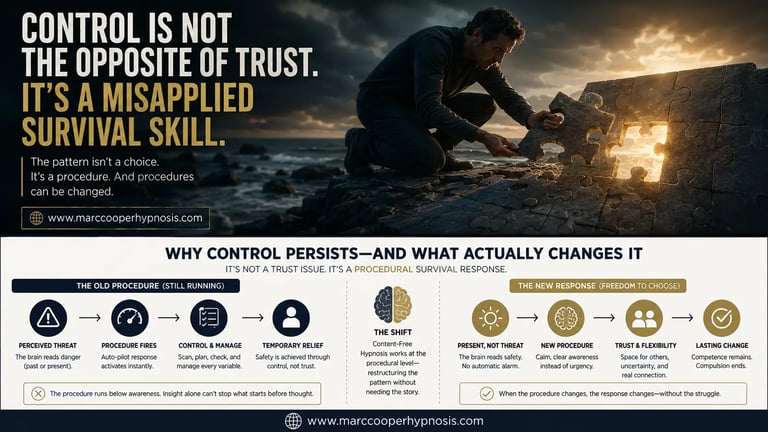
Control Is Not the Opposite of Trust. It's a Misapplied Survival Skill
The person who controls everything is not afraid of failure. They are afraid of what happens when they stop.
That distinction matters. Most interpretations of controlling behavior treat it as a character flaw, a trust deficit, or evidence of emotional immaturity. The cultural shorthand is that controlling people simply need to learn to let go. What that explanation misses is the structure underneath the behavior. Control, in its most persistent forms, is not a preference. It is a procedural solution to a threat that no longer exists.
The threat was real once. That is worth stating plainly. At some point, the environment required close management. Unpredictability meant damage. Staying ahead of every variable was the rational response to a system that had proved itself unreliable. The person who learned to do this was not wrong. The learning was accurate for the conditions.
The problem is that procedural learning does not expire automatically.
When Accuracy Becomes Liability
The brain does not store coping strategies in the same place it stores facts. A fact can be updated. A procedure runs independently of whether it is still warranted.
This is why intellectual understanding has so little traction with controlling behavior. The person who manages every detail of a presentation, every tone of a conversation, every potential outcome of a meeting already knows, in one part of their mind, that the situation is not actually dangerous. They can articulate this clearly. They may have processed it extensively. And they will return to the same behavior the next time the stakes feel real.
The pattern continues not because of a belief that needs correcting. It continues because the procedure fires before belief is consulted.
People who operate this way tend to experience this as vigilance rather than anxiety. It presents as competence: meticulous preparation, proactive problem-solving, a preference for being the one who handles things. The costs are real but they surface slowly. Relationships that require the other person to remain managed. Exhaustion that builds without a clean explanation. A kind of ambient alertness that never fully powers down.
There is also a particular isolation that accompanies this pattern. It is not the isolation of loneliness. It is the isolation of being the only person in the room who knows what would happen if the management stopped. Other people experience this person as capable, composed, reliable. The internal experience is closer to load-bearing. Remove the structure and everything shifts. That belief is rarely examined. It was also learned.
This is the moment things quietly tilt. The strategy that made someone successful begins to create friction in the same spaces it once created safety. The qualities that produced results in professional environments produce rigidity in intimate ones. The same calibration that reads a room accurately makes genuine spontaneity feel reckless. There is no cognitive error here. The system is doing exactly what it was built to do. The problem is that the original specifications are no longer the relevant ones.
What Conventional Approaches Address
The standard intervention for controlling behavior is relational and cognitive. Explore the origins. Name the early experience that established the pattern. Build insight into the triggers. Practice tolerating uncertainty in incremental doses.
This produces genuine understanding. It can shift the narrative a person holds about themselves.
What it rarely shifts is the procedural layer.
Insight operates through language. Language is processed cortically. The behavioral pattern that produces the controlling response is encoded below that. It does not respond to reframing because it is not organized around a frame. It is organized around a physical, pre-verbal response sequence that runs before interpretation is available.
This is why people can understand exactly why they do something and continue doing it with full self-awareness. The insight is real. The access is insufficient.
This is not a criticism of the therapeutic process. Insight is real. Understanding the origin of a pattern changes a person's relationship to it in ways that matter. But changing the relationship to a pattern is not the same as changing the pattern. One produces understanding. The other produces a different behavioral sequence.
The content-free hypnosis approach works at the procedural level because it does not require the pattern to be named, narrated, or understood in order to be altered. The pattern does not need to be retrieved verbally. It needs to be accessed structurally.
The Trust Question Is Secondary
Most people working on controlling behavior frame the goal as learning to trust: other people, circumstances, outcomes. That is not wrong. But it is downstream.
Trust is not a decision that overrides a survival procedure. Trust becomes available when the procedure no longer fires with the same urgency. That sequence matters. Trying to install trust on top of an active threat response is like installing new software on a system that is already running a competing process. The new installation runs, but the old one does not stop.
People who have spent years in therapy, journaling, and self-examination and still find themselves managing every variable are not failing to apply what they have learned. They are experiencing the ceiling of language-based intervention. The procedural pattern is not a thought. It is not a belief. It is a physical sequence with a trigger, a momentum, and an end state.
That is not what reflection reaches.
The controlling behavior is, structurally, the same as the original survival response. Same architecture. Different context. The context has changed completely. The response has not received that update.
What Changes When the Procedure Changes
When the procedure is addressed at the level where it actually operates, the behavioral shift does not feel like discipline or decision-making. There is no effortful override. The response simply does not arise with the same force.
This is also why the change is difficult to explain afterward. There is no narrative attached to it. The person who had anxiety organized around control does not gain a new belief that allows them to relax. They relax because the signal that was organizing the behavior has changed.
That distinction is not subtle. It is the difference between managing a pattern and ending it.
What this looks like practically: the situation that previously triggered the controlling sequence presents itself. The urgency is not there. The review of every variable does not feel necessary. The relationship can breathe. The meeting can be imperfect. The outcome can be unknown without that unknowing producing a procedural cascade.
It is not the same as indifference. Competence remains. Standards remain. The drive to do things well does not dissolve.
What dissolves is the compulsive, pre-deliberate quality of the checking and managing behavior. The one that was never really about the meeting or the relationship or the outcome in the first place.
Who This Applies To
This applies to people who are high-functioning, self-aware, and have already done the intellectual work. They understand the pattern. They can trace its origins. They have modified the behavior in isolated moments through sustained effort.
The pattern returns without effort.
It does not apply to people who are looking for support, validation, or a framework to process their experiences. It does not apply to people who want to talk about what happened to them in order to feel less alone.
Both needs are real. They require different approaches.
When the analysis has been exhausted and the behavior has not changed, people eventually ask a different question.
That is usually when they find their way to me.
Address
Based in Los Angeles, CA
Online sessions available worldwide
Contacts

