
Decision Fatigue: Why Your Thinking Degrades by Afternoon
Decision fatigue is the measurable decline in judgment that follows sustained choosing. Here's what drives it and why insight alone doesn't resolve it.
CHANGE WORK
Marc Cooper
5/4/20265 min read
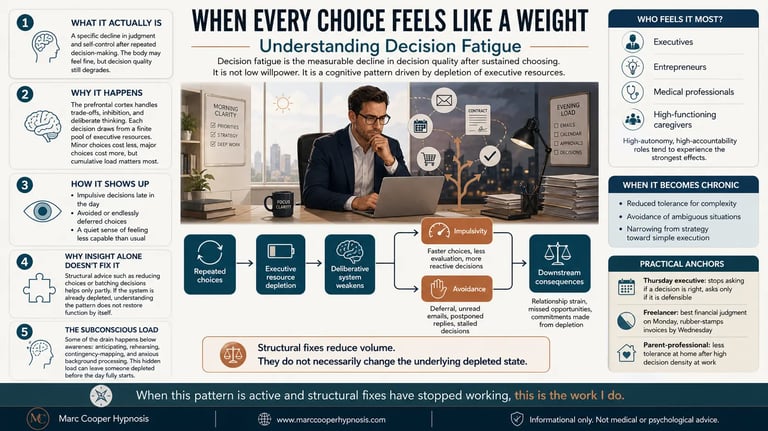
When Every Choice Feels Like a Weight: Understanding Decision Fatigue
Decision fatigue is the measurable decline in the quality of decisions made after a sustained period of choosing. It's not a mood. It's not low willpower. It's a cognitive pattern with a specific mechanism, and most people running at high capacity have already felt it without knowing what to call it.
What Decision Fatigue Actually Is
The brain treats choosing as effortful work. Each decision, regardless of size, draws from the same finite pool of executive resources. By the end of a day dense with choices, something shifts. Not dramatically. Quietly.
The person who can negotiate contracts at 9am makes impulsive purchases at 8pm. The executive who runs sharp meetings before lunch starts rubber-stamping approvals by 4pm. The quality degrades. The pattern is consistent.
Decision fatigue is defined as the deterioration of decision-making ability and self-control caused by repeated engagement in decision-making tasks, and represents a more specific form of self-depletion that primarily impairs decision-related cognitive processes. It differs from general tiredness. The body may feel fine. The decision-making function is compromised anyway.
Why This Happens
The mechanism is rooted in executive resource depletion. The prefrontal cortex governs deliberate, effortful thinking. It handles trade-offs, weighs competing information, and suppresses impulsive responses. It does not do this indefinitely without cost.
Every decision activates this system. A minor one costs less. A high-stakes one costs more. But the cumulative load matters as much as the individual weight.
Research across multiple domains has identified both individual and organizational causes of decision fatigue, finding that it leads to reduced efficiency in both the rate and quality of decisions.
The system doesn't send a clear signal when it's depleted. That's part of the problem. People experience the effects, attribute them to other causes, and keep deciding.
How It Shows Up
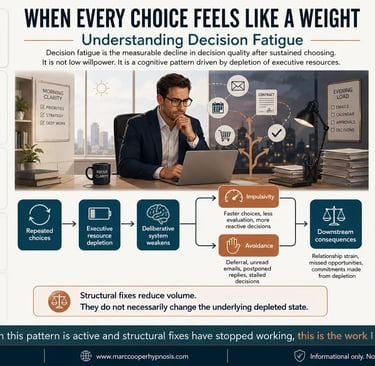
Decision fatigue tends to surface in one of two ways. The first is impulsivity. Choices get made faster, with less evaluation. The person snaps at something they'd have considered carefully earlier in the day. They agree to things they'd normally push back on.
The second is avoidance. Decisions get deferred indefinitely. The inbox sits unread. The email requiring a considered reply stays drafted. The choice that needs to happen keeps not happening.
Both patterns feel different from the outside but they share the same internal cause. The deliberative system has gone offline. What remains is either reactive or passive.
People often notice a change in self-perception alongside this. There's a quiet sense of being less capable. Less like themselves. The work is still getting done, but something in the execution feels degraded.
This tends to compound. When the pattern of impulsive or avoidant decisions accumulates, there are real downstream consequences. A relationship strain. A missed opportunity. A commitment made at 6pm that looked different at 8am.
Why Insight Alone Doesn't Fix It
Most approaches to decision fatigue are structural. Reduce the number of decisions. Batch similar choices. Decide important things first. These recommendations make sense. They also tend to fail in practice for people whose decision load is not discretionary.
The problem with structural fixes is that they address volume but not the underlying state. If the system is already depleted, routing fewer decisions through it does not restore function. It just slows the drain.
There's also a layer that structural solutions can't reach. Decision fatigue does not just show up in the volume of choices made. It shows up in how a person relates to uncertainty. Some people have an elevated baseline of decision-related tension. Even routine choices carry cognitive weight because the underlying system is already running high.
Talking about this often provides temporary clarity. But clarity is not the same as a changed state. Understanding why you're depleted and not being depleted are two different things.
The Subconscious Load
What makes decision fatigue more than just a cognitive throughput problem is what it shares with other high-demand states: a significant portion of the load is not conscious.
The background processing that runs continuously, anticipating, evaluating, running contingencies, contributes to depletion even when no active decision is being made. This is why some people arrive at 9am already drained. They've been deciding through the night. Planning, rehearsing, contingency-mapping, all below the surface.
This is also where a content-free approach to hypnosis has structural relevance. The point of contact is not the decisions themselves. It's the system generating the ongoing load. When that system recalibrates, the experience of decision-making changes. Not because the volume of choices dropped, but because the resource cost per decision is different.
For people who experience anxiety alongside decision fatigue, the two patterns reinforce each other. A depleted decision-making system is more vulnerable to anxious anticipation. Anxious anticipation generates more background load. The cycle is self-sustaining until something interrupts it at the level where it originates.
What Chronification Looks Like
When decision fatigue becomes a sustained pattern rather than an occasional state, the effects extend beyond decision quality.
The person starts to notice reduced tolerance for complexity in areas that used to feel manageable. They begin avoiding situations that require a lot of choosing. They restructure their environment not for efficiency but for escape. Fewer options. Less exposure. Less engagement.
Over time, this contraction is mistaken for a change in values or priorities. It's not. It's a coping adjustment. The system has learned that stimulation costs too much. It begins declining inputs that used to be welcome.
Professionally, this often looks like someone who has become less innovative. Less willing to take on ambiguous projects. More focused on execution than strategy. The capacity for complex judgment narrows. This is not burnout in the traditional sense, though it shares features with it.
It's a system that has been drawing on resources faster than it regenerates them, for long enough that the baseline has shifted down.
Practical Anchors
A senior executive reports that by Thursday, she's stopped asking whether a decision is right. She just asks whether it's defensible. The evaluative criteria have changed because the resource base has changed.
A freelancer notices that he makes all of his best financial decisions on Monday morning. By Wednesday, he's approving invoices without reading them. He thinks this is efficiency. It's depletion.
A parent who manages a demanding professional role finds that patience at home correlates almost perfectly with decision density at work. The more he chose during the day, the less he can tolerate ambiguity in the evening. He attributed this to stress for years before the actual mechanism became clear.
These are not character failures. They are predictable outputs of a system running past its sustainable load.
FAQ
Is decision fatigue the same as burnout? No. Burnout is a chronic depletion of motivation, identity, and engagement across multiple domains. Decision fatigue is more specific: it refers to the deterioration of decision quality following sustained or repeated choosing. They can co-occur, but they have distinct mechanisms and different timelines.
Can decision fatigue affect sleep? Yes. The same executive processes involved in decision-making are active in rumination and planning. If these processes remain activated at night, sleep quality degrades. The fatigue cycle then continues into the following day from a lower starting point.
Does reducing choices actually help? Structurally, yes, but only to a degree. Reducing discretionary decisions can lower daily load. It doesn't address an elevated baseline state or the background cognitive activity that contributes to depletion independent of active decision volume.
Is this a permanent change or a temporary state? In most cases, it's a dynamic state that shifts with load and recovery. However, when the pattern is sustained over a long period without adequate recovery, the baseline can shift downward in ways that feel more fixed. Intervention at the level of the underlying system is more effective than behavioral management at that stage.
Who is most affected by decision fatigue? People in high-autonomy, high-accountability roles tend to experience it most acutely. The more decisions a person is responsible for, and the higher the stakes attached to those decisions, the faster the depletion tends to occur. This includes executives, entrepreneurs, medical professionals, and high-functioning caregivers.
When this pattern is active and structural fixes have stopped working, this is the work I do.
This article is informational only and not medical or psychological advice.
Address
Based in Los Angeles, CA
Online sessions available worldwide
Contacts

