
Empty Routines After Pet Loss | Marc Cooper Hypnosis
When your pet dies, the routines you shared don't disappear. They stay, empty. Here's what's actually happening and why it persists.
PET LOSS
Marc Cooper
3/16/20265 min read
When the Routine Stays and the Pet Doesn't
Empty routines after pet loss are one of the least-discussed and most disruptive features of animal grief. You reach for the leash. You check the water bowl. You wake at the same time without any reason to. The behavior pattern survives the loss. The animal doesn't.
This isn't sentimentality. It's a structural problem inside the nervous system, and it doesn't resolve through understanding.
Why Empty Routines Form After Pet Loss
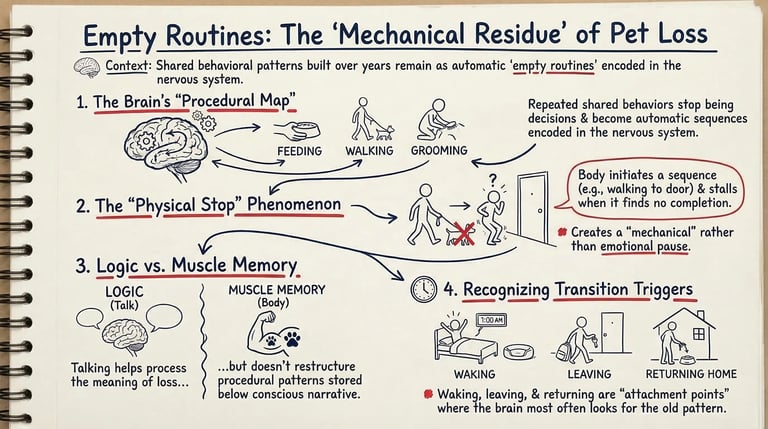
Repeated shared behavior becomes encoded. When you feed, walk, groom, or simply sit with an animal every day for years, those sequences stop being decisions. They become automatic. The brain builds a procedural map around another living being.
When that being is gone, the map remains.
The brain doesn't delete procedural memory because the context changes. It updates slowly, reluctantly, and only through accumulated new experience. In the short term, the behavioral sequence fires anyway. You reach for the food bag before the thought catches up with the action.
This is not a grief symptom in the clinical sense. It's the mechanical residue of a shared life.
How Empty Routines Show Up
People often notice it in the first minutes of the morning. The body starts moving through a sequence before the mind arrives. Walk to the door. Pause. Nothing to open the door for.
This usually feels like a physical stop. Not an emotional one. The hand on the leash hook. The pause at the food cabinet. The glance toward a specific corner of the room. The system initiates, finds no completion, and stalls.
It tends to show up in moments of transition: waking, leaving the house, returning home, preparing food, sitting down to rest. These were the attachment points. The places in the day where the relationship had its clearest structure.
Some people report the absence as louder than the loss itself. The grief comes in waves. The empty routine comes in every day, at the same time, with mechanical precision.
Why Talking About It Changes Little
Insight doesn't interrupt procedural memory. You can understand exactly why your hand moves toward the leash. You can narrate the neuroscience. You can process the grief in conversation with a skilled therapist or a trusted friend.
The hand still moves.
Talk-based approaches operate at the level of meaning. They help people make sense of what they're experiencing. That's useful work. But making sense of a procedural pattern doesn't restructure it.
The routine is stored somewhere that language doesn't reach directly. It was built through repetition and physical action. It was encoded outside conscious narrative. Talking about it adds a layer of understanding over a layer of behavior that continues to run beneath.
This is why people who have done real grief work, people who have processed the loss thoroughly, still find themselves standing in front of an empty bowl six months later. The grief may have shifted. The routine hasn't.
Understanding why the content-free approach to pattern change tends to be more effective here matters less than recognizing that the right level of intervention is below the narrative.
What the Pattern Actually Costs
The Accumulation Problem
A single empty routine, once a day, is tolerable. The math changes quickly.
When the same unresolvable sequence fires multiple times daily across months, it keeps the loss active in a way that conscious grieving doesn't. The mind can move forward. The behavior keeps pulling it back to a specific time when the animal was still present.
People often describe a fragmented recovery. They feel better, then the morning walk sequence fires, and they're back at the beginning. Not emotionally, necessarily. But somatically. The body re-enters the loss state through the procedural trigger.
Social Invisibility
Pet loss carries a specific social tax. It is frequently minimized by people who haven't experienced it. "It was just a dog" is still a sentence people say.
This means the empty routine problem rarely gets named in the support a person receives. People focus on the grief. They don't focus on the behavioral residue that keeps recycling it. The person is left managing something they can't articulate clearly, because the cultural framework for pet loss grief doesn't make room for procedural memory as a distinct and addressable problem.
The Replacement Trap
Some people get a new animal quickly, partly to give the empty routines somewhere to land. This sometimes helps. Often it doesn't fully resolve the problem, because the new animal doesn't fit the old behavioral map. The timing is different. The need sequence is different. The body is still looking for the original pattern to complete.
The decision to get another pet is a personal one with no right answer. But doing it primarily to resolve the routine problem is worth examining carefully, because the resolution doesn't always follow.
What Happens When This Goes Unaddressed
Empty routines that continue without interruption tend to stabilize. The brain is adaptive. If the sequence fires and finds no completion repeatedly, it can begin to reroute, but this process is slow and often incomplete.
More commonly, the sequence stays active at a lower threshold. It stops producing the sharp, conscious recognition of loss. It becomes background noise. A persistent low-level state that doesn't announce itself as grief anymore.
People in this state often describe feeling flat. Not sad in a way they can work with. Just dull. Less present. Slightly removed from their own life.
This is worth taking seriously. A pattern that moves from active grief to background noise is harder to address than one that is still producing a clear signal. The signal is the access point. When it quiets into ambient weight, the problem becomes less visible but not smaller.
For people managing grief that has calcified into something more diffuse, the hypnotherapy for anxiety and grief work I do addresses these patterns at the level where they're stored.
Practical Anchors
The bowl still on the floor. Many people find they can't move the physical objects associated with their pet. The bowl. The bed. The leash. This is sometimes interpreted as denial or inability to let go. More accurately, it's that the objects are nodes in the behavioral map. Moving them feels like erasure. This is structurally different from pathological avoidance.
The sound expectation. Dogs produce a specific acoustic environment: nails on floors, breathing during sleep, the sound of movement in another room. Many people report hearing these sounds briefly after the death. The auditory expectation was so consistent that the brain generates it from pattern. This resolves without intervention, but it can be disorienting.
The body's clock. For animals on medication schedules or with specific health routines, the caretaking structure was elaborate. The loss of that structure is sometimes experienced as purposelessness. The day was organized around the animal's needs. Without those needs, the shape of the day dissolves.
Cooking for two. People who prepared their pet's food manually often continue the motion for days. This is the procedural system operating as normal. It has no information yet that the recipient is gone.
FAQ
How long do empty routines typically last after pet loss? There's no standard timeline. The duration depends on how long the routine was established, how central the animal was to daily structure, and whether anything interrupts the procedural pattern directly. For some people, months.
Is it normal to still reach for the leash months after my pet died? Yes. Procedural memory doesn't update on an emotional timeline. The behavior was encoded through repetition. It fades through accumulated absence, not through grief resolution.
Why do I feel worse in the morning than at other times of day? Morning is typically when shared routines were most active. Waking, feeding, walking. The behavioral system initiates the sequence before conscious awareness catches up, producing a daily re-entry into the loss.
Can a new pet resolve the empty routine problem? Sometimes partially. A new animal gives the sequence a completion point. But the behavioral map was built around a specific animal's needs, timing, and patterns. The fit is rarely exact. The underlying template may continue alongside the new relationship.
Why hasn't talking about it made the behavior stop? Talk-based processing addresses meaning, not procedural structure. Both are useful. They operate at different levels. Understanding the loss doesn't interrupt the encoded sequence that preceded it.
When the behavioral residue is what's keeping the loss active, that's the specific problem this work addresses.
This article is informational only and not medical or psychological advice.
Address
Based in Los Angeles, CA
Online sessions available worldwide
Contacts

