
Grief Is Not an Emotion. It's a Structural Rupture.
Grief doesn't need to be processed. It needs to be understood for what it actually is: a break in the organizing structure of a life.
GRIEF
Marc Cooper
2/19/20264 min read
Grief Is Not an Emotion. It's a Structural Rupture.
The most damaging thing ever said about grief is that it comes in stages.
Not because the stages are wrong. Because the framing implies grief is something that moves through a person, rather than something that dismantles the architecture a person was built around. That distinction is not semantic. It determines everything that happens next.
Grief is treated culturally as an emotional state: intense, prolonged sadness accompanying loss. Something to be felt, worked through, metabolized, resolved. The therapeutic model is built on this premise. Process the emotion. Give it language. Let it move. The assumption underneath all of it is that grief lives in the feeling body, and the feeling body, given enough space and support, will eventually return to equilibrium.
This is structurally incorrect.
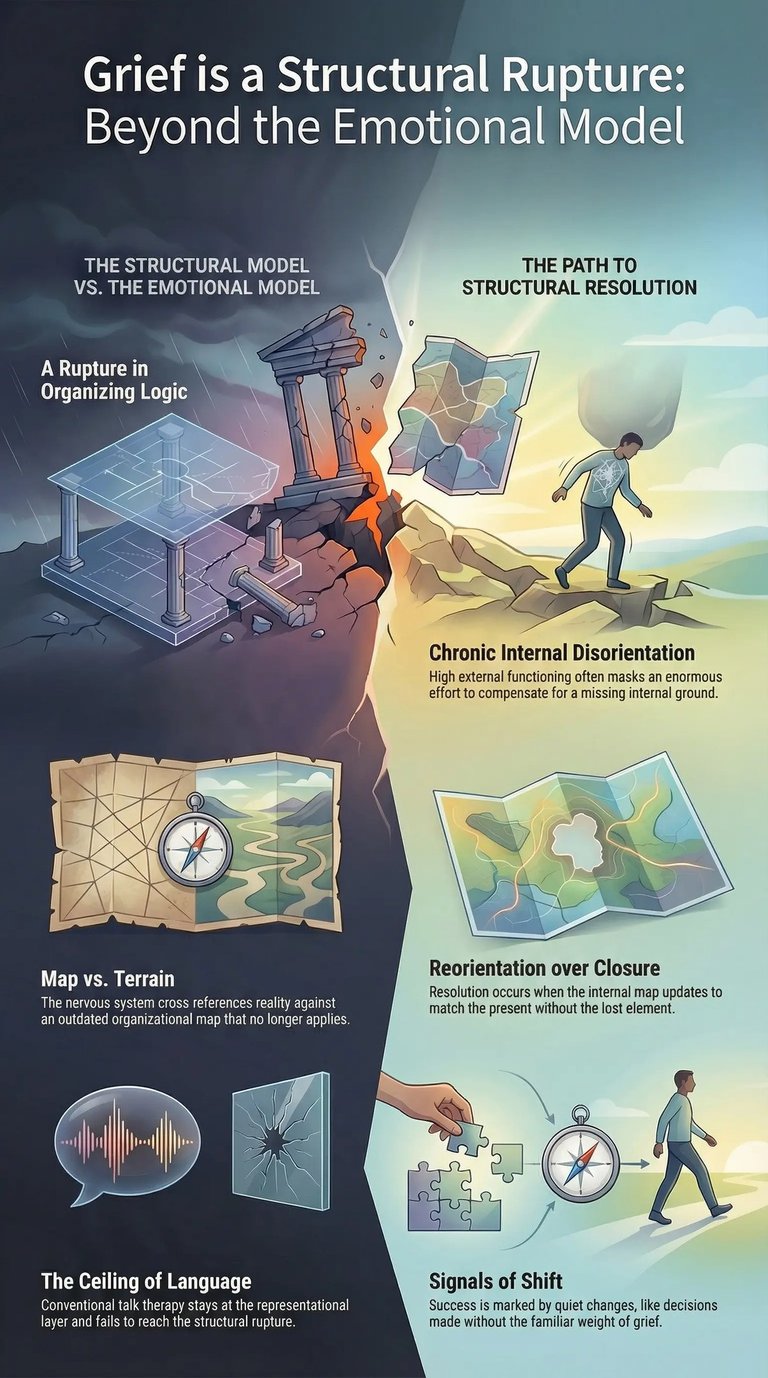
Grief is not an emotion that visits. It is the aftermath of a rupture in the organizing logic of a person's interior world. When someone or something central enough is removed, the system that formed around that presence does not simply miss it. The system loses coherence. The internal map stops corresponding to the actual terrain. What looks like sadness is often the nervous system registering that a load-bearing element has been removed. The structure has not yet collapsed, but it is no longer the same structure.
This is why grief behaves the way it does. Why it resurfaces without warning. Why it attaches to unrelated objects, times of day, physical sensations. Why it can sit dormant for months and then arrive with full force at something as ordinary as a particular light in a room. The nervous system is not being dramatic. It is still cross-referencing reality against an organizational map that no longer applies. The incongruences accumulate faster than they can be reconciled.
People who operate in this rupture (and most people who have experienced significant loss are operating in it, whether they identify it as grief or not) tend to describe the experience in structural terms without realizing it. They say things like: I don't know who I am anymore. The future I was planning doesn't exist. I can't find my footing. Nothing means what it used to mean. These are not expressions of sadness. They are descriptions of a dismantled organizing system struggling to reconstitute itself around an absence.
This usually looks like a person who is functioning well externally but experiencing a persistent internal disorientation they cannot locate or name. They're going to work. They're present in conversations. They're doing, in most technical respects, fine. But there is something they cannot access. A reliable internal ground. And the effort required to compensate for its absence is enormous. Exhaustion without clear cause. Difficulty making decisions that once felt automatic. A subtle but chronic disconnection from what used to feel meaningful.
This is not complicated sadness. This is a system running on a map that no longer corresponds to reality.
Conventional approaches fail here because they are addressed to the emotion rather than the structure. Talking about loss can provide relief, context, witness. These things matter. But language operates in the representational layer. It describes experience, organizes narrative, provides framework. It does not reach the layer where the original organizational rupture occurred. The grief that returns six years later at a smell or a song is not a failure to process. It is information from a layer that was never addressed, surfacing again because it remains unresolved at the level where it actually lives.
Journaling finds the same ceiling. Introspection reaches a certain depth and then loops. Not because the person is avoiding something, but because the part of the system that holds the rupture does not communicate in language. It communicates in orientation, in tone, in the felt sense of whether the world is organized or not. Coping strategies help people manage the surface. They do not touch the floor.
There is a level of this work that has to happen beneath language entirely. Not around it. Beneath it. The system that reorganizes following rupture is not a cognitive system. It does not respond to reframes, new perspectives, or meaning-making. At least not first. It responds to something more fundamental: the experience of coherence returning. Not explained. Not processed. Restored. The content-free approach exists precisely because the organizing disruption of grief does not require a narrator. It requires resolution at the level where the disruption occurred.
What becomes possible when that level is addressed is not closure, a word that has been so misused it has lost all precision. What becomes possible is reorientation. The internal map updates. The cross-referencing stops firing against an absence and begins to recalibrate around what is actually present. This is not the same as moving on. It is the same as the system regaining structural coherence without requiring the lost element to return.
Grief work at this level is not for everyone in the same way, or at the same time.
It is for people who have done the conventional work: the talking, the journaling, the therapy, the time. They have arrived at a persistent wall. Something remains that language cannot reach. They are not in acute crisis. They are in chronic structural displacement, and they are beginning to understand that more conversation about it will not be what resolves it. It is for people who want precision, not support. Resolution, not management.
It is not for people in the early acute phase who need witness and language and space. It is not for people who have not yet wanted to examine what they are actually carrying. It is not for people seeking comfort. The work that addresses grief at this level does not offer comfort. It offers structural resolution. Which, afterward, may produce something that feels like relief, but is not the same thing, and should not be mistaken for it.
There is no performance in this work. No breakthrough moment. No catharsis designed for narrative. The signal that something has shifted is usually quiet: a morning that feels different without explanation. A decision made without the familiar weight. The past present in memory without reorganizing the present around it.
When the structural nature of what they are carrying becomes undeniable, people usually find their way to me.
Address
Based in Los Angeles, CA
Online sessions available worldwide
Contacts

