
Guilt After Pet Euthanasia, Why It Persists
A clear explanation of guilt after pet euthanasia, why it doesn’t resolve with understanding alone, and how the pattern stabilizes over time.
PET LOSS
Marc Cooper
2/9/20264 min read
What Guilt After Pet Euthanasia Actually Is
Guilt after pet euthanasia is a persistent internal pattern where responsibility for a companion animal’s death remains unresolved, even when the medical reasoning, timing, and intent are clearly understood.
This is not confusion about the decision. It is not uncertainty about the diagnosis. It is a specific form of responsibility-based cognitive and physiological activation that does not complete.
Why Guilt After Pet Euthanasia Persists
The persistence of this guilt is structural.
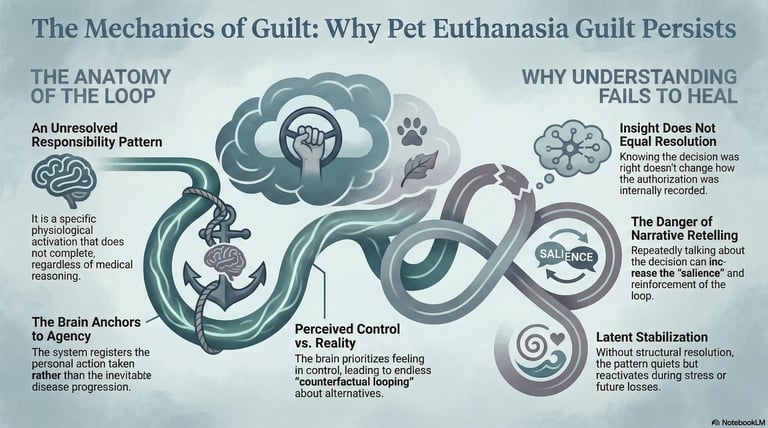
Euthanasia requires authorization. That authorization is given by someone emotionally bonded to the animal, under conditions of stress, urgency, and irreversible consequence. From a nervous system perspective, this is not registered as an outcome that occurred. It is registered as an action taken.
When suffering ends immediately after a decision, the decision becomes the dominant causal marker. Disease progression, prognosis, and inevitability are cognitively known but perceptually distant. The system anchors to the moment where agency was exercised.
Under emotional load, the brain prioritizes perceived control. The euthanasia decision feels controllable in hindsight, even when no viable alternative existed. This produces counterfactual looping, repeated internal scans for a different choice that could reduce perceived responsibility.
Grief further constrains processing. During acute attachment loss, contextual integration narrows. The system favors replay over resolution. The authorization moment becomes the focal point because it is concrete, identifiable, and emotionally charged.
This is why guilt persists even when the decision was medically sound and ethically consistent.
How This Guilt Is Commonly Experienced Internally
People often notice a repetitive mental return to the final decision point.
This usually feels like revisiting the same questions without new information emerging: timing, dosage, whether waiting longer would have mattered, whether acting sooner was premature.
This tends to show up during low-distraction states. Quiet evenings, early mornings, or transitional moments often reactivate the loop. External reminders such as photos, empty routines, or veterinary references can also trigger it abruptly.
There is often a split experience. One part of the mind holds the facts clearly. Another part continues to behave as if the action remains unresolved. These positions coexist without integrating.
Some people notice that praise or reassurance from others increases discomfort rather than reducing it. External validation conflicts with the internal encoding, creating friction instead of relief.
Why Talking It Through Often Doesn’t Resolve It
This pattern is not maintained by misunderstanding.
Talking-based approaches rely on narrative clarification, emotional expression, or cognitive reframing. These methods can confirm intent and reinforce rational coherence, but they do not alter how the authorization was internally recorded.
Each retelling returns attention to the same decision point. Rather than closing the loop, this often increases its salience. The system learns that the moment remains relevant and unresolved.
Insight does not complete an action-based encoding. The mind already knows why the decision was made. The problem is not explanation. It is completion.
Time alone also fails for many people. Without structural resolution, the pattern quiets but remains latent. It can reactivate around anniversaries, subsequent losses, or new caregiving responsibilities.
When Understanding Isn’t the Issue
When guilt remains active despite full understanding, the issue is no longer informational.
At this level, approaches that do not require recounting details or reprocessing the narrative are often better aligned with how the pattern is held internally. The goal is not reinterpretation. It is resolution of an incomplete internal action.
This is why a content-free orientation becomes relevant in cases where explanation has already been exhausted without effect.
A detailed overview of that orientation is available in my Content-Free Hypnosis Guide.
How This Pattern Shows Up in Daily Life
Some people notice they can explain the medical necessity of the decision fluently, yet internally the phrase “I chose this” still carries weight. The facts are settled. The charge remains.
Others become aware of subtle avoidance. They steer away from the time of day the appointment occurred or avoid driving past the clinic without consciously deciding to.
In some cases, decision-making around remaining pets changes. Routine choices begin to feel heavier, as if the earlier authorization has generalized into hesitation.
There are also cases where guilt intensifies when others describe the decision as compassionate. The internal system does not register compassion as the unresolved variable, so the feedback fails to land.
What Happens When the Guilt Doesn’t Resolve
When this pattern is left unaddressed, it tends to stabilize rather than disappear.
The intensity often decreases, but the structure remains. The guilt becomes quieter, more embedded, and more easily triggered by stress or future losses.
Over time, this can contribute to prolonged grief patterns or generalized self-doubt around responsibility. For some people, it affects willingness to attach deeply again. For others, it manifests as chronic rumination around moral decisions.
The original event continues to function as a reference point because the internal action was never completed.
Common Questions About Guilt After Pet Euthanasia
Is this guilt the same as missing my pet?
No. Missing your pet is attachment loss. Guilt is a responsibility-based action loop. They often coexist but are distinct processes.
Why does the guilt persist even when I know it was the right decision?
Because knowing does not change how the decision was encoded at the time it was made.
Does repeatedly talking about the decision eventually resolve the guilt?
For some people it helps. For many, it reinforces the loop by repeatedly activating the same decision point.
Can this affect future decisions or caregiving roles?
Yes. Unresolved responsibility can generalize into hesitation, avoidance, or chronic self-questioning.
Is this a common response?
Yes. Responsibility-based guilt following authorized euthanasia is documented in both pet owners and veterinary professionals.
Research Context and Support
Responsibility-related grief responses following euthanasia have been documented in veterinary and caregiver literature, particularly around moral stress and authorized end-of-life decisions.
An authoritative overview is available from the American Veterinary Medical Association:
https://www.avma.org/resources-tools/animal-health-and-welfare/animal-welfare/euthanasia-and-grief-support
For people seeking focused support where guilt remains active after loss, I work directly with pet loss patterns where responsibility and decision-related distress persist.
When this pattern is active, this is the work I do.
This article is informational only and not medical or psychological advice.
Address
Based in Los Angeles, CA
Online sessions available worldwide
Contacts

