
Healing Does Not Require Reliving Your Worst Moment
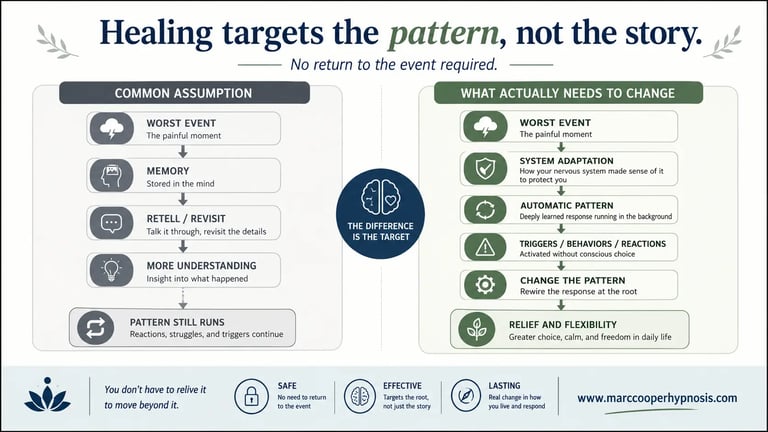
Most people assume healing means returning to the worst moment and working through it. That assumption is structurally wrong.
CONTENT-FREE HYPNOSIS
Marc Cooper
6/8/20265 min read
Healing Does Not Require Reliving the Worst Moment of Your Life
The assumption that healing requires revisiting the event is so thoroughly embedded in how people think about recovery that almost no one stops to question whether it is true.
It is not true.
It is also not a minor error. It is a structural misunderstanding of where the problem actually lives, and acting on that misunderstanding is one of the primary reasons people remain stuck for years after the event itself is long over.
Most therapeutic frameworks operate on a retrieval model. The logic goes: something happened, it left a mark, the mark needs to be examined. Examining it requires returning to the source material. The source material is the memory. So healing means going back into the memory, experiencing it again in some form, and processing it into something manageable.
This model feels intuitively correct because it mirrors how we solve most problems. If something broke, you find where it broke. If something is wrong, you trace it back.
But memory is not a broken machine with a precise fault location. It is a behavioral system. And behavioral systems do not store problems the way a hard drive stores a corrupted file.
They store them as operational patterns.
What people are actually carrying after a traumatic or deeply disrupting experience is not the event. The event is over. What they are carrying is the adaptation the system made in response to it.
That adaptation runs procedurally. Automatically. Below the level of narrative.
This is why people can narrate the event with complete emotional detachment and still flinch when something peripheral triggers it. The story they are telling and the pattern the system is running are two different things. The story is verbal. The pattern is not.
The pattern does not care how many times the story has been told.
Most people who have spent significant time in talk-based approaches notice this eventually. They develop fluency in the narrative. They can describe what happened, when it happened, what it meant, how it changed them. The description becomes refined. The emotional texture of the description becomes more manageable.
The pattern keeps running.
This is where the retrieval model breaks down. If the problem were located in the narrative, narrative-level work would resolve it. More examination would produce more resolution. People would feel better in proportion to how thoroughly they had processed the story.
That is not what happens.
What happens instead is that the verbal processing produces something more like a well-organized archive. The memory becomes categorized. The emotional response to discussing it decreases. People say they have made peace with it.
And then something happens, usually small, usually seemingly unrelated, and the system responds in a way that has nothing to do with peace.
The pattern was never in the story.
Revisiting the story to reach the pattern is like reading the instruction manual to fix the machine. The manual describes the machine. It is not the machine. You can read it indefinitely without touching anything that actually moves.
Understanding this is what separates a productive intervention from an extended explanation of a problem that continues unresolved. More information about a procedurally encoded pattern does not change the pattern. It adds information to the layer that runs above it.
The two layers do not communicate the way most people assume they do.
There is a period most people can identify in retrospect: the point at which additional narration stopped producing movement. The story was refined but the system was unchanged. Conversations became more efficient descriptions of a problem that remained fully intact.
That period is the diagnostic. When the story stops producing traction, the story was never the mechanism.
The corollary to this is one that most people find uncomfortable when they first encounter it: the worst moment of your life is not necessarily the most important thing to work with.
What matters is not the event. What matters is the configuration the system is currently running.
That configuration can be accessed without touching the event at all. This is not a workaround. It is not a gentler path to the same destination. It is a different destination entirely, because the destination is behavioral change, not narrative resolution.
People sometimes arrive in my work carrying years of detailed, articulate, emotionally sophisticated accounts of what happened to them. The accounts are often impressive. They reflect real effort and real intelligence.
The system underneath those accounts is often running the same pattern it was running the day they started.
This is not a failure of effort. It is a mismatch between method and mechanism. You cannot resolve a procedural problem with a verbal solution. The structural mismatch is the reason insight so frequently fails to produce change.
Insight and change are not the same event. They often occur in the same person in the same period of time, which makes them appear related. The relationship is incidental.
What this means practically is that the threshold people often set for themselves, I will deal with this when I am ready to go back there, is based on a requirement that does not exist.
No return is required.
The system that needs to change is accessible without re-entering the worst version of what happened. In fact, the demand that healing must be earned through re-exposure is one of the more counterproductive ideas in how people approach this, because it means that anyone who finds the prospect of re-entry intolerable simply does not pursue change.
They manage instead.
Management is not resolution. Managing something means building structures around a pattern that is still running in full. The structures can be sophisticated. They can become habitual enough to look like resolution from the outside.
Inside, the effort required to maintain them is continuous.
That effort is the cost. Most people have no baseline for a different state, so they treat the maintenance cost as the normal cost of living. It becomes invisible. It becomes personality.
The management strategies are often genuinely impressive. Sleep discipline, controlled environments, careful relationship selection, emotional regulation routines built over years. These are real things. They require intelligence and consistency to construct.
They are also the clearest evidence that the pattern is still running. You do not need elaborate management structures around something that has actually resolved. The sophistication of the workaround is proportional to the depth of what it is working around.
Nobody builds a retaining wall in a field where nothing moves.
This is the part that a content-free approach surfaces first. Not what happened, but what the system is currently doing. The content-free hypnosis guide on my site covers this distinction in more detail for those who want the underlying framework before deciding whether this applies to them.
The people I work with are not fragile. They are not avoidant. They are not unwilling to do difficult things.
Many of them have already done enormous amounts of difficult work. They have examined the event from every available angle. They know the shape of it precisely. They have built functional lives while carrying it.
They arrive because the pattern is still running and they are done with explanations.
This is specifically different from someone who wants to talk through the experience. That person needs a different kind of space, one organized around narrative processing. I am not that space, and I do not position myself as one.
The work I do is for people who have already established that understanding the event has not changed the system. That distinction matters. It is the correct entry point.
Reliving the worst moment of your life is not a prerequisite for changing how your system currently operates.
It is not even necessarily useful.
The moment already happened. The system has already adapted around it. The adaptation is what is running now. The adaptation is what needs to change.
When that becomes obvious, people usually find their way here.
Address
Based in Los Angeles, CA
Online sessions available worldwide
Contacts

