
Helping a Partner Grieve a Pet | Marc Cooper Hypnosis
When your partner is grieving a pet, conventional support often falls short. Here's what's actually happening, and why it matters.
PET LOSS
Marc Cooper
3/9/20265 min read

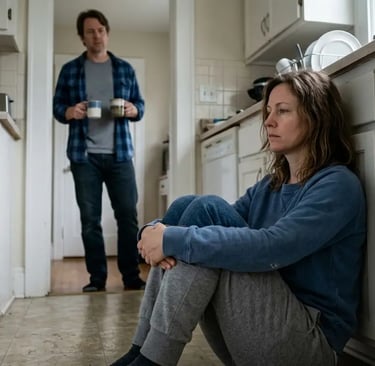
Helping a Partner Who's Grieving a Pet
What Pet Grief Actually Looks Like in a Partnership
When a partner is grieving a pet, what surfaces isn't always recognizable as grief. It can look like withdrawal, irritability, preoccupation, or a flatness that doesn't match the situation you're both in. Pet bereavement is a clinically documented grief response, and it activates the same neurological and emotional systems as any significant loss.
The complication, in a partnership, is that two people rarely grieve at the same depth or on the same timeline.
Why the Grief Hits Differently for Your Partner
The bond between a person and their pet operates outside most social scripts. There are no formal rituals, no bereavement leave, no collective acknowledgment. What there is: years of daily physical contact, a relationship defined by consistency and non-judgment, and a form of attachment that research on human-animal bonds classifies as genuine secure attachment.
When that relationship ends, the nervous system registers it as a real loss. Not a symbolic one. The grief is neurologically equivalent to losing a close human relationship, even if the external world doesn't treat it that way.
For your partner, this discrepancy is part of the weight. The loss is real. The social permission to grieve it often isn't.
That gap matters.
How This Shows Up Day to Day
People in this state often describe it less as sadness and more as a structural absence. The morning routine is wrong. The house sounds different. Muscle memory keeps activating, reaching for a leash, looking toward a bed that's no longer there.
This tends to produce grief in uneven waves rather than sustained emotion. Your partner may seem fine for hours, then be leveled by something ordinary. A smell. A sound. A moment of habit.
They may also cycle through grief and guilt simultaneously. This is common. The guilt is often disproportionate, attached to decisions made at the end of the pet's life, or to moments of impatience years earlier. Cognitively, they may know the guilt is irrational. That doesn't reduce its grip.
Some people move through this relatively quickly. Others become locked in it in ways they don't fully understand.
Why What You're Doing May Not Be Landing
Most partners respond to grief with comfort: presence, reassurance, practical care, listening. These are not wrong. They're often just insufficient for this specific type of loss.
The problem is structural. Talking about the pet, reminiscing, or processing the loss verbally can temporarily activate the grief rather than move it. This happens because the relationship being mourned wasn't primarily linguistic. It was physical, sensory, habitual.
Insight doesn't resolve it. Your partner may understand the situation clearly, understand that the grief is appropriate, understand that the pet had a good life. None of that reaches the part of the system that's still responding to absence.
Conventional support strategies work at the level of thought and narrative. This loss often isn't stored there.
This is why well-intentioned support sometimes lands badly. Not because you're doing it wrong. Because the method doesn't reach the location of the problem.
What Actually Helps the System Shift
The grief response, at its deepest level, is a pattern held in the body and nervous system, not a set of beliefs that need correcting. Approaches that work at that level, without requiring your partner to reprocess or retell the loss repeatedly, tend to produce more durable change.
For more context on what a content-free approach to grief actually involves, the content-free hypnosis guide explains the structural difference.
The goal isn't to help someone feel better about the loss. It's to resolve the pattern of response so they can move forward without the loss continuing to dominate their daily functioning.
Small Patterns Worth Recognizing
The Repetitive Loop
Your partner keeps returning to one specific moment, usually a decision made near the end, a symptom they didn't catch, a day they were distracted. This isn't processing. It's a fixed loop. The narrative circulates without resolution. Each revisit reinforces rather than releases.
The Minimization Reflex
Some people withdraw from the grief entirely by minimizing the relationship. "It was just a dog." This tends to appear when the social environment has failed to validate the loss. It's a form of preemptive self-protection. It does not indicate reduced attachment; it often indicates the opposite.
Grief Displaced Onto Other Things
Your partner becomes unusually irritable about unrelated matters, overreactive to small frustrations, or emotionally flat in contexts that would normally engage them. The grief has no clear outlet, so it surfaces laterally. This is the body looking for a release valve it isn't finding.
What Happens When This Stays Unresolved
Pet grief that doesn't resolve within a recognizable window often moves into a more chronic state. This isn't about weakness. It's about what happens when a genuine neurological response doesn't complete its cycle.
What tends to follow: sleep disturbance, reduced motivation, a low-grade emotional flatness that becomes the new baseline. The acute grief fades, but the system remains slightly dysregulated. Some people report this lasting months or years.
For a smaller subset, the grief anchors into a broader anxiety response. Worry about other people they love, hypervigilance about health or safety, or a heightened sensitivity to loss that extends well beyond the original event.
If your partner's grief is showing signs of becoming a fixed pattern, that's a different situation than acute bereavement. It warrants a different kind of attention.
My work with pet loss grief focuses specifically on this, on helping the system reach completion when it's become stuck.
Frequently Asked Questions
Is it normal for pet grief to be as intense as human loss?
Yes. Human-animal attachment activates the same neurological systems as human-human attachment. The intensity of grief corresponds to the depth of bond, not to the species of the one lost. Dismissing it as lesser grief doesn't reduce it; it only removes the social support available to process it.
How long does pet grief typically last?
There's no standard duration. Acute grief in the first weeks is common and expected. Grief that remains at the same intensity beyond two to three months, or that begins to affect daily functioning persistently, is worth addressing directly. Duration alone doesn't indicate a problem; trajectory does.
What should I avoid saying to a grieving partner?
Avoid minimizing comparisons ("at least it was just a pet"), premature redirects ("you can get another one"), and timeline expectations ("you should be feeling better by now"). These statements don't accelerate resolution. They tend to add a layer of shame to existing grief.
Why does my partner feel guilty even when they made good decisions?
Grief and guilt frequently co-occur in pet loss because the owner held decision-making authority over the pet's care and end of life. The guilt is often not logically connected to actual error. It's a fixed response pattern, not a rational assessment. Rational reassurance rarely resolves it.
When should my partner consider professional support?
When grief is showing up in sleep, concentration, daily motivation, or relationships in ways that persist beyond the acute phase, that's the signal. The question isn't whether the grief is justified. It is. The question is whether the system has gotten stuck in a way it can't exit on its own.
When the pattern has become fixed and conventional support isn't moving it, that's the specific situation my work addresses.
This article is informational only and not medical or psychological advice.
Address
Based in Los Angeles, CA
Online sessions available worldwide
Contacts

