
Holiday Overload: Why the Season Depletes High-Functioning People
Holiday overload isn't a mood problem. It's a recognizable pattern of sustained demand that outpaces cognitive and emotional capacity. Here's what's actually happening.
GENERAL
Marc Cooper
5/11/20265 min read
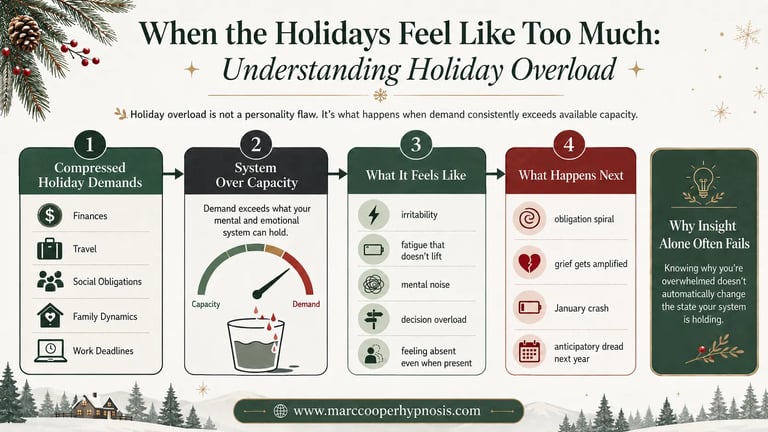
When the Holidays Feel Like Too Much: Understanding Holiday Overload
Holiday overload isn't a personality flaw or a lack of gratitude. It's a specific cognitive and emotional state that builds when demand consistently exceeds available capacity, and the season makes that gap unavoidable.
Most people who experience holiday overload don't identify it by name. They just feel irritable, flat, or mentally unavailable, while simultaneously managing a calendar that keeps adding obligations.
Why Holiday Overload Happens
The holiday season compresses an unusual number of demands into a short window. Financial pressure, social performance, travel logistics, family dynamics, end-of-year work deadlines, and the ambient expectation that this should all feel meaningful, arrive at the same time.
Each demand is individually manageable. Together, they saturate the system.
The mechanism isn't complicated. Research published in Frontiers in Human Neuroscience confirms that stress consistently impairs prefrontal cortex function, which governs working memory, decision-making, and cognitive flexibility. When that region is under sustained load, the brain shifts control toward more reactive circuits. Executive function drops. Emotional reactivity rises. The ability to filter, prioritize, or let things go diminishes.
This is why people who are otherwise competent and composed find themselves snapping at small things in December, unable to make simple decisions, or lying awake running through logistics they can't act on until morning.
The brain is doing what it was built to do under sustained pressure. The problem is that the environment provides no off-ramp.
What Holiday Overload Actually Feels Like
People often notice it first as a low-grade irritability that doesn't seem proportionate to what triggered it.
Then comes the fatigue that doesn't respond to sleep. The kind where rest exists but doesn't restore. Then the mental noise, the running list that never clears, the social obligations that feel like performance rather than connection.
This usually shows up as an inability to be present. People sit at tables with the people they're supposed to be glad to see and feel strangely absent. They're running the mental tab of everything still undone.
The internal experience tends to oscillate between two states. High-demand mode, when there's too much to manage. And deflation, when the event ends and nothing feels as expected. Neither state gets much acknowledgment, because both feel like personal failure rather than a recognizable pattern.
It's not personal failure. It's a system that's been running over capacity for weeks.
Why Talking It Through Usually Doesn't Help
The standard advice around holiday stress involves planning ahead, setting limits, practicing presence, and managing expectations. People have already heard this. Most have tried some version of it.
The issue isn't informational. People experiencing holiday overload generally know what's happening. They can describe it clearly. The problem is that the knowing doesn't change the state.
This is the structural limitation of insight-based approaches when the pattern is held below the level of conscious reasoning. The mind can understand the pressure while the system underneath continues responding as if the threat is ongoing. Understanding why you're overwhelmed doesn't interrupt the signal that keeps the overwhelm running.
That gap, between intellectual clarity and internal state, is where most conventional approaches lose traction.
The Hidden Cost of Obligated Connection
One of the least-discussed features of holiday overload is the specific weight of social obligation performed without genuine engagement.
Research finds that the majority of adults attend holiday gatherings primarily out of obligation rather than genuine desire. That's not cynicism. It's an honest account of how the season operates for a significant portion of high-functioning adults.
Sustained social performance, presenting as well and present when the internal state doesn't match, draws on the same cognitive resources already under strain. It doesn't replenish them.
People often report that the most exhausting part of the season isn't the work. It's the maintenance of an emotional register they're not actually in.
When the Season Amplifies What's Already There
Holiday overload rarely operates in isolation. For people managing grief, an unresolved loss, a strained relationship, or chronic low-level anxiety, the season intensifies what's already present.
Empty chairs at the table are more obvious in December. Relationships in tension become harder to avoid. The contrast between what's expected and what's actually experienced becomes sharper when the season attaches high emotional stakes to togetherness.
This is why some people find the period after the holidays harder than the season itself. The stimulus is gone but the residue remains, and the depletion that built up across several weeks doesn't resolve on its own timeline.
Four Concrete Patterns
The Competent Person Who Can't Slow Down High-functioning people often experience holiday overload as an inability to shift modes. They remain in output mode through a period designed for connection and rest. The capacity to downshift has been trained out of them. The holidays expose this, because the environment demands presence while the internal setting remains on task.
The Grief That Shows Up Without Permission The season surfaces losses people thought they'd processed. A parent who died three years ago. A friendship that ended. A version of a family that no longer exists. These aren't irrational responses. The season is structured around relational presence. Absence becomes more visible.
The Obligation Spiral The commitment to say yes, to make it work, to hold things together for everyone else, is one of the more reliable paths to complete depletion. It usually runs through the end of December and collapses somewhere in January.
The Reset That Doesn't Come People expect January to reset them. Sometimes it does. More often, the fatigue that accumulated across the season persists into the new year, and the feeling of starting from behind becomes a new baseline.
What Happens When Holiday Overload Isn't Addressed
Holiday overload that goes unaddressed tends to accumulate across years. Each season builds on the residue of the last. What begins as manageable exhaustion gradually sharpens into anticipatory dread.
By the time most people seek any form of support, the pattern isn't seasonal. It's become the lens through which they approach the period, and the avoidance, the pre-emptive flatness, the planning-as-protection, has become its own load.
The system learns to brace. Bracing takes energy. That's a tax applied before the season even begins.
A content-free approach to hypnotherapy doesn't require the person to narrate the history of the stress or identify the specific trigger. It works with the state the system is holding, not the story being told about it. For high-functioning people who are already exhausted from over-explaining, that distinction matters.
If you're managing anxiety that spikes during this period, that pattern is worth looking at directly. The work I do with anxiety and stress addresses the state underneath the behavior, not just the behavior itself.
Frequently Asked Questions
Is holiday overload a clinical condition? No. It's a recognizable pattern of sustained demand that exceeds cognitive and emotional capacity. It doesn't require a diagnosis, but that doesn't mean it's trivial. Left unaddressed, it tends to compound.
Why do I feel worse after the holidays than during them? The holidays sustain a high level of output and suppression. When the external demand drops, the internal state that was managed underneath it becomes more available to awareness. Feeling worse after is often a sign of how much was being managed throughout.
Why don't I feel better after sleeping or taking time off? When the system has been running under sustained pressure, rest alone doesn't reset it. The state that's been established doesn't lift simply because the schedule clears. This is one reason people can be technically on holiday and feel no relief.
I function well during the holidays. Why does it hit me afterward? High-functioning people are often skilled at managing outward performance while internal resources deplete quietly. The collapse doesn't arrive mid-season. It arrives when the performance requirement drops and there's nothing left underneath it.
How is this different from seasonal depression? Holiday overload is primarily load-driven rather than seasonal or physiological in origin. Seasonal depression tends to have a biological component tied to light exposure and follows a more predictable calendar pattern. Holiday overload is more directly tied to the compression of demand. Both warrant attention. They're not the same.
When this pattern is active and it's showing up year after year, that's the work I do.
This article is informational only and not medical or psychological advice.
Address
Based in Los Angeles, CA
Online sessions available worldwide
Contacts

