
If You Can Explain Your Pain Clearly, You're Avoiding It
Insight is not change. If your explanation of the problem is clean and precise, you may be maintaining the structure, not dismantling it.
OVERFUNCTIONING
Marc Cooper
2/26/20264 min read
If You Can Explain Your Pain Clearly, You're Probably Still Avoiding It
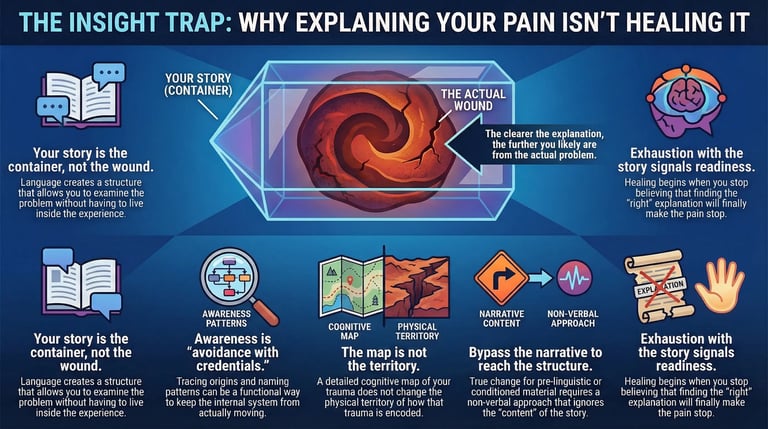
The cleaner the explanation, the further the person is from the actual problem.
This is not a paradox. It is a structural feature of how pain gets managed internally. When something lands hard enough to disrupt the system, the mind does not sit with the raw experience. It builds a container for it. Language is that container. Narrative is that container. And the container, once constructed, becomes something a person can hold at arm's length, examine, and describe to others with precision.
What gets described is never the wound. It is the architecture built around the wound.
The cultural assumption is that articulation means insight. Therapy has reinforced this for decades. If a person can name what happened, trace the origin, identify the pattern, and connect it to current behavior, they are considered to be "doing the work." Awareness is treated as the mechanism of change.
But awareness is not change. Awareness is often the most sophisticated form of avoidance available. It is avoidance with credentials.
The person who can explain their attachment style, their childhood wound, their nervous system response, their recurring relational pattern, and the specific moment it formed is not closer to resolution. They have built an elaborate cognitive structure that allows them to live adjacent to the pain rather than inside it. The explanation is functional. It gives them something to say when asked. It keeps others from pressing further. And it gives the internal system a way to believe that the problem has been addressed without anything actually moving.
This is not a criticism of those people. It is a description of how intelligence responds to intolerable experience.
This usually looks like someone who has been to therapy, has read the relevant literature, understands the mechanism behind their behavior, can predict when the pattern will emerge, and still finds themselves in the same situation again. They are not in denial. They are in explanation. The map they have drawn is detailed and accurate. The territory has not changed.
People who operate this way often feel a quiet frustration they cannot fully account for. They have done everything they were supposed to do. They have named the thing. They have understood the thing. They have talked about the thing from multiple angles with multiple people. And the thing remains. Not loudly. Not dramatically. Just structurally. It runs underneath their decisions and their relationships and their sense of themselves, largely undisturbed by everything the conscious mind has learned about it.
This is the moment things quietly tilt. Not when someone hits bottom. When someone realizes that understanding it has not made it stop.
Talk-based approaches are built on a reasonable premise: that making the unconscious conscious produces change. In some structures, this is accurate. When the issue lives primarily at the level of interpretation, giving the person new interpretive frames can shift behavior. That is a real mechanism with real results.
But there is a category of problem that does not live at the level of interpretation. It lives at the level of experience. Specifically, the original experience, which was encoded before language, or encoded under conditions where language could not process it cleanly, or encoded so early that the narrative came later and was retrofitted onto something that had already calcified.
In those cases, the narrative is secondary. It is decoration. Talking about the experience gives the person a way to represent the experience without returning to it. And returning to it, which is the actual requirement for anything to reorganize, does not happen in language. Language prevents it. Language is, by design, a step removed from raw experience. That step is precisely what the system wants.
Journaling extends this further. Writing the story out, analyzing it, rewriting it with new understanding, is cognitive processing applied to material that is not primarily cognitive. The activity feels meaningful because it requires effort and produces output. The underlying structure does not care.
Introspection produces the same result at lower resolution. The person asks themselves why they do the thing. They generate plausible answers. The answers become the new story. Nothing below the narrative level has been accessed.
There is a category of intervention that does not require a person to explain anything. That does not engage the narrative at all. That bypasses the container entirely and works with the structure underneath it. Not because it is mysterious, but because the mechanism of change for non-verbal, pre-linguistic, or deeply conditioned material is not verbal. The medium has to match the structure of what is being addressed.
This is not about technique. It is about logic. You cannot negotiate with something that does not speak. You cannot explain your way out of something that was never an idea.
The approach I work with does not ask the client to revisit the story. It does not need the origin. It does not need the explanation. The content of the problem is not the point of entry. This matters because the content, the clean, well-articulated, carefully maintained explanation, is almost always what is keeping the structure in place.
If you want to understand more about how a content-free approach works in practice, the Content-Free Hypnosis Guide covers the core reasoning without overpromising anything.
This perspective applies to people who have already exhausted the explanatory route. Who have done the insight work and found that insight did not move the thing. Who are not looking to be understood or validated. Who want the pattern to stop regardless of whether they ever fully understand why it started.
It does not apply to people who need to tell the story. Who are still finding relief in articulation. Who feel that being heard is the primary requirement. That work is real and it serves a real purpose. It is simply not the same work.
It also does not apply to people who believe that if they find the right explanation, the right reframe, the right cognitive map, everything will finally shift. That belief is itself part of the structure. I do not argue with it.
For people dealing with the kind of entrenched, explanation-resistant anxiety or trauma this piece describes, the service page for anxiety and trauma work outlines what I actually address.
The clearest signal that someone is ready for a different approach is not desperation. It is exhaustion with their own story. They still know it perfectly. They can still recite it. But somewhere underneath the recitation, they have stopped believing the story is the problem.
When the pattern becomes undeniable, people usually find their way to me.
Address
Based in Los Angeles, CA
Online sessions available worldwide
Contacts

