
Micro-Resets for Busy Days | Marc Cooper Hypnosis
When busy days push past your limits, micro-resets aren't a productivity hack. They're a pattern-level response to how the brain actually operates under load.
SELF IMPROVEMENT
Marc Cooper
6/1/20265 min read
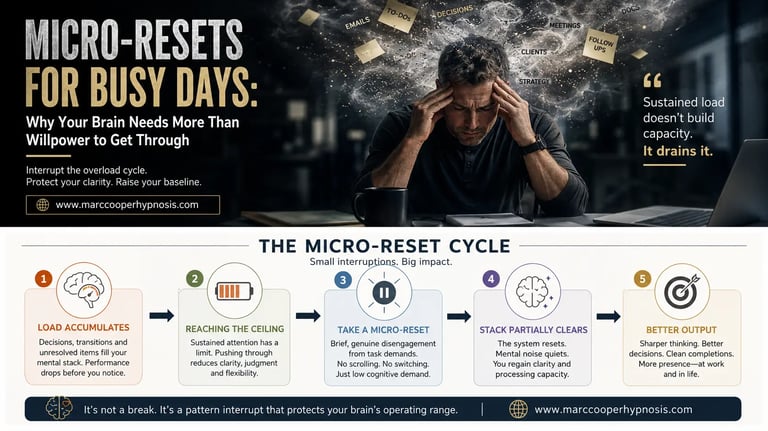
Micro-Resets for Busy Days: Why Your Brain Needs More Than Willpower to Get Through
A micro-reset is not a break. It is a brief, deliberate interruption of a cognitive load cycle. Most people skip them. Not because they don't have time, but because the pattern that makes them necessary is the same pattern that makes them feel impossible to take.
What Happens to the Brain on a Full Day
The brain does not run at a flat line. Cognitive load accumulates. Each decision, transition, and unresolved item adds to the processing stack. When the stack gets full, performance degrades, but the subjective experience often lags behind the actual decline. People feel fine while operating at reduced capacity. That mismatch is where most problems originate.
Research on micro-breaks published through systematic review confirms that short, low-demand interruptions support well-being and can buffer the compounding effects of accumulated strain during high-output work periods. The mechanism is not mystery. Sustained attention has a ceiling. When load runs continuously past that ceiling, the cognitive functions most critical to judgment, including executive processing and response flexibility, are the first to diminish.
The day does not feel slower. It just gets harder to think clearly, and people attribute that to the work rather than to the load pattern producing it.
Why Busy People Don't Interrupt Themselves
There is a specific internal logic to pushing through. It feels productive. Stopping feels like losing ground. This is not irrational. In a compressed schedule, pausing carries real cost.
But the push-through pattern operates on a false assumption. It treats the brain as a storage unit rather than a processing system. A storage unit can stay full indefinitely. A processing system running at capacity stops processing cleanly. Output suffers while input continues.
The result is a stack that never empties. Tasks get completed but not cleanly. Decisions get made but not with full resolution. By the time the day ends, there is a residue of half-processed material that follows the person into the evening and sometimes into sleep.
This is not about stress management. It is a structural output problem with a structural cause.
What a Micro-Reset Actually Does
A micro-reset interrupts the accumulation cycle before the ceiling is hit. Not after. Not at the end of the day. During it.
The function is not relaxation. It is system interruption. A brief period of genuinely low cognitive demand, taken before overload sets in, allows the processing stack to partially clear. It does not require a quiet room or a long period of time. It requires disengagement from active task demands. Not substituting one demanding task for another.
This distinction matters. People who check their phone during a break are not resetting. They are extending the load. People who switch to a simpler task are still accumulating. The pattern that produces overload does not care what the task is. It responds to demand level. Only genuine disengagement interrupts it.
How This Pattern Shows Up
The Late-Day Sharpness Problem
People often notice that they can think clearly in the morning and cannot think clearly by mid-afternoon, even after a reasonable amount of sleep. This is typically attributed to diet, caffeine, or general tiredness. It is more often the output of a load cycle that ran without interruption from early in the day.
The sharpness does not return after coffee. It does not fully return after lunch. It returns, partially, after a genuine interruption of sufficient length. This is not motivational. It is operational.
The Transition Tax
Most busy days involve multiple shifts between different types of work. Client calls, documentation, strategic thinking, email, logistics. Each transition carries a cognitive overhead. When transitions happen too fast and too frequently, that overhead compounds.
People often notice a particular heaviness or sluggishness right before a major task, especially when that task follows a string of smaller ones. That heaviness is load accumulation expressing itself. A deliberate pause before the major task, even a brief one, often produces noticeably better output on that task.
The Unfinished Items Effect
Uncompleted items occupy working memory. This is sometimes called the Zeigarnik effect in research literature, but the operational reality is simpler. The brain keeps a background tab open for anything that does not have a resolved status. On a busy day, those tabs multiply. By mid-afternoon, cognitive capacity is partially occupied by a queue of unresolved items that have nothing to do with the current task.
Micro-resets do not close those tabs. But they reduce the load enough for cleaner foreground processing.
The Cost of Powering Through
The pattern of pushing through without interruption does not build capacity. It depletes it. Performance quality drops. Decision quality drops. And the ability to be present in the evening, in conversation, in anything that requires actual attention, is compromised by a system that never fully cleared during the day.
For high-functioning people, this chronic underperformance is easy to miss because output is still happening. The work is still getting done. What is not visible is the quality of processing happening below what's possible.
Why Insight Alone Does Not Fix the Pattern
People who understand the micro-reset concept often still do not implement it. Not because they forgot. Because the pattern of continuous output has its own pull.
Understanding that the brain has a cognitive ceiling does not interrupt the loop that keeps the person running past it. The loop is automatic. It responds to environmental cues, to the presence of uncompleted tasks, to the internal standard that stopping is a form of failure. Knowing this does not change it.
This is where a content-free approach to pattern work is relevant. The loop does not operate at the level of conscious reasoning. Changing it at the reasoning level is like addressing a malfunctioning operating system through the user interface. The access point is different. If you want to understand what that means practically, the content-free hypnosis guide explains the orientation without jargon.
What Happens Without It
When the push-through pattern runs without interruption, over weeks and months, the accumulation stops being a daily event. It becomes baseline. The cognitive ceiling drops. The range of what feels manageable narrows. People describe a constant low-grade tiredness that sleep does not fix, a difficulty accessing the kind of thinking they used to find easy, and a reduced tolerance for complexity.
This is not burnout in the clinical sense. It is a pattern that has become structural. The brain has recalibrated around chronic overload. At that point, the problem is no longer about individual days. It is about the operating range the system has settled into.
For people managing high demands over sustained periods, this trajectory is worth understanding before it reaches that stage. Hypnotherapy for anxiety and sustained cognitive load is the work I do when the pattern has become entrenched enough that behavioral adjustments alone are not moving it.
Frequently Asked Questions
What is a micro-reset?
A micro-reset is a brief, deliberate interruption of cognitive load. It is not a break in the conventional sense. The defining feature is genuine disengagement from task demands, not substituting one task for another. Its function is to partially clear the processing stack before accumulated load degrades performance.
How long does a micro-reset need to be?
Research on brief rest periods suggests even short intervals of low-demand disengagement can produce partial recovery. The more relevant factor is quality of disengagement, not duration. A ten-minute low-demand pause is more useful than a ten-minute phone scroll. The former interrupts load accumulation. The latter extends it.
Why do I forget to take micro-resets even when I intend to?
The push-through pattern is automatic. It does not respond to intention. The same loop that creates the need for interruption also suppresses the cue to take one. This is a behavioral pattern operating at a level below conscious scheduling.
Is cognitive fatigue the same as being tired?
Not precisely. Cognitive fatigue refers specifically to decline in processing efficiency from sustained mental load. A person can be cognitively fatigued without feeling physically tired, and can feel physically rested while carrying significant cognitive load from the prior day. The two interact, but they are not the same mechanism.
When does a pattern like this require more than behavioral change?
When the pattern has become structural. When adjustments to routine produce no meaningful shift. When the baseline has moved and the ordinary range of function has narrowed. At that point, the pattern is operating at a level that behavioral strategies cannot reach on their own.
This article is informational only and not medical or psychological advice.
When the push-through pattern has become the default operating mode, that is the work I do.
Address
Based in Los Angeles, CA
Online sessions available worldwide
Contacts

