
Morning Anxiety Reset: Why It Starts Before You're Awake
Morning anxiety isn't a mood. It's a physiological pattern that begins before consciousness returns. Here's what's driving it and why it persists.
ANXIETY
Marc Cooper
4/13/20266 min read
Morning Anxiety Reset: Why It Starts Before You're Awake
Morning anxiety isn't a reaction to bad news. It isn't a character flaw or a sign that something has gone wrong overnight. It's a pattern that activates before the first coherent thought forms, and for many people, it's already running by the time they open their eyes.
That's the part most explanations miss.
What Morning Anxiety Actually Is
Morning anxiety is the experience of waking into an already-elevated state. The mind isn't calm and then triggered by something. It arrives activated. The body is ahead of consciousness, already scanning, already braced. This isn't unusual. What makes it a problem is when the activation level is disproportionate to anything actually happening.
The primary keyword here is accurate: this is a reset problem. The system didn't return to baseline overnight. It's carrying forward a charge from the previous day, or the previous year.
Why the Body Runs Hot in the Morning
There's a documented physiological event that happens in the first thirty to forty-five minutes after waking. Cortisol rises sharply. This is normal. It's the body preparing for the demands of the day.
In most people, it's unremarkable. They notice mild alertness. They move through their morning.
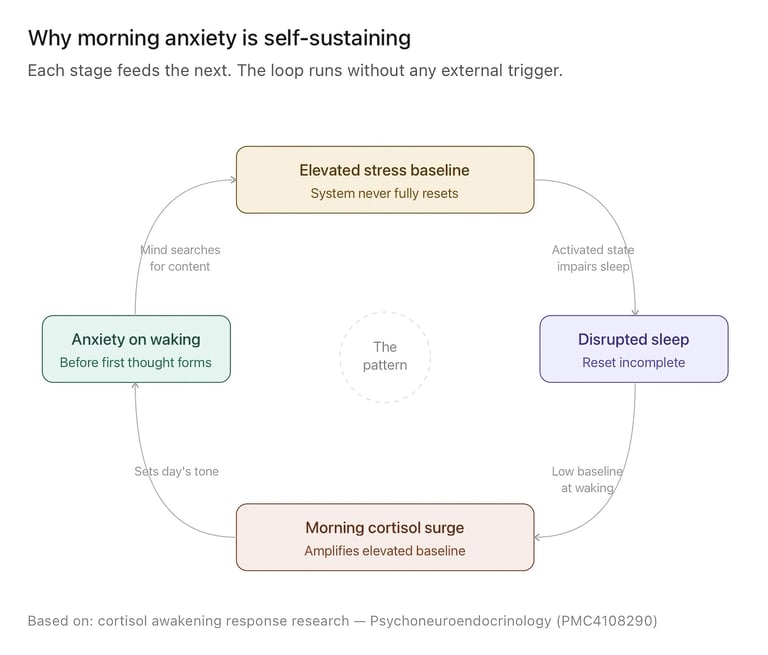
In people with chronic anxiety or sustained high stress, that same cortisol rise amplifies an already-elevated baseline. The system reads the morning as threat. Research published in Psychoneuroendocrinology found that an elevated cortisol awakening response is a prospective predictor of anxiety disorder onset, meaning the morning hormonal pattern isn't just a symptom. It precedes the disorder.
The morning isn't causing the anxiety. The morning is revealing a system that never reset.
What This Pattern Feels Like From the Inside
People often notice it before they can name it. The alarm goes off. There's a half-second of neutral. Then the weight arrives.
This usually feels like a tight chest before any specific thought. It shows up as dread without a clear object. The mind starts searching for what's wrong, as if the anxiety needs a reason, and inevitably finds one.
That search is the pattern. The body is already in a stress state. The mind constructs justification after the fact.
This tends to show up most clearly when nothing externally bad is happening. The day ahead looks manageable. There's no crisis. But the sense of something is still there, persistent and shapeless.
For some people, it peaks in the first hour and then fades as the day builds momentum. For others, it sets the tone for the whole day. The morning becomes a daily negotiation with a state that wasn't chosen.
Why the Standard Approaches Miss It
Most attempts to address morning anxiety target the content. The racing thoughts. The to-do list. The worry about a specific conversation or event.
Breathing exercises and journaling operate on this level. They give the mind something constructive to do. For mild or situational morning anxiety, this can work. The system wasn't that elevated to begin with, and a redirect is enough.
But when the anxiety is physiological first and cognitive second, content-level interventions address the wrong layer. The system is already running before the mind knows what to worry about. Teaching someone to reframe their thoughts in that state is like adjusting the radio while the engine is misfiring.
Talking about it has a similar limitation. Insight doesn't change the baseline. A person can have complete understanding of why their body activates in the morning and still wake up the same way tomorrow. The pattern isn't maintained by misunderstanding. It's maintained by repetition.
The Pattern Is Structural, Not Situational
This is the key distinction. Morning anxiety that persists across multiple life contexts, across changes in job or relationship or circumstance, isn't responding to those circumstances. It's running on its own logic.
The mind adapts. It finds new content to match the state. If one worry resolves, another takes its place by morning. The specific concern changes. The activation level doesn't.
That's a structural pattern. The system has a set point, and it keeps returning to it.
When the Reset Mechanism Is Offline
Sleep is the primary reset mechanism the body uses to downregulate the stress response. Deep, uninterrupted sleep allows cortisol to decline to its nighttime nadir and rebuild gradually.
When sleep is disrupted, or when the person goes to bed in an activated state, that process is incomplete. The morning starts from wherever the system left off. If that baseline is high, the cortisol rise on waking amplifies a charge that was never fully cleared.
This is why morning anxiety tends to compound over time. Worse mornings produce worse sleep. Worse sleep produces worse mornings. The cycle doesn't require anything external to sustain itself.
Four Patterns That Indicate This Is Structural
Activation without a trigger. The anxiety is fully present before any specific thought has formed. The mind searches for a reason rather than reacting to one.
Consistency across circumstances. The mornings are similar regardless of what the previous day held, or what the current day requires. A free Sunday feels the same as a high-pressure Monday.
Content-independence. When one worry resolves, another takes its place. The anxiety doesn't dissolve when circumstances improve. It relocates.
Physical precedence. The body is ahead of the mind. The chest tightness, the held breath, the elevated heart rate are already present before the first coherent thought.
These aren't personality traits. They're evidence of a system that's running on a miscalibrated pattern.
The Limitation of Reset Strategies
The term "morning anxiety reset" is useful because it names the right goal. The system needs to return to a different baseline. But most methods marketed as resets operate at the surface level.
Cold exposure, exercise, light therapy, breathwork. These are all real inputs. Some of them have measurable effects on cortisol timing.
What they don't address is why the baseline is elevated in the first place. They manage the output. The source pattern continues producing.
For some people, management is enough. They build a routine that keeps the system functional. The anxiety remains present but doesn't determine the day.
For others, the charge is high enough that management tools barely make a dent. They've built elaborate morning routines and the anxiety finds them anyway.
Why This Requires Working at a Different Level
When a pattern is structural, the reset has to happen at the same level the pattern operates. Not in the content of thinking. Not in the management of symptoms. In the underlying mechanism that's producing the output.
This is where a content-free approach to hypnotherapy becomes relevant. Content-free means the work doesn't require analyzing the anxiety, identifying its origin, or rehearsing new thoughts. It operates on the pattern directly.
The session doesn't need the person to recount what happened or construct insight about why their morning is hard. That content is beside the point. What matters is the system's baseline, and whether it can be shifted.
This is also why the work I do in anxiety and related patterns is structured differently from talk-based approaches. The goal isn't understanding. The goal is a different default.
What Chronification Looks Like
A morning anxiety pattern that goes unaddressed tends to generalize. It becomes the ambient condition, not a morning-specific one. The activation that was once concentrated in the first hour starts to show up throughout the day.
Sleep quality declines further. The threshold for triggering the stress response lowers. Things that were previously manageable start to feel effortful.
The person adapts, often by narrowing. Fewer social commitments. More controlled environments. A smaller life organized around managing a state that should have been a temporary condition.
That trajectory isn't inevitable. But it doesn't reverse on its own.
Frequently Asked Questions
Why is anxiety worse in the morning than at other times of day? Cortisol reaches its daily peak in the first thirty to forty-five minutes after waking. In people with elevated stress baselines, this normal hormonal rise amplifies an already-activated system. The result is anxiety that's present before any specific thought has formed.
Is morning anxiety different from general anxiety? The mechanism overlaps significantly, but morning anxiety often indicates a baseline issue rather than a reactive one. General anxiety can be triggered by specific events. Morning anxiety tends to be present regardless of what's happening, which suggests the system is running elevated before external input arrives.
Can morning anxiety improve without addressing the underlying pattern? Symptom management can reduce its intensity. Lifestyle changes, sleep hygiene, and structured morning routines can lower the severity of any given morning. They don't change the set point the system returns to.
What does a content-free approach mean in this context? It means the session doesn't require talking through the anxiety's history or analyzing its causes. The work targets the physiological and cognitive pattern itself, not the story around it.
How long does morning anxiety typically persist if untreated? There's no fixed timeline. Patterns that are structural tend to remain stable until something actively changes the baseline. Without that, adaptation is the more common outcome than resolution.
This article is informational only and not medical or psychological advice.
When this pattern is active and management strategies have reached their ceiling, this is the work I do.
Address
Based in Los Angeles, CA
Online sessions available worldwide
Contacts

