
Most Anxiety Isn’t Fear. It’s Suppressed Control
Anxiety often emerges from control that can no longer be consciously maintained. This essay examines the structure beneath the pattern.
ANXIETY
Marc Cooper
2/5/20263 min read
Most Anxiety Isn’t Fear. It’s Suppressed Control
The moment control stops working, anxiety appears, not as fear, but as the residue of a system that can no longer hold its shape.
This is where most explanations begin to fail. Anxiety is routinely framed as anticipation of threat, misfiring survival circuitry, or unresolved emotion pushing upward. Those interpretations are not emotionally wrong. They are structurally incomplete. They assume anxiety originates in what is being felt, when in practice it emerges from what has been prevented from moving.
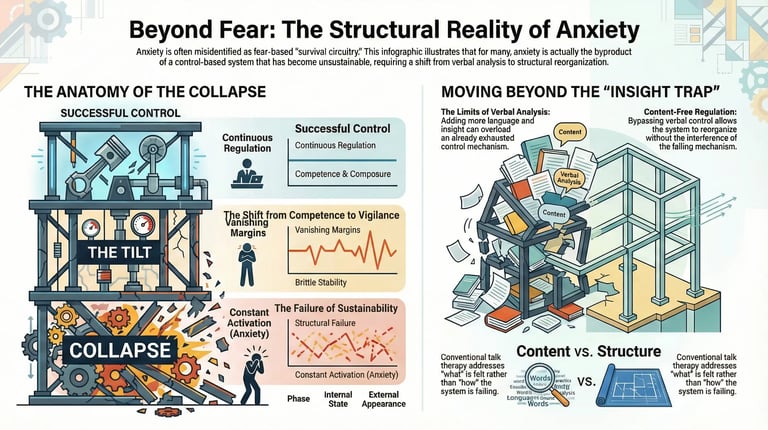
Control is not the absence of feeling. It is an active process. It requires continuous regulation, monitoring, suppression, adjustment, and correction. When control functions smoothly, it is invisible. It looks like competence. It looks like composure. It looks like being the person who does not overreact, does not lose footing, does not create mess. The nervous system stays narrow, efficient, restrained. Over time, that restraint becomes the baseline.
Anxiety does not appear during the period of successful control. It appears when the effort becomes unsustainable.
The prevailing therapeutic assumption treats anxiety as an excess, too much emotion, too much fear, too much sensitivity. The structural reality is often the inverse. Anxiety is what happens when a long-running suppression strategy begins to leak. It is not the emotion itself that overwhelms the system, but the collapse of the mechanism that was holding it in check.
This distinction matters because it reverses cause and effect. If anxiety were primarily fear, then reassurance, reframing, and gradual exposure would resolve it. If anxiety is suppressed control, those interventions add pressure to an already overloaded system. They ask the person to manage the very structure that is failing.
People who operate this way are rarely described as anxious early in life. They are described as responsible, self-contained, composed. They learn quickly that maintaining control produces safety, approval, predictability. Emotion becomes something to be optimized, delayed, or handled privately. The internal posture is not avoidance, but containment.
This usually looks functional until it doesn’t. The system runs clean for years. Sometimes decades. Then subtle distortions begin to appear. Sleep becomes shallow. The body holds tension without clear cause. Attention narrows. Irritability rises without an identifiable target. The mind starts scanning for explanations because something feels off, but nothing appears wrong.
This is the moment things quietly tilt. Control continues, but the margin disappears. What was once effortless becomes vigilant. What was once stable becomes brittle. Anxiety enters not as panic, but as background noise, a constant low-grade activation that cannot be resolved through understanding.
Conventional approaches fail here because they address content, not structure. Talk therapy assumes that articulation leads to resolution. Journaling assumes that insight dissolves tension. Cognitive strategies assume that correcting interpretation will calm the system. These methods are effective when anxiety is driven by misappraisal or unresolved narrative. They stall when the issue is mechanical rather than semantic.
A control-based system does not fail because it lacks explanation. It fails because it has been overutilized. Adding more language asks the system to do more of what is already exhausting it. Insight becomes another task. Awareness becomes another layer of monitoring. The person becomes better at describing the problem while remaining trapped inside it.
This is why many individuals report understanding their anxiety in detail while experiencing no structural change. The explanation is accurate. The relief never arrives. The system was never designed to resolve itself through analysis.
A non-verbal, content-free approach works here for a simple reason. It does not require the control system to participate. When language is removed, the structure that depends on language loses leverage. Regulation occurs without asking permission from the mechanism that has been enforcing restraint. The system is allowed to reorganize without being managed.
There is no technique to understand in that statement. Only a logic. Control cannot dismantle itself. Any approach that bypasses control will appear unfamiliar, even threatening, to someone whose stability has depended on it. That discomfort is not a warning sign. It is a structural signal.
This perspective applies to people whose anxiety arrived late, quietly, after years of apparent stability. It applies to those who function well under pressure but cannot rest without vigilance. It applies to individuals who do not resonate with fear-based explanations because fear has never felt like the primary driver. It does not apply to those seeking reassurance, coping tools, or narrative processing. It is not for people who want to talk through the experience.
I have spent years observing how control-based systems fracture and what allows them to reconfigure without force. The pattern is consistent. When the structure becomes visible, the explanation loses importance. What matters is whether the system is allowed to stop holding itself together.
The structural fault line becomes clearer when language is removed from the equation. I have documented this distinction directly in the Content-Free Hypnosis Guide, not as a technique, but as an explanation of why certain internal systems only reorganize when verbal control is no longer involved.
The same control-collapse pattern appears consistently in my work with anxiety. In those cases, the issue is not fear, but the cumulative cost of sustained containment. The structural implications of that pattern are outlined on the Anxiety service page, for those already recognizing the limits of insight-based approaches.
When the pattern becomes undeniable, people usually find their way to me.
Address
Based in Los Angeles, CA
Online sessions available worldwide
Contacts

