
Performance Jitters: What They Are and Why They Persist
Performance jitters aren't nerves you push through. They're a nervous system pattern. Here's what drives them and why insight rarely resolves them.
SELF IMPROVEMENT
Marc Cooper
4/27/20266 min read
Performance Jitters: What They Are and Why They Persist
Performance jitters are a specific, repeatable physiological and cognitive response that activates before or during high-stakes situations. They are not a character flaw. They are not inexperience. They are a pattern the nervous system has learned to run, and it runs that pattern reliably.
Understanding the distinction matters. Most people try to fix the wrong thing.
What Actually Drives Performance Jitters
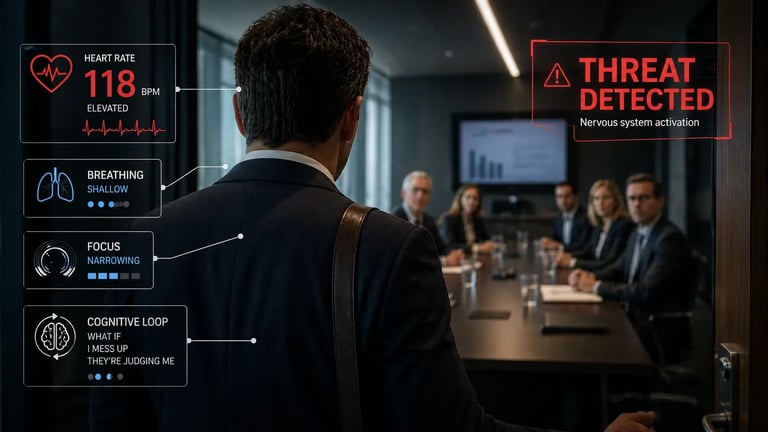
The nervous system doesn't distinguish between a real threat and a perceived one. When a high-stakes situation approaches, the autonomic nervous system reads it as danger. It triggers sympathetic activation. Heart rate increases. Breath becomes shallow. Muscle tension rises. Blood flow redirects.
This response evolved for survival. It was never designed for boardroom presentations.
Research identifies three overlapping dimensions in performance anxiety: cognitive anxiety, reflected by worry and self-focus; physiological anxiety, reflected by autonomic hyperactivity and somatic tension; and a regulatory dimension concerned with how individuals perceive their capacity to cope with perceived threat.
All three can be active simultaneously. Most people only notice the physical symptoms. The cognitive layer runs underneath, often below conscious awareness.
The body is in protection mode. The mind interprets the body's state as evidence of danger. That interpretation amplifies the physiological response. The loop tightens.
This is why reassurance doesn't stop it.
How Performance Jitters Show Up Internally
People often notice a distinct shift in the hours before a high-stakes event. Not just nerves. Something more specific.
The thinking changes. Cognitive bandwidth narrows. Attention collapses inward. There's a preoccupation with potential failure that feels automatic, almost involuntary.
Under anxiety, skilled performers tend to reinvest conscious control into processes that no longer need it, and paying deliberate attention to something that was previously automatic can cause it to malfunction. This is why experienced professionals sometimes perform worse than expected in high-visibility situations. Competence isn't the variable. The nervous system state is.
People often describe the internal experience like this:
A presentation they've delivered ten times suddenly feels unreliable. The words are there. The knowledge is intact. But there's a low-level hum of threat that makes fluency feel uncertain. The body registers the audience as a form of evaluation, and evaluation activates the same system that registers danger.
This tends to show up as physical restlessness, difficulty settling the mind, an urge to over-prepare, and a moment of genuine self-doubt that feels disproportionate to actual capability.
The gap between competence and felt competence is the problem.
Why Performance Jitters Don't Respond to Insight or Preparation Alone
Most approaches to performance jitters focus on two things: increasing preparation, or reframing thoughts. Both have limited leverage.
Preparation addresses skill. Jitters aren't a skill deficit.
Reframing addresses the conscious interpretation of the experience. But physical symptoms of performance anxiety arise primarily from sympathetic activation of the autonomic nervous system, manifesting as accelerated heartbeat, increased blood pressure, tremors, rapid and shallow breathing, and dry mouth. These are not cognitive events. They're physiological ones. Changing a thought doesn't reset the system producing them.
There's a structural mismatch between what talk-based approaches can reach and where the pattern actually lives.
The nervous system learns through repetition and association, not reasoning. A person can know, intellectually, that they are safe and competent. That knowledge can coexist with a body that continues running threat responses. Knowing and feeling operate through different mechanisms.
This is also why positive self-talk often fails in the moment. The nervous system isn't listening to language. It's reading context, interpreting situational cues, and activating patterns it has rehearsed many times before.
Some researchers have noted that intentionally attempting to change one's internal state before performance can create resistance, which may actually exacerbate anxiety rather than reduce it. Trying harder to calm down can amplify the system's arousal.
The approach that fits here is one that works at the level of the pattern itself. Not through reasoning with it, but through interrupting and reorganizing it at the source. That's what a content-free approach to this kind of work is designed to do. The pattern doesn't need to be understood in detail. It needs to be changed.
Practical Micro-Anchors
There's a specific kind of professional who experiences performance jitters as a persistent low-grade problem, not a crisis. They've functioned well enough. They've delivered enough times that the gap between their output and their potential is invisible to others. But they feel it. The cost is internal: a persistent expenditure of energy managing the system before and during performance, rather than directing that energy toward the performance itself.
High-trait-anxiety individuals tend to interpret physiological arousal as a threat signal. Research in cognitive-physiological models of performance suggests that high trait anxiety speakers are likely to interpret their physiological arousal as anxiety or fear, whereas low trait anxiety speakers may perceive the same arousal as enthusiasm or excitement. Same body state. Different label. Profoundly different outcome.
A lawyer preparing for a high-stakes hearing doesn't lack knowledge of the law. What activates is a threat-detection system that treats judgment, evaluation, and visibility as danger signals. The system does its job. The problem is that its job interferes with performance.
The experience of performance jitters in leadership contexts often looks like this: a meeting is approaching, the stakes are clear, and a week before it, the preoccupation begins. Sleep degrades slightly. The internal rehearsal starts running on a loop. Energy that could be directed outward gets redirected toward managing internal noise.
That redirection has a cost. And over time, the cost compounds.
What the Research Points To
Research indicates that prolonged neuroendocrine activation and overstimulation of the sympathetic nervous system, when chronic, can have significant downstream effects on health, wellbeing, and occupational functioning. Performance jitters that remain unresolved don't usually stay bounded to performance contexts. The nervous system that runs threat responses before presentations is the same system that runs throughout the rest of life.
For many professionals, managing the work of performance-related anxiety over years creates a cumulative load that exceeds what cognitive strategies can absorb. The management strategies work, until they don't.
The pattern persists because it's efficient. The nervous system is conserving energy by running a known response. It's not malfunctioning. It's functioning exactly as designed, in a context where that design no longer serves the person carrying it.
What Happens When Performance Jitters Go Unaddressed
Performance jitters that are managed rather than resolved tend to narrow range over time.
The professional begins avoiding certain contexts. Not dramatically. Subtly. They take fewer high-visibility opportunities. They decline speaking roles. They underperform in evaluation contexts relative to their actual skill level. The visible career trajectory doesn't always reflect this, but the internal experience does.
At its most severe, unresolved performance anxiety can constitute an occupational constraint, limiting the kinds of roles and opportunities a person is willing to pursue.
The management layer also thickens. More preparation. More rehearsal. More internal negotiation before each event. The energy expenditure increases. The return diminishes.
This is a pattern of progressive contraction. It rarely looks like collapse from the outside. It looks like someone who has learned to function within limits they've quietly accepted.
Those limits are not fixed.
Frequently Asked Questions
Are performance jitters the same as stage fright? Stage fright typically refers to anxiety specific to public performance contexts like presenting or speaking on stage. Performance jitters is a broader term that covers any high-stakes evaluation situation, including professional meetings, negotiations, high-visibility conversations, and client presentations. The underlying mechanism is the same.
Is this something that gets better with more experience? Sometimes. Repeated exposure to performance situations can reduce the novelty response over time. But for people with an established pattern, experience alone doesn't resolve it. The nervous system has already learned the response and continues running it regardless of demonstrated competence.
Why do jitters sometimes get worse the higher the stakes? The nervous system calibrates its response to the perceived level of threat. Higher stakes equal higher perceived threat. For people whose systems interpret evaluation as danger, increased importance amplifies the response rather than focusing it.
Can performance jitters affect physical health over time? Chronic sympathetic nervous system activation has documented downstream health effects. This is not a benign, bounded problem if the pattern runs consistently over years.
Why don't breathing exercises or mindfulness resolve this for most people? Breathing and mindfulness can modulate the acute physiological response in the moment. They don't change the underlying pattern that produces the response. The pattern continues to activate; the person continues to manage it. Resolution requires working at a different level.
When this pattern is active and insight-based approaches have reached their ceiling, this is the work I do.
This article is informational only and not medical or psychological advice.
Address
Based in Los Angeles, CA
Online sessions available worldwide
Contacts

