
Safety & Boundaries in Content-Free Hypnosis
What safety actually means in content-free hypnosis, and why working without client content changes the structure of the work entirely.
CONTENT-FREE HYPNOSIS
Marc Cooper
6/29/20266 min read
Safety and Boundaries in Content-Free Hypnosis
The most common question I receive about content-free hypnosis is about safety. Specifically: what does it mean for a session to be safe when the client hasn't shared what they're working on?
That question reflects a reasonable assumption. The assumption is that disclosure creates protection.
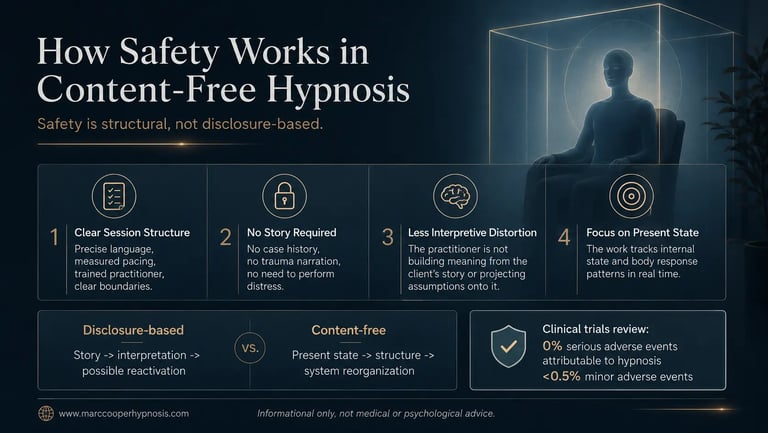
In a content-free context, safety is structural. It doesn't depend on what the practitioner knows about the client's history. It depends on the design of the work itself.
What Safety Actually Means in Content-Free Hypnosis
Safety in clinical hypnosis isn't produced by knowing the content of someone's experience. It's produced by the structure of the session: the precision of the language, the pace, the practitioner's training, and the absence of interpretive overlay.
When a practitioner doesn't know the content, they can't project onto it.
That's not a limitation. That's structural protection.
In content-based work, the practitioner builds a model of the client's internal world from the story they're told. They interpret. They make assumptions. They frame the work around their understanding of what happened. Each of those steps introduces a layer of distortion.
Content-free work removes that layer.
If you're not familiar with how this approach works, the content-free hypnosis guide explains the orientation in more detail.
What Working Without Content Changes About Risk
In conventional psychological settings, safety is framed around disclosure. The more a client shares, the more the practitioner can tailor the intervention.
In practice, this introduces a different set of risks.
When a client describes their history in detail, the practitioner is now working from a second-hand account of an event that occurred inside a particular nervous system at a particular moment in time. That account has been filtered, condensed, and shaped by memory, meaning-making, and social presentation.
The practitioner is working from a model of a model.
Content-free hypnosis sidesteps this entirely. The session is structured around internal states and the body's response patterns, not the narrative surrounding them. The client doesn't need to reconstruct events. They don't need to revisit the affect around them. The session doesn't require them to perform distress to demonstrate that something needs to shift.
Research tracking adverse events across hypnosis clinical trials found the rate of serious adverse events attributable to hypnosis was 0%, with minor adverse events occurring in less than 0.5% of cases.
That isn't surprising. The risk in clinical work rarely comes from the modality. It comes from structural misalignment between the method and the client's actual presentation.
How Clients Experience the Boundary Structure
People often notice that the absence of content-sharing feels unfamiliar at first. There's a pull toward explaining. Toward giving context. Toward making sure the practitioner understands the complexity of the situation.
That pull is real. It's also not required.
The session doesn't need the story to do its work. What the practitioner is tracking is the system: how the client's internal experience organizes, where it holds, what shifts when certain language or attention patterns are introduced. That information is present regardless of the narrative.
This tends to feel strange in the first session.
By the second or third, most clients report the absence of storytelling as a relief. They weren't aware they needed permission to stop explaining.
Why Disclosure-Based Work Carries Its Own Risks
Content-based approaches aren't inherently unsafe. What they do is create a different set of vulnerabilities.
When a session is structured around a client's account of past events, the process of narrating those events can reactivate the internal state associated with them. This is sometimes useful. It can also produce experiences the practitioner did not anticipate and cannot easily navigate, particularly when the material involves trauma, grief, or suppressed affect.
The clinical term for this is retraumatization. It isn't rare.
For people working with anxiety or complex stress patterns, hypnotherapy structured around the current state rather than the history of that state changes the risk profile significantly.
Content-free work doesn't require the client to approach distressing material directly. The session works laterally. The system reorganizes without the client having to narrate what happened, why it happened, or how it felt.
The absence of content is a precision tool. Not an omission.
Four Patterns Worth Recognizing
The client who can't stop explaining. Some people arrive with a comprehensive account of their history ready to deliver. They've told the story many times. It's organized and detailed. In a content-free session, they're redirected early. Not because the history isn't real, but because the session doesn't require it. The resistance to letting go of the narrative is often itself part of what the session will address.
The client who is afraid of going too deep. This comes up regularly. People worry that hypnosis will remove their capacity to control what surfaces. In content-free work, the session is structured around the client's own internal signals. The practitioner isn't driving toward a particular emotional destination. Nothing is being excavated or pulled forward. The direction of the work is determined by the client's system, not the practitioner's clinical goals.
The client who has been reactivated in previous work. A subset of clients arrive having had difficult experiences in talk-based or trauma-focused settings where engaging with past material produced weeks of dysregulation afterward. The content-free structure is not therapeutic exposure. It's not designed to bring the client into contact with what was painful. The session works with the organization of the internal state, not the content of it.
The client working on current-state patterns. For clients whose primary concern is a current-state problem, whether performance anxiety, sleep disruption, or chronic low-level tension, the content-free structure is efficient. There is no history to review. The session addresses what's present now.
When the Architecture Is Absent
When boundaries in clinical hypnosis work are poorly defined, the risks increase without a corresponding increase in precision.
The most common outcome isn't dramatic. It's subtler. The client reports feeling exposed without feeling helped. They leave the session activated rather than settled. They find that revisiting painful material in a clinical setting has reinforced its importance rather than reduced its hold.
These outcomes aren't inherent to hypnosis. They are products of structural misalignment.
Content-free hypnosis addresses this by removing the narrative layer from the design of the work. The practitioner doesn't interpret, project, or reconstruct. The client doesn't explain, justify, or demonstrate.
The session operates below the level of the story.
That's where the real organization happens.
Frequently Asked Questions
What does "content-free" mean in terms of what the client shares? It means the client doesn't share the personal details of their history, and the session doesn't require them to. There is no case history, no disclosure of traumatic events, no narration of what happened. The practitioner works with internal states, not accounts of experience.
Is it possible to have a difficult response to a content-free session? Yes. Any psychological work can produce unexpected internal movement. What's different in a well-structured content-free session is that the practitioner isn't directing the session toward difficult material. If something surfaces, the session can work with it without requiring the client to narrate or analyze it.
Does working without client content leave the practitioner with less to go on? Not in the way most people assume. The practitioner has significant real-time information: the client's current state, their physical presentation, their response to language, how their system is organizing in the moment. None of this requires a history. In many cases, it's more precise than a second-hand account of past events.
What if the client wants to share their history? That conversation happens at intake. In a content-free context, the practitioner explains what information is useful and what the session doesn't require. Clients often share a brief description of the current concern without going into detailed history. That's usually sufficient.
Is content-free hypnosis appropriate for everyone? Not universally. There are presentations where a more integrated clinical approach is appropriate, particularly where there are active psychiatric diagnoses or where the client is under care from a mental health professional. A good practitioner screens for this at intake. For most high-functioning adults presenting with anxiety, stress, grief, or performance concerns, the content-free structure is a good fit.
When the work is designed at this level, the question of safety stops being about disclosure.
This is the work I do when that structure is what the situation calls for.
This article is informational only and not medical or psychological advice.
Address
Based in Los Angeles, CA
Online sessions available worldwide
Contacts

