
Sleepless After Pet Loss: Why It Happens
Sleepless after pet loss is a stress response driven by grief, attachment disruption, and nervous system activation.
PET LOSS
Marc Cooper
2/16/20265 min read
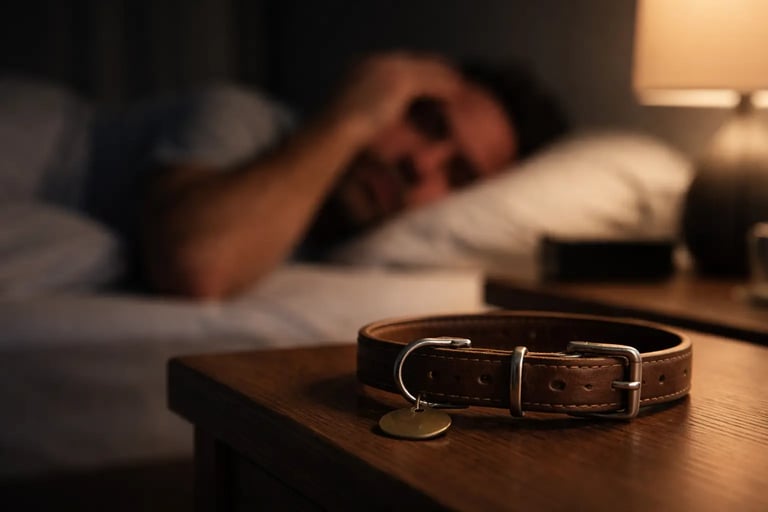
Sleepless After Pet Loss
Sleepless after pet loss refers to persistent difficulty falling asleep, staying asleep, or returning to sleep following the death of an animal companion. It is a grief-based stress response involving attachment disruption and nervous system activation.
Why Sleepless After Pet Loss Happens
Grief alters physiological regulation. When a bonded animal dies, the attachment system is abruptly severed. The brain does not process this as a minor emotional event. It registers it as relational rupture.
Attachment research consistently shows that separation from a primary bond figure activates threat circuitry, including increased amygdala activity and elevated stress hormones such as cortisol. Sleep requires parasympathetic dominance. Grief, especially acute grief, increases sympathetic arousal. The body remains on alert.
A pet is often embedded in daily rhythms. Feeding times. Bedtime routines. Morning walks. Physical proximity at night. When that presence disappears, the nervous system loses predictable cues associated with safety and continuity.
From a conditioning perspective, the bed may also become associated with absence. If the animal slept in the room or on the bed, nighttime becomes a repeated exposure to loss. The brain registers mismatch: the expected presence is gone.
Research on bereavement and sleep disturbance shows that insomnia is common in early grief and may persist if not addressed. The American Academy of Sleep Medicine recognizes stress-related hyperarousal as a primary mechanism in insomnia disorders. Grief functions through similar pathways. https://aasm.org/resources/factsheets/insomnia.pdf
The result is not simply “thinking too much.” It is a regulatory disruption.
How This Feels Internally
People often notice that nights feel longer than usual. Silence becomes louder. The absence of small animal sounds becomes intrusive.
This usually feels like a state of alertness without a clear task. The body is tired. The mind remains active.
Some wake at the time their pet used to move, drink water, or shift position. The system anticipates the cue. When it does not arrive, it jolts awake.
Others fall asleep briefly and wake with images, memories, or sudden awareness that the animal is gone. The moment of remembering repeats.
This tends to show up when the house becomes quiet. Daytime distractions mask the loss. Night removes distraction.
There may also be anticipatory dread of bedtime. The person knows sleep will be difficult. The bed becomes associated with struggle rather than rest.
Why Talking Alone Often Fails
Insight does not automatically regulate physiology.
Someone can fully understand that their pet has died. They can process memories verbally. They can articulate grief clearly. Sleep may still not return.
The issue is not cognitive confusion. It is nervous system activation combined with disrupted attachment cues.
Conventional insight-based approaches rely on narrative processing. Sleepless after pet loss is not primarily narrative. It is regulatory.
Explaining grief does not deactivate conditioned nighttime alertness. It does not restore lost sensory cues. It does not recalibrate the body’s threat response.
This is why some people say, “I understand what’s happening, but I still can’t sleep.”
The system is operating below conscious reasoning.
Structural Implication of a Content-Free Orientation
When a pattern is regulatory rather than narrative, direct verbal exploration is often unnecessary.
A content-free orientation works at the level of the pattern itself, without requiring detailed retelling of events. The focus is structural recalibration rather than story.
For those unfamiliar with this framework, I outline the broader philosophy here: Content-Free Hypnosis Guide
The relevance is simple. If sleeplessness is being driven by activation patterns rather than unfinished conversation, the intervention must address activation patterns.
No detailed recounting is required.
Micro-Anchors of the Pattern
A person lies down and automatically reaches a hand to the side of the bed where the dog used to sleep. The empty space triggers alertness.
Someone wakes at 3:17 a.m., the time their cat used to jump off the bed. They check the floor instinctively, then remember. Sleep does not resume.
A client reports that the house feels normal during the day. At night, the quiet becomes oppressive. They turn on the television just to create noise.
Another describes being exhausted at 10 p.m., then fully awake the moment lights go off. Thoughts are not racing. The body simply will not settle.
These are not character flaws. They are conditioned responses paired with attachment rupture.
Chronification of Sleepless After Pet Loss
If persistent sleep disruption continues, secondary patterns form.
The bed becomes associated with failure. Anticipatory anxiety develops around bedtime. Cortisol increases earlier in the evening.
Daytime fatigue reduces emotional resilience. Grief feels heavier because sleep deprivation amplifies negative affect.
Cognitive performance declines. Concentration weakens. Irritability increases. This can create relational strain.
In some cases, short-term grief-based insomnia evolves into chronic insomnia disorder. The original trigger becomes less relevant than the conditioned sleep struggle.
At that point, the issue is no longer solely pet loss. It is a learned sleep dysregulation pattern layered onto grief.
This is where targeted work for pet loss becomes relevant: Pet loss support
The goal is not sedation. It is system recalibration.
Distinguishing Grief Insomnia From General Anxiety
Sleepless after pet loss has a specific profile.
The trigger is identifiable. The onset closely follows the death. Nighttime cues are linked to the animal’s absence.
Generalized anxiety insomnia tends to involve broader worry themes, future concerns, or persistent hypervigilance unrelated to a single relational rupture.
In grief-based insomnia, sleep may partially improve on nights away from home, where environmental cues tied to the pet are reduced. This contextual shift is informative.
The distinction matters because the intervention target differs. One is attachment-based. The other is threat-forecast based.
The Role of Guilt and Responsibility
Some people replay final moments repeatedly.
They question medical decisions. They reconsider timing. They wonder if they missed symptoms.
Cognitive replay increases arousal. The brain attempts to solve an unsolvable scenario. At night, without distraction, the loop intensifies.
Even when guilt is irrational, the body responds as if a corrective action is possible. Alertness persists because the system believes there is something to fix.
This contributes to sleep disruption independent of sadness.
Environmental Echoes
Sleep is environment-dependent. Sensory cues matter.
If the pet wore a collar that jingled, that absence is noticeable. If they snored, the silence is stark. If they required nighttime medication, the routine is gone.
These small signals functioned as regulatory anchors. Their removal creates sensory discontinuity.
The nervous system prefers predictability. Loss removes it abruptly.
Rebuilding regulation does not mean replacing the animal. It means stabilizing the system in the absence of those cues.
When Sleeplessness Signals Complicated Grief
Most grief-related sleep disruption gradually reduces as the nervous system adapts.
If sleep disturbance remains intense and unchanged for months, with persistent intrusive imagery and inability to reengage with daily life, assessment for complicated grief or trauma-related activation may be appropriate.
The difference is not intensity alone. It is rigidity.
When the system cannot shift states at all, deeper structural work may be required.
FAQ: Sleepless After Pet Loss
Is insomnia normal after losing a pet?
Yes. Sleep disruption is a common physiological response to attachment loss. The nervous system remains activated during early grief.
How long does sleeplessness last?
Duration varies. For some, it reduces within weeks. If it persists and becomes conditioned, it may require direct intervention.
Is this just anxiety?
Not necessarily. While anxiety can contribute, grief-based insomnia is often attachment-driven and cue-specific.
Should I use sleep medication?
Medication decisions require medical consultation. Short-term use may reduce acute distress, but it does not address underlying regulatory patterns.
Why do I wake at the same time each night?
The brain anticipates previous nighttime cues associated with your pet. When those cues are absent, alertness increases at predictable times.
When this pattern is active, this is the work I do.
This article is informational only and not medical or psychological advice.
Address
Based in Los Angeles, CA
Online sessions available worldwide
Contacts

