
Social Overwhelm: Why People Drain You | Marc Cooper Hypnosis
Social overwhelm isn't shyness or introversion. It's a specific pattern of cognitive and emotional overload that gets worse when it's left unaddressed.
SELF IMPROVEMENT
Marc Cooper
5/25/20265 min read
When People Become Too Much: Understanding Social Overwhelm
Social overwhelm is a specific, recurring state in which social contact, social environments, or the anticipation of social demands exceeds a person's current processing capacity. It is not shyness. It is not introversion. It is a pattern, and it tends to intensify over time.
Most people who experience it already know they function differently in groups than they do alone. What they don't always recognize is why it keeps getting worse, why it spills into contexts it never used to reach, or why rest alone doesn't reset it.
Why Social Overwhelm Happens
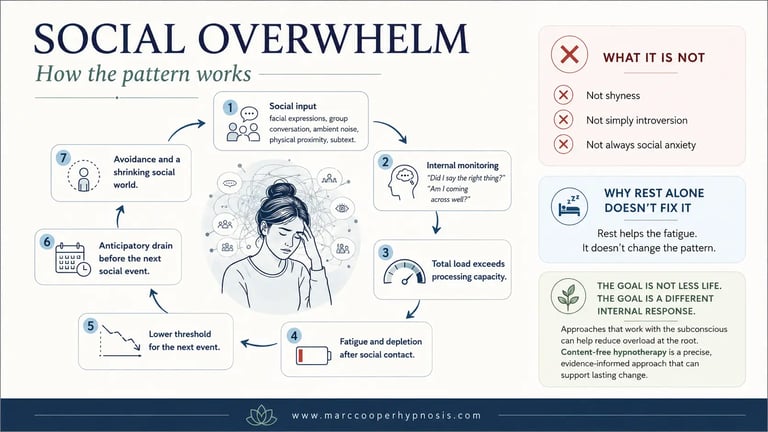
The brain processes social environments differently than it processes solitary tasks. A crowded room, a work event, a family dinner, a group conversation — each of those requires the brain to track multiple simultaneous inputs. Facial expressions, conversational turns, subtext, social roles, ambient noise, physical proximity. These aren't experienced consciously as separate tasks. They arrive as a single compressed load.
Research in cognitive psychology has established that humans have a finite capacity for processing information at any given time. When the volume and complexity of incoming social data exceeds that capacity, the system compensates by increasing effort. More effort means higher fatigue. Higher fatigue means the threshold drops. The next social event requires even more effort to manage the same load.
This creates a compounding cycle. The system doesn't reset to baseline during sleep or a quiet weekend. The elevated effort-response becomes the new default.
There's a secondary mechanism worth understanding. Social environments don't just create cognitive load from external input. They also generate internal monitoring demands. The person tracking whether they said the right thing, whether they came across as competent, whether they spoke too much or too little, whether anyone noticed them go quiet — that internal audit runs in parallel to the social event itself. It doubles the processing requirement.
That internal monitoring layer is where social overwhelm often originates, even before the room gets crowded.
What It Feels Like From the Inside
People often notice the fatigue first. Not tiredness from effort. Something closer to depletion. A kind of hollowness after social contact that feels disproportionate to what actually happened.
This usually feels like wanting to cancel things before they start, not because of specific dread, but because the energy calculation doesn't add up. It tends to show up as a low-grade irritability during social events, even ones a person would normally enjoy. There's often a recognizable drop in warmth or patience that the person doesn't intend and can't fully explain.
The anticipatory dimension is a consistent feature. Social overwhelm rarely stays confined to the event itself. It starts earlier, sometimes days earlier, as a low background processing cost that preloads the drain before anything has happened.
People often misread this as introversion or social anxiety and conclude they need more alone time. Alone time addresses the surface. It doesn't address the underlying pattern driving the overcalculation.
Why Standard Approaches Fall Short
The most common response to social overwhelm is behavioral management. Limit the social calendar. Protect recovery time. Set firmer boundaries. These strategies provide relief in the short term. They don't alter the processing pattern responsible for the depletion.
Talk-based approaches run into a structural problem. Social overwhelm isn't primarily a cognitive distortion. The person usually understands, intellectually, that dinner with friends isn't a threat. Insight into that fact doesn't change the load calculation the system is running. The pattern operates at a level that verbal reasoning doesn't reliably reach.
This is where the framing of hypnotherapy for anxiety becomes relevant. The issue isn't what a person thinks about social situations. The issue is how the system has learned to respond to them. That learned response is what needs to shift.
A Content-Free Orientation
The pattern driving social overwhelm is procedural. It runs automatically. It doesn't require the person to consciously initiate it. They walk into a room and the internal monitoring system activates. They prepare for a conversation and the anticipatory load begins. None of that is a decision.
Procedural patterns don't respond to insight alone. They respond to approaches that work at the level where the pattern is stored. A content-free approach to hypnotherapy doesn't require the person to recount their social history or identify the origin event. The focus is on the pattern itself, not the narrative around it. The system can update without a full excavation of context.
This matters because many people who experience social overwhelm are highly functional. They're not struggling across the board. They're managing well in most areas and running one very expensive subroutine in social contexts. The work doesn't need to be dramatic. It needs to be precise.
How the Pattern Shows Up in Practice
At work events. A person who presents confidently in professional settings finds themselves depleted after the conference reception. They didn't find it aversive. They simply couldn't locate their normal level of engagement, and they needed three days to recover what should have taken one.
In family gatherings. The social roles attached to family dynamics are often older than the person's current identity. Being around family reactivates patterns of self-monitoring that don't operate in other contexts. The overwhelm feels strange precisely because the people are known and the environment is familiar.
In relationships. A partner notices withdrawal after social events. The person experiencing overwhelm often can't explain it clearly. They weren't upset. They aren't angry. They're just running on reserve and have nothing left to give. This gets misread as emotional unavailability. It functions as depletion, not distance.
In anticipatory avoidance. The calendar begins to narrow. Events get cancelled not out of specific reluctance but because the cost-benefit calculation keeps returning the same answer. The avoidance feels rational in the moment. Over time, it functions as a contraction of the social world that the person didn't consciously choose.
What Happens When It's Left Unaddressed
Social overwhelm tends to generalize. Environments that once felt manageable stop feeling manageable. Contexts that previously required minor recalibration start triggering the full depletion pattern. The threshold at which overwhelm activates moves lower.
Over time, the social world shrinks not because of a deliberate withdrawal but because the system is conserving resources. The person often isn't aware of the contraction while it's happening. They're aware of its effects: fewer relationships maintained, less engagement in professional networks, a recurring low-grade sense of isolation that coexists with genuine relief at being alone.
The relief is real. It is also misleading. It signals that the pattern is being managed, not that it's been addressed. A system running an expensive subroutine doesn't need less input indefinitely. It needs the subroutine to change.
Frequently Asked Questions
Is social overwhelm the same as social anxiety?
They overlap but are not identical. Social anxiety typically involves a fear of negative evaluation. Social overwhelm can occur without fear. It's primarily a processing load issue: too much simultaneous input, including internal monitoring, exceeding the system's current baseline capacity. A person can experience both, or one without the other.
Why does social overwhelm seem to get worse with age?
Several factors compound. Years of managed avoidance can lower the threshold for what triggers the pattern. Increased professional and relational responsibilities raise the baseline cognitive load a person is already carrying. When social events are added to an already taxed system, the cost is higher.
Can I have social overwhelm if I enjoy being around people?
Yes. Enjoyment and depletion are not mutually exclusive. Many people who experience social overwhelm are genuinely social in preference. The depletion isn't evidence of not wanting contact. It's evidence of a pattern that runs at a high cost regardless of how the person feels about the interaction.
Why doesn't rest fix it?
Rest addresses the surface-level fatigue. The underlying pattern remains. The next social event reactivates the same subroutine. Until the pattern itself changes, rest functions as maintenance, not resolution.
What kind of work actually addresses this?
Work that operates at the level where the pattern is held, not the level where it's described. Social overwhelm isn't a knowledge problem. The person doesn't need to understand it differently. The system needs to run differently.
When this pattern is active and beginning to narrow the life a person is trying to maintain, this is the work I do.
This article is informational only and not medical or psychological advice.
Address
Based in Los Angeles, CA
Online sessions available worldwide
Contacts

