
Some Problems Resolve Faster When You Stop Explaining Them
Why explanation delays resolution, and what actually changes when a person stops narrating the problem.
CONTENT-FREE HYPNOSIS
Marc Cooper
7/20/20265 min read
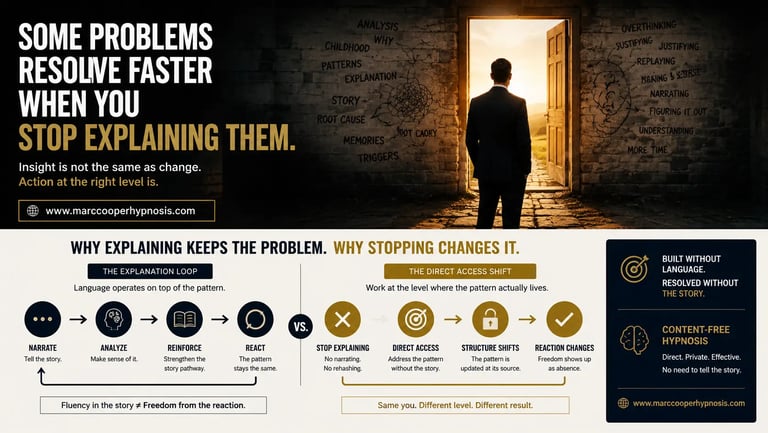

Some Problems Resolve Faster When You Stop Explaining Them
The more precisely someone can explain a problem, the longer they tend to keep it.
This sounds backwards. It isn't. Explanation and resolution are not the same activity, and most people have quietly confused one for the other for years without noticing the cost.
The Assumption Behind Explanation
The cultural belief is simple: understand the problem, and the problem loosens its grip. Name the pattern, trace its origin, articulate the mechanism, and insight will do the rest.
This belief is structurally incorrect.
Explanation operates in language. It requires sequence, causality, narrative order. First this happened, then that, then the pattern formed. This is a useful skill for organizing a story. It is not the same operation as resolving what the story is about.
The problem itself, the one that produces anxiety at 2 a.m. or the flinch before a hard conversation, was not built in language. It was built procedurally, through repetition, association, and consequence, long before most people had the vocabulary to describe it. A three-year-old does not narrate why a particular tone of voice creates a contraction in the chest. The pattern installs without commentary.
So when an adult, twenty or thirty years later, sits down to explain that same pattern in careful, articulate language, they are using a system that had nothing to do with building it to try to dismantle it. The explanation gets sharper. The pattern does not move.
What This Looks Like
People who are very good at explaining themselves are often the ones who struggle longest.
This usually looks like a person who can describe their triggers with clinical accuracy. They know the childhood scene. They know the defense mechanism. They can name the attachment style, the cognitive distortion, the family role they were assigned. Ask them what's wrong and they will give you a coherent, often impressive account.
Ask them if it's better.
This is the moment things quietly tilt. The explanation has become a substitute for change, not a step toward it. It functions almost like a performance of insight, and performance, however sincere, is still language operating on top of a system that does not process language as its native input.
The more the explanation improves, the more convincing the illusion of progress becomes. Meanwhile the reaction, the flinch, the shutdown, the spike, stays exactly where it was.
Why the Usual Approaches Stall Here
Talk therapy, journaling, and introspection all share the same operating system: language. They ask a person to narrate their way toward a different internal state.
For certain problems, that works. Grief that needs to be witnessed. Decisions that need to be reasoned through. Confusion that needs a second perspective. These are genuinely narrative problems, and narrative tools solve them.
But a procedural pattern is not a narrative problem wearing a disguise. It is a different category of structure entirely.
Talking about the pattern can even reinforce it. Each retelling strengthens the neural pathway of the story, not the resolution of the reaction. The person becomes more fluent in describing the problem and no more free of it. Fluency is mistaken for progress.
This is not a failure of the person. It is a mismatch between the tool and the material.
Why Removing the Explanation Changes the Outcome
If a pattern was installed without language, it makes structural sense that it responds to something other than language.
This is not mysticism. It is simply working at the level where the pattern actually lives, rather than one level up, where the pattern gets discussed.
When the explaining stops, and the narrating stops, and the analyzing stops, something becomes available that constant explanation was actually blocking. Not through avoidance. Through directness.
Content-free work operates on exactly this principle. There is no requirement to recount the story, relive the scene, or produce a tidy narrative for anyone, including yourself. The story stays private. The structure gets addressed anyway.
This is not a technique to be taught here. It is simply the logical consequence of recognizing where the problem actually lives.
Who This Is For
This is for people who are done explaining themselves.
Not because their story isn't valid. Because they have already told it, accurately, many times, to therapists, to partners, to themselves at 2 a.m., and the telling has not moved the needle.
It is not for people who need to talk through the experience before they're ready to let it change. That is a legitimate stage for some people, and there is no shortage of places built for it.
It is for the high-functioning professional who can diagnose their own anxiety with more precision than most clinicians, and who is exhausted by how little that precision has bought them. It is for the executive who understands exactly why the pattern started and still reacts the same way in the boardroom. Insight was never the missing piece. It was mistaken for one.
Some people want a better story about the problem.
Others want the problem gone.
This distinction matters more than most people realize before they've lived both sides of it. A person can spend a decade producing an increasingly sophisticated account of why they react the way they do, and still react the way they do. The explanation gets published, refined, workshopped in a hundred conversations. The reaction is untouched by any of it, because the reaction was never listening.
There's a specific kind of fatigue that comes from this. Not the fatigue of not knowing. The fatigue of knowing completely and having it change nothing. That particular exhaustion is a signal, not a personal failing. It usually means the level being worked on is the wrong level, not that the work has been insufficient.
Anxiety that has been mapped, labeled, and rehearsed in explanation for years often responds within a single session once the explaining is set aside, because the structure was never waiting for a better story. It was waiting for direct address.
Grief operates the same way. So does the low-grade suppressed tension that professionals carry without a name for it, the kind that shows up as a short temper, a flat affect, a persistent sense of being one step removed from their own life. All of it was built the same way. All of it responds to the same shift.
The Shift Itself
The shift is not dramatic. It rarely feels like a breakthrough in the moment. It feels closer to a door that was previously locked simply opening, because the thing blocking it, the endless re-explaining, is no longer in the way.
People often expect resolution to feel like a revelation. It rarely does. It tends to feel like absence. The reaction that used to be there, isn't. There is no story attached to why. There doesn't need to be.
This is uncomfortable for people who have built their identity around understanding themselves. Letting go of the explanation can feel, briefly, like losing a form of control. It is the opposite. The explanation was never control. It was circling.
When the pattern becomes undeniable, people usually find their way to me.
Address
Based in Los Angeles, CA
Online sessions available worldwide
Contacts

