
Stages of Grief After Losing a Pet
A precise, clinical explanation of the stages of grief after losing a pet, how they function, and why the pattern often persists.
PET LOSS
Marc Cooper
2/2/20265 min read
What the Stages of Grief After Losing a Pet Actually Are
The stages of grief after losing a pet describe a recurring pattern of psychological and physiological responses that arise when an attachment bond with a companion animal is abruptly ended.
They are not emotional milestones or a recovery checklist. They are adaptive responses produced by an attachment system attempting to resolve absence.
Why Pet Loss Triggers Distinct Grief Stages
Grief after pet loss is driven by attachment disruption, not sentimentality.
Companion animals participate in daily regulation. They anchor routines, provide nonverbal feedback, structure time, and contribute to emotional stability through consistent presence. When that presence is removed, the nervous system loses a stabilizing reference it relied on to predict safety and continuity.
Different systems attempt to resolve this disruption simultaneously. Cognitive understanding registers the loss quickly. Habit memory, emotional expectation, and autonomic regulation update more slowly. Each system responds with its own corrective strategy.
The stages of grief represent these strategies surfacing sequentially and repeatedly. They are not emotions in isolation. They are functional responses to the same unresolved absence.
How These Stages Are Experienced Internally
People often notice sudden internal shifts without clear cause.
This usually feels like moving between distinct internal states rather than remaining in a single emotional tone. One moment the loss feels distant or abstract. Another moment it feels immediate and intrusive.
This tends to show up during routine interruption. Feeding times, walks, returning home, or quiet transitional moments often activate a stage automatically.
Many people report repetitive thought loops, unexpected emotional spikes, or a sense that time has collapsed. These are not failures of coping. They reflect competing systems attempting integration at different speeds.
What Each Grief Stage Represents Functionally
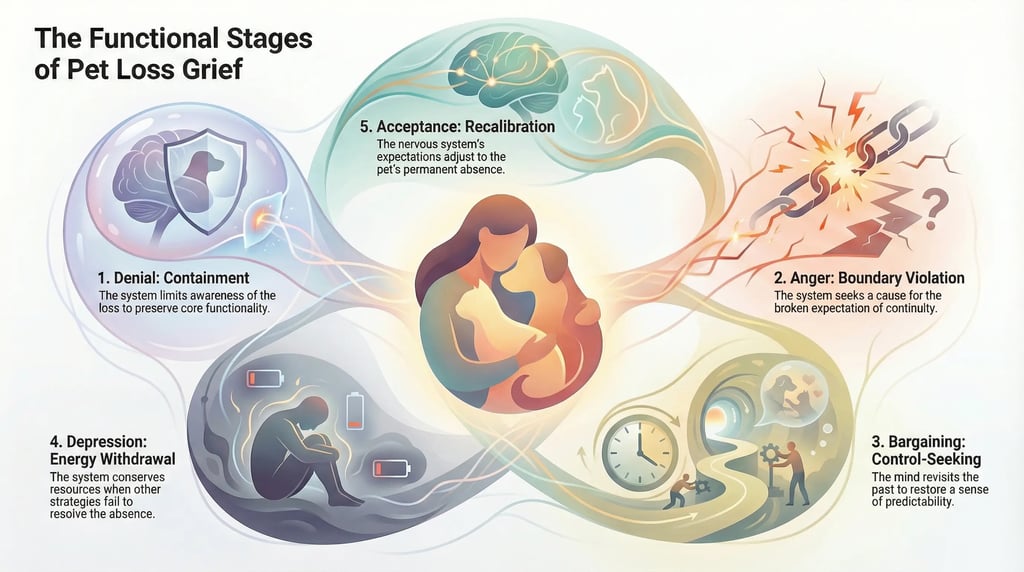
Denial
Denial is a containment response.
The system limits how much of the loss is registered at once. This preserves functionality by narrowing awareness. Emotional blunting or mechanical behavior often accompanies this stage.
Anger
Anger reflects boundary violation.
Attachment systems expect continuity. When that expectation is broken, the system searches for causality. Anger provides direction and energy, even when there is no actionable target.
Bargaining
Bargaining is retroactive control-seeking.
The mind revisits decisions and imagines alternative outcomes. This is not logical problem-solving. It is an attempt to restore predictability after sudden disruption.
Depression
Depression represents energy withdrawal.
Once control strategies fail, engagement reduces. Motivation drops, interest narrows, and the system conserves resources while integration attempts continue internally.
Acceptance
Acceptance is expectation recalibration.
The system no longer anticipates the animal’s presence in daily patterns. Triggers still occur, but they no longer produce the same destabilizing mismatch.
These stages were first articulated in the work of Elisabeth Kübler-Ross. In pet loss, they are best understood as cycling states rather than a linear sequence.
Why the Stages Rarely Follow a Straight Line
The stage model is descriptive, not procedural.
Different neural systems update on different timelines. Emotional memory, habit expectation, and cognitive understanding do not synchronize automatically. As a result, someone can intellectually accept the loss while still experiencing anger or bargaining at a physiological level.
This mismatch produces the experience of “going backwards.” In reality, the system is integrating asynchronously.
Why Talking About the Loss Often Does Not Resolve It
Most conventional approaches rely on narrative processing.
Pet loss grief is not primarily a narrative problem. The mind usually understands what happened. Recounting the story does not update the expectation circuits that still anticipate the animal’s presence.
Talking can organize thoughts, but it often reactivates the same memory loops without altering the pattern that produces them. Insight does not necessarily translate to physiological recalibration.
This is why people frequently report understanding their grief while still feeling trapped inside it.
When Narrative Processing Is Not the Core Issue
When grief operates below the level of conscious story, approaches that do not depend on recounting or analysis become structurally relevant.
The issue is not suppressed content. It is unresolved expectation embedded in automatic response patterns. When those patterns remain active, repetition of the narrative does not complete the process.
A broader explanation of this orientation is outlined in my Content-Free Hypnosis Guide.
How This Pattern Shows Up in Everyday Moments
A person pauses when opening the door, waiting for a sound that no longer comes. The body responds before conscious recognition.
Another prepares two bowls at feeding time, stops midway, and later experiences an unrelated surge of irritation.
Someone else feels stable during the day but wakes at night with a sudden sense that something is missing, without a corresponding thought.
These are not memories. They are expectation mismatches resolving in real time.
What Happens When Pet Loss Grief Becomes Chronic
When the stages of grief after losing a pet remain unresolved, the pattern stabilizes rather than escalates.
Triggers become predictable. Emotional responses flatten or fragment. The system adapts around the unresolved attachment instead of completing integration.
Over time, this can manifest as persistent anxiety, emotional detachment, or avoidance of future attachment to animals. The original loss becomes less conscious but more structurally embedded.
Why Pet Loss Is Often Harder to Integrate Than Expected
Pet loss is frequently minimized socially.
This does not cause grief, but it interferes with resolution. When the experience is invalidated, expression is suppressed while the underlying pattern remains active.
Suppression increases internal cycling. Anger and bargaining often intensify internally without external acknowledgment. This contributes to prolonged integration timelines.
Remembering a Pet Versus Re-Experiencing the Loss
Remembering involves memory retrieval with temporal context.
Re-experiencing involves pattern activation without temporal placement. The system reacts as if the attachment should still be present.
The stages persist when re-experiencing dominates remembering. This distinction explains why time alone does not reliably resolve pet loss grief.
How the Role Your Pet Played Shapes the Grief Pattern
The intensity and duration of the stages correlate with functional role, not affection.
Animals that regulated routine, emotional safety, or identity create deeper disruption when lost. Service animals, working dogs, and long-term companions often produce prolonged cycling.
This is not about attachment strength. It is about system integration.
Research Context on Companion Animal Grief
Research on companion animal bereavement shows physiological and psychological stress responses comparable to human loss, including sleep disruption and cortisol changes. The American Psychological Association summarizes this attachment-based grief response in its published work on bereavement and bonding American Psychological Association.
How This Understanding Informs My Work With Pet Loss
My work with pet loss focuses on resolving the attachment disruption rather than repeatedly processing the narrative.
This approach is described in more detail on my Pet Loss Hypnosis page, where the emphasis is on addressing the pattern that remains active after the loss.
FAQ
Are the stages of grief after losing a pet universal?
They appear in most people, but sequence, duration, and intensity vary based on attachment role and nervous system sensitivity.
Can someone stay stuck in one stage?
People rarely remain in a single stage. More commonly, they cycle between a limited set of unresolved stages.
Why can grief return suddenly after periods of stability?
Because expectation-based patterns can reactivate independently of conscious mood or understanding.
Does acceptance mean the grief is finished?
Acceptance means expectation has recalibrated. Emotional responses can still occur without destabilization.
Is pet loss grief comparable to human bereavement?
From an attachment and nervous system perspective, it can be.
When this pattern is active, this is the work I do.
This article is informational only and not medical or psychological advice.
Address
Based in Los Angeles, CA
Online sessions available worldwide
Contacts

