
Talking It Through Makes Smart People Worse
Why analysis amplifies certain patterns, and why language stops working before resolution begins.
WHEN TALKING FAILS
Marc Cooper
1/15/20266 min read
Talking It Through Makes Smart People Worse
The harder someone tries to explain an internal problem, the more that problem starts behaving like it is being rehearsed instead of resolved.
Most cultural models treat articulation as progress. Name it, frame it, understand it, then it loosens. That model fits some categories of confusion and some categories of conflict. It fails when the core issue is not a lack of insight, but an overdeveloped insight function being used to manage a system that is not designed to be managed by language.
The popular assumption is simple: if something hurts, talking about it should reduce the hurt. If it does not, the person either has not found the right words or has not gone deep enough. That assumption is structurally wrong.
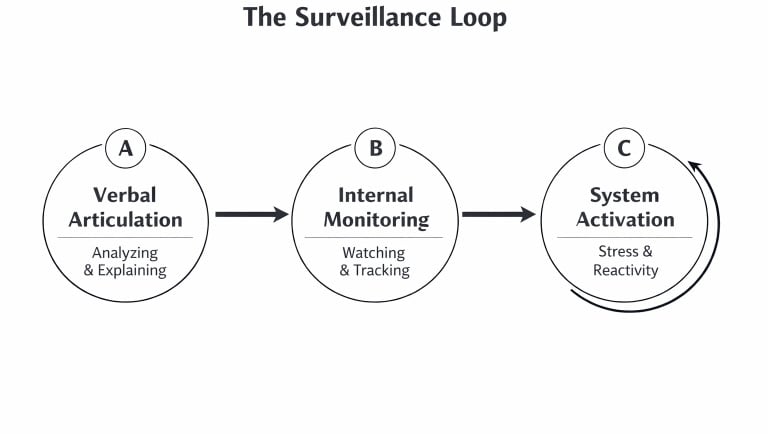
The nervous system does not run on narrative. Narrative is an overlay, a reporting layer. It can describe a pattern with impressive fidelity and still be irrelevant to the mechanism generating the pattern. When that mismatch exists, additional precision does not help. It increases signal, which increases attention, which increases internal monitoring. Monitoring is not processing. Monitoring is surveillance.
Intelligent people tend to confuse these functions because intelligence makes surveillance look like clarity. A clean explanation can feel like control. A coherent timeline can feel like integration. A well-reasoned interpretation can feel like closure. The system rewards the mind for producing these artifacts, and the person learns to treat the artifacts as movement.
This is where “talking it through” turns into a pressure multiplier. The person is not just recounting an experience. The person is reactivating a tracking loop, trying to solve internal intensity by building a better map of the intensity. The act of mapping becomes the activity. The original target quietly disappears.
A common therapeutic framing says the goal is expression. Say what was never said. Feel what was never felt. Many people interpret that as “make the story complete.” So they return to the material again and again, refining it. They update the language, sharpen the causal links, locate the betrayal, define the wound, identify the unmet need. The narrative gets more accurate. The internal state does not improve. Sometimes it worsens.
The reason is not resistance. The reason is architecture.
When a system is overloaded, its priority becomes prediction and prevention. It looks for threat and tries to keep threat from repeating. For a high-functioning person, prediction is built out of analysis. That analysis is fueled by attention. Talking, journaling, and introspection are attention-heavy activities. They do not just bring things up. They also teach the system which signals deserve amplification. If the system already has a bias toward threat scanning, these tools can become reinforcement.
People who operate this way often present as calm and articulate while describing distress with clinical precision. The language is controlled. The tone is reasonable. The story is coherent. The body is not resolved. Sleep stays shallow. Appetite stays off. The mind stays alert at the edges of silence. The person can explain the pattern and still cannot stop it.
This usually looks like one of two modes.
In the first, the person has an internal narrator running constantly, summarizing what is happening and why it is happening. The narrator is not comfort. It is management. The narrator produces interpretations fast enough to keep emotion from becoming fully present. Nothing explodes, but nothing completes. Life becomes a sequence of handled moments.
In the second, the person has already done years of work on the story. The person knows the childhood, the attachment style, the family roles, the formative events. There is no missing context. There is only the same feeling returning under different labels. The labels change. The feeling does not.
This is the moment things quietly tilt: the person starts doubting the self because the mind has done everything it knows how to do and the system remains reactive. That doubt creates another layer to analyze. A clean loop forms. Explain the pattern, notice it persists, conclude there is something wrong, try harder, increase monitoring, increase activation.
Conventional approaches fail at this structure because they assume the bottleneck is meaning. They aim at insight, articulation, and cognitive reorganization. Those aims are not wrong in general. They are wrong for a subset of people and a subset of problems where the bottleneck is not meaning but state.
Talk therapy can be effective when distorted beliefs drive the emotional response, or when relational repair requires language, or when decisions need clarity. It becomes limited when the person’s words are already accurate and the system still reacts as if accuracy is irrelevant.
Journaling can help when thoughts are vague and need ordering. It can backfire when ordering becomes compulsion. Some people write to discover; others write to control. The second group tends to produce pages of insight and then feel more wired, more self-conscious, more watched from the inside.
Introspection can be useful when it reduces avoidance. It becomes corrosive when it is the avoidance. In that case, the mind turns inward not to feel, but to prevent feeling from becoming unmanageable. The person becomes skilled at describing emotion while remaining one step away from it.
Coping strategies often fail here as well, not because they are ineffective, but because they are applied as another form of management. When the core move is “get rid of this state,” every technique becomes a negotiation with the state. The negotiation keeps the state central. The system hears the message: this signal is important, keep tracking it.
At a certain point, language stops being a bridge and becomes a treadmill. More talking does not create resolution, it creates more representation. Representation is not the same as change.
I work with this distinction directly. The work I do is not built around narrative disclosure, and it does not rely on verbal explanation as the main mechanism. I have a clear position on this, and I wrote it plainly in my Content-Free Hypnosis Guide. The essential point is that some patterns are held at a layer that does not respond to better descriptions of the pattern.
When that is true, the requirement is not to say it differently. The requirement is to stop treating the verbal layer as the control panel.
This is not an anti-language stance. Language has its domain. It becomes a problem when it is used to substitute for a different kind of shift. Many intelligent people have spent years refining their internal explanations. They are not lacking vocabulary. They are over-leveraging it.
A practical sign is this: the mind can produce a correct explanation and still feel no relief. Another sign is that talking produces immediate temporary coherence followed by a rebound, often stronger than the original signal. The system stabilizes while speaking, then destabilizes in the quiet. The person begins to fear the quiet, not because of thoughts, but because the body is no longer distracted by the act of explaining.
This is why “processing” can feel like reopening. The brain tags the material as relevant again. It updates the threat file. It scans for more. It remembers more. It anticipates more. The person leaves a session or a journaling spiral with the strange sensation of having done work and yet being more activated. That is not paradox. It is consistent with a system that equates attention with importance.
The cultural answer is to add more effort. Go deeper. Speak longer. Be more vulnerable. Find the root. The structural answer is different: stop feeding a loop that grows by being observed.
There is a category of high-functioning anxiety that is essentially this loop in disguise. It looks like conscientiousness. It looks like insight. It looks like someone who has done the work. It is often just a sophisticated form of internal control that the system refuses to accept as resolution. For people in that position, the most relevant entry point is often not another conversation. It is a reset of state and pressure, the kind of work framed on my Mental Detox.
This is also why some people do not benefit from being asked to recount, relive, and narrate. The retelling can create a second trauma: not the original event, but the repeated activation of the same circuit without completion. The person becomes skilled at surviving the activation while never exiting it.
A non-verbal, content-free frame works here because it does not reward the surveillance system. It does not ask the mind to perform. It does not require the person to become an expert witness for the self. It treats internal patterns as patterns, not as cases to be argued. When the mind is taken off the job of proving and explaining, the system has room to shift without being monitored mid-shift.
That implication tends to irritate people who have built an identity around insight. It should. Insight is valuable. It is not sovereign. There are domains where insight is an observer, not an operator.
This perspective applies to people who can already explain the problem better than most professionals can. It applies to people who have read the books, done the work, and still feel the same internal pressure after the conversation ends. It applies to people who notice that articulation increases self-surveillance, and that self-surveillance increases symptoms.
It does not apply to people who are confused about what is happening and genuinely need clarity. It does not apply to people who need to make decisions or set boundaries and are using conversation to avoid action. It does not apply to people who want a long relational container, or who want to narrate life in detail as the central process.
This is for people who are done explaining themselves. It is not for people who want to talk through the experience.
When the pattern becomes undeniable, people usually find their way to me.
Address
Based in Los Angeles, CA
Online sessions available worldwide
Contacts

