
The Hidden Cost of Holding It Together
Control looks like strength until it becomes identity and the system cannot unwind.
OVERFUNCTIONING
Marc Cooper
1/22/20265 min read


The Hidden Cost of Holding It Together
The person who always holds it together is rarely stable, that person is simply the one who has decided instability is not allowed to exist.
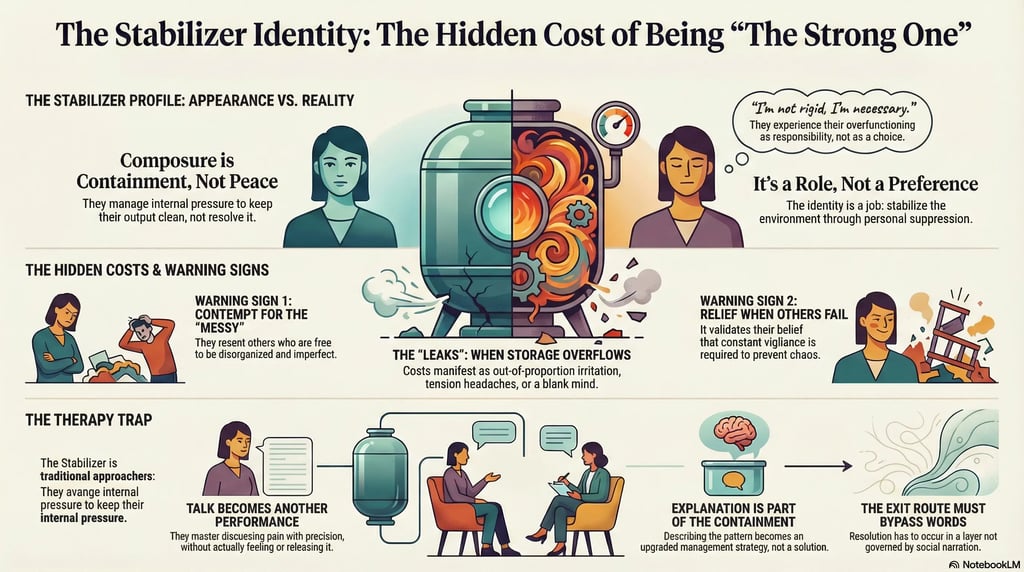
That decision is treated as maturity. Culture rewards it, workplaces promote it, families lean on it, and even “self-awareness” communities confuse it with emotional intelligence. The common assumption is simple: composure is proof of regulation. The structure underneath is different. Composure is often a management layer, not a regulated state. Management is not the same as resolution, it is the ability to keep the output clean while the internal process runs hot.
The mistake is structural because it confuses behavior with load. A system can produce acceptable behavior while carrying unacceptable internal pressure. In fact, the more pressure the system carries, the more it becomes invested in producing acceptable behavior, because any visible failure would force exposure. Holding it together becomes both defense and proof. It is not peace, it is containment.
Containment works until it becomes identity. Once it becomes identity, the system cannot relax without feeling like it is becoming someone else.
People who operate this way do not experience themselves as “controlling.” They experience themselves as responsible. They do not feel rigid, they feel necessary. They do not hear “overfunctioning,” they hear “I’m the only one who will handle it correctly.” The identity is built from repetition: crisis appears, response is competent, everyone calms down, reputation strengthens, internal cost is ignored, cycle repeats.
This usually looks like high reliability in public and private erosion in the places no one sees. Decisions are made fast. Emotions are processed as logistics. Sleep becomes optional. Appetite becomes background noise. Pleasure becomes inefficient. Rest becomes suspicious. Stillness becomes a problem to solve. When the system is quiet, the internal pressure becomes audible, so quiet is avoided.
This is the moment things quietly tilt: the person who “has it together” starts feeling contempt for people who do not. Not because those people are weak, but because they are free to be messy. Contempt is the tell. It is the nervous system trying to justify a contract it can no longer afford.
There is a second tell, and it is uglier: relief when someone else fails. Not because failure is enjoyable, but because it proves a private thesis, that chaos is real and vigilance was always required. This is how the identity protects itself. If composure is the reason everything works, then the cost must be worth it. If the cost is not worth it, then the identity collapses.
Most cultural and therapeutic interpretations frame this pattern as fear of vulnerability, fear of abandonment, perfectionism, or trauma responses. Those may be true, but they are not the structural core. The core is role fixation. Holding it together is not a preference, it is a position. The system has adopted a job: stabilize the environment through personal suppression. It is not “I manage my emotions,” it is “I prevent emotional variance from entering the room.”
That role fixation creates an internal rule set. The rules are not spoken, they are enforced. Do not need help. Do not create inconvenience. Do not require repair. Do not become a problem. Do not be caught. The rules create a narrow band of acceptable internal experience, and anything outside that band is treated as threat, not as information.
The reason the pattern persists is because it works socially. It buys trust, it reduces conflict, it increases status, it creates predictability. People rely on the stabilizer. Over time, reliance becomes dependency. Dependency becomes invisibility. The stabilizer is no longer seen as a person, but as a function. Functions do not get supported, they get used.
This is where the hidden cost becomes measurable. A stabilizer cannot receive care without breaking the role. The role requires competence. Receiving care implies need. Need implies unpredictability. Unpredictability threatens the social contract that made the stabilizer valuable in the first place. So the system chooses the contract over repair.
Inside, the pattern is not constant suffering. It is compartmentalized. That is why it can last for years. The stabilizer learns how to move distress into storage and continue operating. The storage fills slowly. The system adapts by increasing efficiency, increasing tolerance, decreasing feeling, and calling that “strength.”
Then the storage leaks. The leaks are rarely dramatic. They are specific and humiliating. Irritation that is out of proportion. A sudden inability to speak. A blank mind in a moment that should be easy. A body that refuses to sleep. A tension headache that is not about hydration. A pattern of snapping at safe people and performing perfectly for demanding people. The leak does not match the story of competence, so it gets interpreted as personal failure.
At this stage, most conventional approaches fail for structural reasons. Talk therapy relies on narration and meaning-making. Journaling relies on articulation and sequencing. Introspection relies on cognitive access. Coping strategies rely on substitution and repetition. All of that operates in the layer that the stabilizer has already mastered: the verbal, explanatory, socially acceptable layer.
The stabilizer does not need more insight. The stabilizer can explain the pattern with precision. That is part of the trap. The explanation is accurate, and the system still does not change. The stabilizer leaves with better language and the same internal contract.
There is also a deeper mismatch. Language is a social instrument. The stabilizer has used social instruments for years to manage reality. When the solution is delivered in the same instrument, the system treats it as another management task. The person becomes excellent at discussing pain without allowing pain to exist. The discussion becomes a containment upgrade.
That is why “processing” often becomes another performance. The stabilizer learns to sound honest. The stabilizer learns to describe feelings. The stabilizer learns to cry in controlled amounts. The stabilizer learns to say the right things. The internal rule remains untouched: do not become disorganized.
When conventional work does not move the structure, a different implication becomes obvious. Resolution has to occur in a layer that is not governed by social output. The system has to unwind without needing to justify itself. It has to release the role without narrating the reasons, because narration is how the role stays in control.
This is where content-free logic becomes unavoidable. If explanation has become part of the containment architecture, then explanation cannot be the exit route. The exit route has to bypass the narrative supervisor entirely. It has to work beneath the layer that insists on coherence.
I have written the clearest orientation to that logic here: https://www.marccooperhypnosis.com/content-free-hypnosis-guide. The value of that page is not the label, it is the structural claim, some patterns do not respond to more describing because describing is part of the pattern.
The stabilizer identity also tends to come with a specific kind of fatigue: not tiredness, but saturation. The mind is full of unfinished internal movements that never complete because completion would require disorganization. The body carries the remainder. The person becomes “fine” in ways that are increasingly expensive.
That expense is why I point some people toward a simple reset concept, not as self-help, and not as a lifestyle, but as a boundary against accumulated internal noise: https://www.marccooperhypnosis.com/mental-detox. Again, the point is not the branding, the point is that the system sometimes needs subtraction, not interpretation.
This perspective applies to a specific group. It applies to people whose primary identity is reliability, whose default mode is containment, whose competence has become a substitute for intimacy, and whose emotional life has been reduced to what can be handled privately.
It does not apply to people who like talking as an end in itself. It does not apply to people who are still attached to being seen as the strong one. It does not apply to people who want reassurance more than they want structural change. It does not apply to people who treat insight as the finish line.
This is for people who are done explaining themselves. It is not for people who want to talk through the experience.
When the pattern becomes undeniable, people usually find their way to me.

Address
Based in Los Angeles, CA
Online sessions available worldwide
Contacts

