
The Myth of "Feeling Safe Enough to Talk"
Insight lives in one system. Behavioral patterns live in another. Understanding why talking fails at the procedural level.
WHEN TALKING FAILS
Marc Cooper
4/9/20264 min read
The Myth of "Feeling Safe Enough to Talk"
The premise that change requires safety is one of the most quietly accepted errors in the psychology of behavior. Not because safety is unimportant. Because safety and change operate in different systems entirely, and conflating them has produced an industry-wide category mistake.
Most people spend years waiting for the conditions to be right. They want the right therapist, the right framework, the right moment of readiness. They believe that when trust is deep enough and the environment safe enough, the thing that drives their behavior will finally surface and shift.
It does not work that way. Not for the patterns that matter.
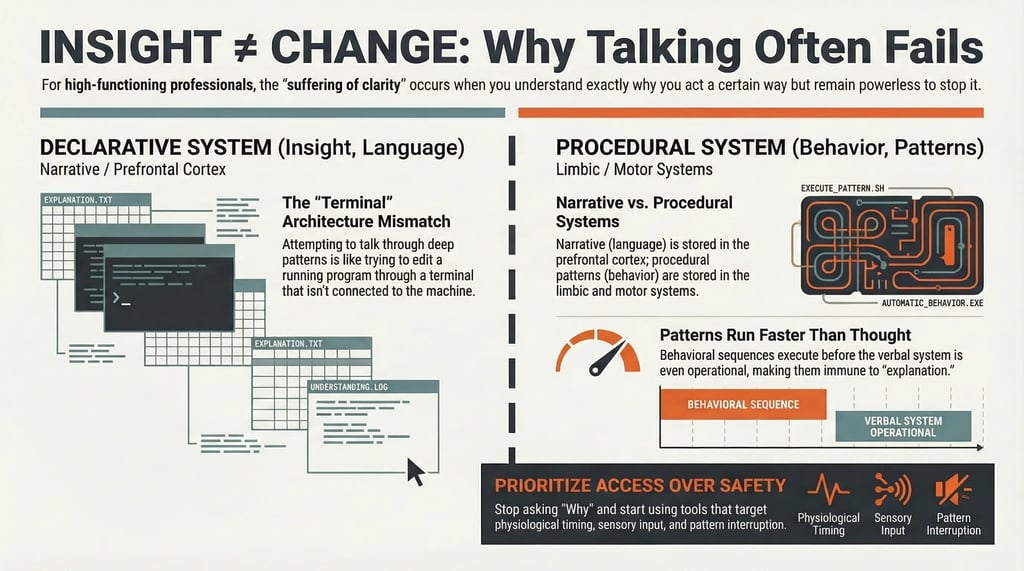
The reason is structural. Language-based approaches rest on an assumption: that the problem lives where language lives, and that talking will therefore access it. For a limited class of issues, this is true. For narrative confusion, for factual misattribution, for beliefs held consciously and reviewed regularly, talk is appropriate. The architecture fits.
But most behavioral patterns are not narrative structures. They are procedural ones. They were built before the verbal system was operational. They run faster than thought, in sequences that do not pass through the prefrontal cortex before executing. They are not stored as stories. They are stored as timing, as physiological signatures, as conditioned sequences in the motor and limbic systems.
You cannot talk your way into those systems. They do not have a verbal interface.
This is not a failure of courage. It is not a failure of honesty or insufficient depth of feeling. People who cannot change through talking are not holding back. They are attempting to edit a running program through a terminal that is not connected to the machine.
The experience this produces is recognizable. Someone can have extraordinary insight into why they behave the way they behave. They can trace the origin clearly. They can name the pattern in real time, watch themselves execute it, and change nothing. The insight sits in one system. The behavior runs in another.
What tends to follow is a particular kind of suffering. Not the suffering of confusion. The suffering of clarity without access. Knowing exactly what is happening and remaining unable to intervene. This is the signature experience of the procedural system operating outside the reach of the declarative one.
The safety requirement, then, is not irrelevant. It is simply misapplied. Safety matters for the work of narrative processing. For reconstructing memory, for building new relational frameworks, for revising consciously held beliefs about the self. These are legitimate objectives and talk is the right tool.
For pattern-level behavioral change, the relevant variable is not safety. It is access. The question is not whether the environment is permissive enough for the person to open up. The question is whether the approach being used has any route into the system that actually holds the pattern.
Most approaches do not. They address the declarative layer competently and assume the procedural layer will follow. It rarely does. The two systems are semi-independent. Insight in one does not propagate automatically to the other.
People who understand this intellectually often find their way to the Content-Free Hypnosis Guide. Not because they are looking for something mystical. Because they have exhausted the talking approaches and recognized the structural mismatch. They are not looking for safety. They are looking for a tool with the right reach.
The procedural system responds to repetition, to pattern interruption, to direct input through sensory and somatic channels. It responds to changes in timing, in physiological state, in the rhythm of experience. It does not respond to explanation. This is not a flaw in the person. It is a design property of the system.
What a content-free, non-verbal approach does is move the work into the layer where the pattern actually lives. No narrative required. No excavation of origin. No requirement that the person understand, explain, or even consciously participate in what shifts. The pattern is addressed at the level of the pattern.
This is not faster because it is better. It is faster because it is correctly aimed.
People dealing with anxiety and trauma at this level often describe years of productive, meaningful therapeutic work that left the core response intact. The talking work was not wasted. The insight was real. The problem was never that they had not processed enough. The problem was that processing and pattern-change are not the same operation.
One organizes narrative. The other rewires procedure. Both are legitimate goals. They are not the same goal, and they do not use the same tools.
This framing applies to people who have done the work. Who have sat in chairs across from thoughtful practitioners and worked genuinely. Who have journaled, reflected, built awareness, developed language for experience that had none before. And who still, despite all of that, find themselves executing the same behavioral sequence in the same circumstances.
The pattern was never in the story. It was always somewhere else.
It is not for people who want to be heard, or who are at the beginning of understanding their experience, or who find meaning in the excavation itself. Those are real needs. This is not the place for them.
This is for people who already understand. Who are no longer confused. Who have run out of use for another conversation about why.
When the talking has done what talking can do, the next question is not what else to say. It is where, exactly, the thing that is not changing actually lives.
Most people already know the answer. They have known it for a while.
Address
Based in Los Angeles, CA
Online sessions available worldwide
Contacts

