
The Problem With "Working Through" Pain
Working through pain assumes language can reach what pain actually is. It usually can't. Here is why that approach stalls.
WHEN TALKING FAILS
Marc Cooper
7/6/20265 min read
The Problem With "Working Through" Pain
The phrase "working through it" assumes pain is a document. Something you can read, annotate, and file away once understood.
It isn't.
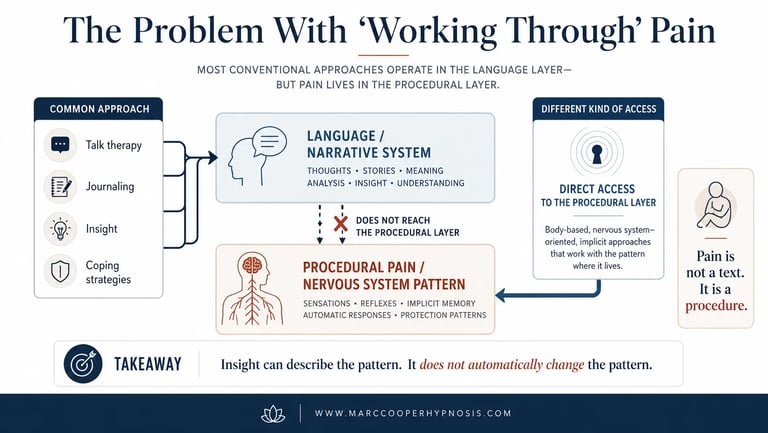
Pain is not a text. It is a procedure. It was installed the same way a reflex was installed: through repetition, through consequence, through a nervous system deciding what to do before the mind was consulted. You cannot edit a procedure by discussing it. You can only run it, again and again, mistaking the running for progress.
This is the first miscalculation. The second is believing that if you understand something clearly enough, your body will eventually agree with your understanding. It won't. Understanding and encoding live in different systems. One is verbal. One is not. A person can narrate their pain with total precision and still flinch at the same trigger a decade later, because the narration was never stored in the part of them that flinches.
Why the Common Interpretation Fails
The cultural assumption is that pain resolves through exposure to language. Talk about it enough, name it accurately enough, and the charge dissipates. This is treated as self-evident. It is not.
Language is sequential. It happens one word after another, processed by a system built for meaning-making, prediction, and narrative construction. Pain, by contrast, is not sequential. It is a whole-body state, assembled instantly, activated as a single unit rather than a string of ideas.
Trying to dissolve a whole-body state with a sequence of words is a category error. It is treating a flood as if it were a sentence. You can describe a flood in exquisite detail. The water does not care.
This is why insight so often fails to produce change. Insight is accurate. It is also structurally unable to reach the layer where the pain is actually stored.
There is a reason this miscalculation persists despite repeated evidence against it. Language produces the sensation of movement. A new sentence feels like a new position. A sharper description feels like progress toward resolution. The feeling is real. The movement is not, because the sentence and the procedure occupy different systems that do not automatically communicate.
Consider how a procedure is built in the first place. It is rarely built through a single dramatic event followed by conscious analysis. More often it is built through repetition so ordinary it barely registers: a hundred small moments of the same dynamic, none individually significant, all of them accumulating into a single automatic response. No one analyzed their way into that response. It was assembled beneath analysis. It will not be disassembled by analysis either.
What This Actually Looks Like
People who operate this way tend to be articulate about their own suffering. They can explain, with real sophistication, where a pattern originated, what triggers it, and why it makes sense given their history. The explanation is usually correct.
This is the moment things quietly tilt. The explanation becomes a substitute for change rather than a route to it. Understanding accumulates. The pattern does not move.
This usually looks like a person who has done years of reflection and can produce a fluent account of their own psychology on demand, while still reacting to the same situations the same way. The account gets sharper. The reaction stays intact.
Eventually the sophistication of the explanation becomes its own kind of evidence, misread as proof that resolution is close. It is not evidence of resolution. It is evidence of a well-developed narrative running in parallel with an untouched procedure.
This tends to show up most clearly under pressure. In calm conditions, the narrative holds. It sounds coherent, even wise. Introduce the actual trigger, the specific person, the specific memory, the specific sensation, and the narrative goes quiet while the old response takes over uncontested. The insight does not disappear. It simply has no jurisdiction in that moment.
High-functioning people are especially prone to mistaking this for something else. Competence in one domain gets mapped onto every domain, including the internal one. If a person can solve complex problems for a living, it seems reasonable to assume the same faculties will solve an internal pattern. The faculties are not interchangeable. Professional competence lives in the deliberate, sequential system. The pattern lives elsewhere.
Where Conventional Approaches Stop
Talk therapy, journaling, and introspection all operate at the level of language. They are excellent tools for meaning-making. They are the wrong tools for procedural change, because they never leave the system where meaning is made.
A person can journal daily for years and become genuinely more self-aware. Self-awareness is real and it is valuable. It is also not the same operation as removing an automatic response. Awareness observes the procedure running. It does not intervene in the procedure itself.
Coping strategies function similarly. They manage the output of the pattern without addressing the pattern's structure. Breathing techniques, reframes, and grounding exercises reduce the intensity of a reaction in the moment. The reaction still fires. It simply fires with a manager standing next to it.
None of this is a failure of effort. People working through pain this way are often working harder than anyone realizes. The structure of the approach is what limits the outcome, not the level of commitment brought to it.
There is also a quiet cost to staying inside an approach that cannot reach the target. Each round of talking, journaling, or reframing that fails to move the pattern reinforces a second belief underneath the first: that the pattern is unusually stubborn, or that something is wrong with the person for not responding to methods that work for others. Neither is true. The method was aimed at the wrong layer. But the person rarely concludes that. They conclude something about themselves instead.
That second conclusion often does more damage than the original pain. It adds a layer of self-doubt on top of a problem that was never a willpower problem to begin with.
I explain the difference between processing and clearing in more detail in the Content-Free Hypnosis Guide, because the distinction matters more than most people are told.
Why a Different Layer Is Required
If pain is encoded procedurally, before language and beneath it, then the intervention has to operate at that same level. Not above it, translating the procedure into insight. Beneath it, where the procedure was actually written.
This is not a matter of trying harder at talking. It is a matter of using a different channel entirely, one that does not require the nervous system to be convinced by an argument first.
The nervous system was never persuaded into the pattern. It was conditioned into it. Conditioning is not undone through debate. It is undone through direct access to the same non-verbal layer where it was formed.
This is the logic, not the method. The method is a separate conversation. The logic is simply this: you do not out-argue a reflex.
Who This Applies To
This is for people who have already done the explanatory work. People who understand their patterns with real precision and are still living inside them. People who are done narrating and want the pattern itself addressed.
It is not for people who are early in the process of understanding what happened to them. That work has its own value and its own timeline.
It is also not for people looking for another framework to talk through. There is no shortage of those. Adding one more will not change what the last dozen didn't.
For anyone dealing specifically with anxiety that has resisted this kind of explanatory work, the mismatch is outlined further on the hypnotherapy for anxiety page.
Pain that has already survived years of accurate explanation is not waiting for a better explanation. It is waiting for a different kind of access.
When the pattern becomes undeniable, people usually find their way to me.
Address
Based in Los Angeles, CA
Online sessions available worldwide
Contacts

