
The Real Reason You Don't Want to Talk About It
The resistance to talking isn't avoidance. It's the system working correctly. Here's why language fails certain experiences entirely.
CONTENT-FREE HYPNOSIS
Marc Cooper
5/21/20265 min read
The Real Reason You Don't Want to Talk About It
The resistance isn't embarrassment. It isn't pride. It isn't even fear of judgment. The resistance is the system working exactly as it was built to work.
Most people misread their own silence. They interpret the reluctance to talk as a character flaw. A deficiency of openness. Proof that something is wrong with them in addition to whatever is already wrong. This interpretation is not only inaccurate. It compounds the problem in a way that makes resolution structurally less likely.
The silence has a function. It is not malfunctioning.
What Gets Called Avoidance Is Usually Something Else
The standard interpretation is that people avoid talking about painful experiences because talking about them is uncomfortable. The cultural prescription follows logically: push through the discomfort, find the words, get it out, begin to heal.
This model assumes that language is the container the experience belongs in. It assumes that if you can articulate something clearly enough, it will lose its charge. That the problem is a lack of expression, not a structural feature of how the experience was encoded in the first place.
That assumption is the problem.
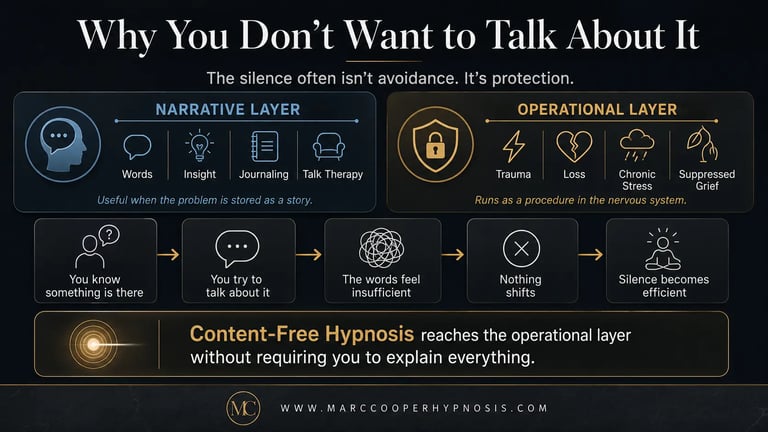
Certain experiences aren't stored the way language works. They are encoded procedurally, in the operational layer of the nervous system, not in the narrative layer where words live. Trying to resolve them through conversation is not a failure of effort. It is a category error. It is like trying to fix a software conflict by writing a letter to the machine.
Language reaches the problem and stops at the surface.
What This Actually Looks Like
People who operate this way often have a very precise internal experience. They know something is present. They can identify that it is affecting them. They can sometimes even name it. But when they attempt to talk about it, something happens that is difficult to describe. The words come out and immediately feel insufficient. Or the words feel accurate but change nothing. Or the act of speaking produces a flatness, an absence of the expected relief, that is more disorienting than the original state.
This is the moment most people conclude they are broken.
They interpret the absence of resolution as personal failure. They think they haven't found the right words yet. They think they need to be more honest, more articulate, more consistent with the talking. So they try again. Different angle. Different relationship. Different therapist.
The mechanism doesn't shift.
And after enough cycles of that, the system quietly but efficiently learns something: talking costs energy and produces nothing. The silence that follows is not avoidance. It is an accurate conclusion.
Why Conventional Approaches Miss This
Talk-based therapy assumes that insight produces change. It operates on the premise that once you understand why you feel what you feel, the feeling reorganizes. This works for some things. For experiences that live in the narrative layer, articulation can recalibrate the meaning assigned to the event. There is real value in that.
But it doesn't work for experiences that bypassed the narrative layer entirely.
Trauma, loss, chronic high-level stress, suppressed grief: these are not stored as stories. They are stored as operational states. Physiological postures the system learned to hold. The body isn't carrying a narrative. It is running a procedure. And procedures are not revised by discussing them.
Journaling doesn't reach this layer. Introspection doesn't reach it. Twelve weeks of articulate, effortful sessions don't reach it, not because the work wasn't real, but because the tool doesn't match the target. A skilled surgeon cannot perform a task with the wrong instrument. The skill is not in question. The instrument is.
What content-free hypnosis addresses is the operational layer directly, without requiring the experience to be translated into language first. This matters because the translation itself is often where resolution is lost.
The System Protects What It Cannot Process
There is something that gets misread as stubbornness or resistance in high-functioning people. The people who have accomplished significant things, who handle complexity at a professional level without difficulty, but who will not go near a specific internal territory.
From the outside, this looks inconsistent. How can someone manage enormous external pressure and still seem almost paralyzed by a particular emotional subject?
The answer is that the cognitive capacity and the procedural state are separate systems. One is extraordinarily capable. The other is running a protection protocol that was encoded at a different level entirely. The intelligence that handles the external environment has almost no access to the layer where the pattern lives.
This is why smart, analytical people often do worse with insight-driven approaches, not better. The intelligence that is supposed to solve the problem is the same intelligence that has already exhausted every verbal and logical route. Giving it more to analyze does not help. It extends the loop.
What interrupts the loop is an approach that works below the level where the loop runs.
The Cost of the Protection
The protection system is not neutral. It requires continuous maintenance.
The energy directed at not going near that territory is not free. It runs in the background of every interaction, every decision, every relationship that gets close to the perimeter. High-functioning people are often skilled enough to contain it so that almost nothing leaks to the surface. The professional competence is intact. The external presentation is intact.
But the containment has a cost.
The precision erodes slightly. The enjoyment of things that should be straightforward becomes slightly effortful. Decisions that used to feel clean now carry a low-grade friction. Relationships that get within a certain proximity of the protected territory get handled rather than experienced. The difference is subtle. But it accumulates.
The upper register of what is possible closes off. Full access requires a kind of internal availability that the maintenance system has partially locked down. High-functioning people often interpret this as aging, or fatigue, or the natural narrowing that comes with responsibility. That interpretation is almost always wrong.
This is what the silence is protecting. Not just the experience. But the entire structure built around it.
For people dealing with anxiety at this level, the pattern is rarely about one discrete event. It is about a system that has been running a long-standing protocol with no off switch and no clear origin story. The anxiety isn't a symptom. It is the maintenance cost made visible.
Who This Applies To
This is for people who have already done the talking. Who are not new to self-examination. Who have invested seriously in understanding themselves and arrived at a point where understanding more does not seem to be the variable.
It is not for people who haven't tried yet. It is not for people looking for a framework to think about themselves with. It is not for people who want to be walked through an emotional process with warmth and reassurance.
The people this applies to already know what the pattern is. They have known for a long time. What they have not found is something that reaches it.
That is a different problem than the one most approaches are designed to solve.
What Follows the Silence
The silence is not permanent. It is a holding pattern, not a destination. The system that created it was built for a specific set of conditions. When the conditions change, the system can change. Not through being talked out of it. Not through deciding differently. Through a direct intervention at the level where the pattern is actually stored.
This is not a redemptive arc. It is not a healing journey. It is a functional correction in the operational structure.
The people who are done explaining themselves, who have nothing left to articulate, who are not looking for insight but for resolution at the level where resolution is actually possible: those are the people who find their way to this work.
When the pattern becomes undeniable, people usually find their way to me.
Address
Based in Los Angeles, CA
Online sessions available worldwide
Contacts

