
When Emotional Intelligence Becomes a Barrier to Change
Why high emotional intelligence can stall real change, and what actually happens when self-awareness replaces transformation.
WHEN TALKING FAILS
Marc Cooper
6/22/20265 min read
When Emotional Intelligence Becomes a Barrier to Change
The more fluently someone can describe their emotions, the less likely they are to change them.
This is not a paradox. It is a mechanism. Emotional intelligence was built as a tool for navigation. Somewhere along the way, for a specific kind of high-functioning person, it became a substitute for movement.
Most people assume emotional intelligence is unambiguously protective. More awareness, more vocabulary, more nuance. The cultural logic says that naming a feeling diffuses it, and that understanding a pattern is the first step toward dissolving it. This logic is not emotionally wrong. It is structurally wrong.
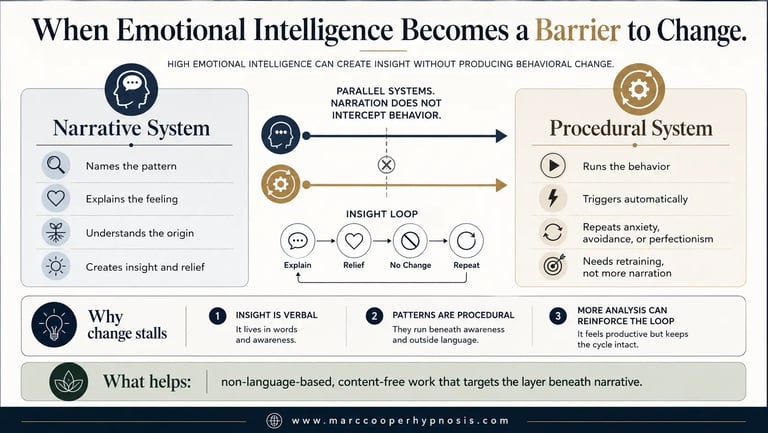
It is structurally wrong because it conflates two separate operations and treats them as one. Identifying a pattern requires language. Interrupting a pattern requires something closer to retraining. The first happens in the part of the mind responsible for narrative. The second happens somewhere narrative was never designed to reach.
Naming a pattern is a cognitive act. Changing a pattern is a procedural one. These operate on different systems, and fluency in one does not transfer to the other. A person can hold a precise, articulate, even elegant account of their anxiety, their avoidance, their relational defaults, and still execute the exact same behavior the next time the trigger appears. The narration runs in parallel to the behavior. It does not intercept it.
Two systems. One observes. One executes.
This is where high emotional intelligence becomes a trap rather than a tool. The insight feels like progress. It produces relief, clarity, even a sense of resolution. But insight is verbal. The behavior it claims to address is not.
People who operate this way tend to be highly self-monitoring. They catch themselves mid-reaction and narrate it in real time. They can identify the childhood origin of a pattern, the cognitive distortion at play, the attachment style underneath it. This usually looks like total self-possession from the outside.
Internally, something else is happening. The narration becomes a kind of performance, running alongside the unchanged behavior rather than altering it. They feel like they understand themselves completely. And they keep doing the thing anyway.
This often shows up in professional settings first. The executive who can diagnose his own avoidance in a board meeting, in real time, with total accuracy, and still avoids the conversation. The founder who names her perfectionism in the same sentence she reinforces it. The pattern is not hidden. It is fully visible, fully narrated, and fully intact.
What makes this particular structure difficult to see from the outside is that it presents as strength. Articulate self-awareness reads as health in almost every professional and social context. Nobody questions a person who can describe their own dysfunction with that much precision. The precision itself becomes the camouflage.
This is the moment things quietly tilt. Understanding becomes the finish line instead of the starting point. The relief of articulation gets mistaken for the relief of resolution. Because the explanation is so precise, it feels earned. Because it feels earned, it goes unquestioned. The behavior, meanwhile, stays exactly where it was.
This is rarely visible to the person experiencing it. It is, however, immediately visible to anyone professionally exposed to enough of these patterns. The fluency is the tell. Someone who can map their own psychology with that level of precision and still describe the same recurring breakdown is not lacking insight. They have an oversupply of it, directed at the wrong layer.
Talk therapy, journaling, and structured introspection share a single mechanism. They operate through language. For someone who is already emotionally intelligent, this approach adds analytical material to a system that is already saturated with it. It does not introduce anything new. It refines the story.
A more articulate account of the problem is not the same as a resolved one.
This is the specific failure point. Conventional approaches assume the obstacle is a lack of clarity. For this population, clarity was never the deficit. The deficit sits beneath language, in procedural and pre-verbal territory that talking was never designed to reach. Adding more words to a system that is already linguistically overdeveloped does not create change. It often produces a more sophisticated description of staying the same.
This is not a failure of effort. It is a category error. The tool and the target operate on different layers of the system, and no amount of refinement closes that gap. People in this position frequently describe a strange fatigue that comes from understanding themselves exhaustively while remaining unable to act differently. That fatigue is diagnostic. It signals that the verbal channel has been maxed out, and that whatever is left to address sits somewhere language cannot directly touch. Many clients arrive describing this exact exhaustion, having already done extensive cognitive work before recognizing the need for a mental detox at a different level of processing entirely.
What a mental detox addresses is not a lack of insight. It is an excess of it, circling the same closed loop without an exit.
There is a layer beneath insight where patterns are actually held. It is procedural, encoded before language was the primary operating system, and largely indifferent to how well a person can describe it. This is why explanation, however accurate, rarely produces behavioral change on its own.
An approach that does not rely on language has a structural advantage here. It is not trying to out-narrate an already over-narrated system. It does not add another layer of explanation to a person who has already explained the pattern from every available angle.
This is not about bypassing insight. It is about recognizing that insight has already done what it can do for this particular structure. What remains is not a knowledge problem.
The logic, not the procedure, is what matters here. Content-free work operates without requiring the client to verbally process anything, which is precisely what makes it viable for people whose verbal processing capacity is not the limiting factor. It does not ask for another explanation. It does not require the story to be told again, refined again, understood from one more angle. For a full explanation of how this distinction works in practice, see the content-free hypnosis guide.
The relief this produces is unfamiliar to people who have only ever experienced relief through articulation. It does not arrive as a new insight. It arrives as the absence of the loop that insight kept generating.
This is not a universal claim. It applies to a specific structure, and it has clear edges.
This is for people who are done explaining themselves. People who have already done the analysis, named the pattern, and traced its origin more than once. People who feel a quiet exhaustion at the idea of doing that work again, more articulately, for the same result.
It is not for people who have not yet done that work. If naming the pattern still feels new, or if talking it through still produces movement, conventional approaches are doing their job. There is no reason to bypass a layer that has not been exhausted yet.
The distinction is not about intelligence. It is about which layer of the system still has room to respond to language, and which layer has already stopped listening to it.
Most people reach this point quietly, without a clear sense of why the usual tools have stopped working. They assume the answer is more analysis, more precision, another angle on the same explanation.
It rarely is.
When the pattern becomes undeniable, people usually find their way to me.
Address
Based in Los Angeles, CA
Online sessions available worldwide
Contacts

