
When Insight Becomes a Defense Mechanism
An analysis of how intellectual understanding functions as a sophisticated barrier to structural change.
WHEN TALKING FAILS
Marc Cooper
1/29/20266 min read
When Insight Becomes a Defense Mechanism
The most sophisticated way to remain stuck is to become an expert on why the problem exists.
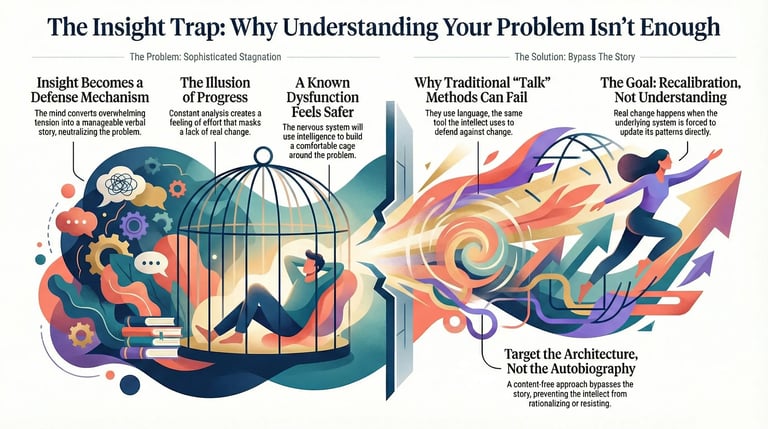
There is a pervasive and almost religious belief in the modern psychological landscape that understanding a pattern is the precursor to dissolving it. This assumption is not merely incomplete. It is structurally flawed. Insight frequently does not facilitate change. Instead, it facilitates the endurance of the status quo by providing the intellect with a sense of progress that never translates to the nervous system. When an individual can name their trauma, categorize their attachment style, and trace their reactivity back to a specific childhood inflection point, they often feel a sense of relief. This relief is frequently mistaken for resolution. In reality, it is the relief of a pressure valve. The internal system has successfully converted an intolerable and non-verbal tension into a manageable verbal narrative. By doing so, the system effectively domesticates the problem. It moves the conflict from the body, where it is dangerous and unpredictable, to the mind, where it can be archived, discussed, and neutralized through analysis.
The structural error lies in the belief that the map is the territory. Culture suggests that if the map is sufficiently detailed, the territory will somehow rearrange itself to match the cartography. This is a category error of the highest order. The narrative of "why" is a post-hoc construction. It is a story the conscious mind tells itself to make sense of a physiological event that has already occurred. The intellect is an observer. It is not the engine. When the objective is accelerated change, feeding the intellect more information is like giving a driver a more detailed manual while the engine is on fire. The manual is accurate, but it is entirely irrelevant to the heat.
The human brain prioritizes the preservation of its current operational state. To the nervous system, a known dysfunction is safer than an unknown solution. Therefore, the system will employ the individual's intelligence to build a more comfortable cage. This creates a state of "sophisticated stagnation." In this state, the person is not avoiding the problem. They are engaging with it constantly. They are reading books, attending seminars, and discussing their "process" with friends. This high-frequency engagement creates a signal of effort that masks the lack of actual movement. The intellect is satisfied because it is busy. The ego is satisfied because it remains the protagonist of a complex and tragic story. Meanwhile, the actual physiological pattern remains untouched. It continues to fire in the background, shielded by the very insights intended to expose it.
I have observed a specific architecture in those who have spent years in the pursuit of self-awareness. These individuals possess a staggering vocabulary for their own limitations. They can describe the genesis of their anxiety with clinical precision. They can explain the mechanical roots of their procrastination or the specific neurological triggers of their anger. Yet, the pattern remains. The internal recognition of this phenomenon is subtle. It usually looks like a person who is doing the work but never actually finishes it. They are perpetually in a state of becoming. They use their intelligence to curate their dysfunction rather than to delete it.
The pattern manifests as a quiet tilt in the internal economy. Information is gathered for the sake of containment rather than for the sake of utility. This is the moment where the intellect becomes a buffer. If a person can explain their behavior, they no longer feel the full weight of its consequences. The explanation acts as a shock absorber. When the internal tension rises, the person immediately reaches for their narrative. They say they are doing this because of a specific past event, and the tension dissipates just enough to allow them to continue the behavior. The insight has become a defense mechanism against the actual experience of the shift. It is a way of staying the same while feeling like one is evolving.
People who operate this way are often the most articulate and the most frustrated. They are trapped in a loop where the very tool they are using to solve the problem is the primary obstacle. They have created a library of their own dysfunction. They spend their time organizing the shelves rather than leaving the building. This is not a failure of character. It is a structural success of the ego. The ego would rather be right and miserable than wrong and free. By maintaining a perfect understanding of the problem, the ego ensures the problem is never truly threatened. It becomes a known quantity. It is predictable. It is safe.
Conventional approaches such as talk therapy, journaling, and standard introspection fail at this specific structure because they are linguistically driven. They operate on the same plane as the defense mechanism. If the problem is that the intellect is using language to buffer against change, then more language only strengthens the buffer. A person can spend years in talk therapy refining their story, but the story is not the source. The story is the byproduct. The linguistic layer of the brain is a late-stage arrival in human evolution. It is not the seat of the automatic responses that govern behavior, fear, or performance. Attempting to talk a nervous system out of a pattern is like trying to rewrite a computer's BIOS by typing a letter in a word processor. The layers are incompatible.
Journaling often serves as an exercise in recursive narrative building. It allows the individual to externalize the defense and make it even more rigid. When a person writes about their feelings, they are, by definition, separating themselves from the feeling. They are becoming the narrator. While this can provide temporary calm, it reinforces the separation between the conscious mind and the underlying physiological pattern. This is why many find themselves writing the same entries for a decade. The mismatch is fundamental. You cannot use the instrument of the defense to dismantle the defense.
Many Mental Detox strategies also fail when they prioritize the "what" and the "why" over the "how." If the intervention requires the individual to understand the content of their issue, it has already invited the defense to the table. The moment the individual starts explaining, the change process stops. The explanation is the exit ramp. It is a way to detour around the actual structural shift and return to the safety of intellectualization. The intellect is a master of the detour. It will happily spend twenty years exploring the scenery of the past to avoid the five minutes of actual reorganization required in the present.
The logic of a non-verbal, content-free approach is that it targets the structure of the pattern instead of the story attached to it. Change does not require an autobiography. It requires a shift in the way the internal system organizes information. When the focus is removed from the narrative, the intellect has nothing to hold onto. It cannot defend what it cannot name. The ego is effectively neutralized when it is given no content to manipulate. This forces the intervention to happen at the level of the mechanism rather than the level of the meaning.
If a person is drowning, they do not need a lecture on the chemical composition of water. They do not need a history of the current that pulled them under. They need to be moved to a different environment. The shift is environmental and structural. It is not educational. By bypassing the content, the intervention bypasses the intellectual shock absorbers that have kept the pattern in place for years. The system is forced to reorganize because it can no longer use its usual narrative shortcuts to bypass the tension. This is where the logic of the Content-Free Hypnosis Guide becomes undeniable. It operates on the premise that the problem exists in the architecture. The architecture does not speak English. It speaks in sequences, tensions, and structural relationships.
When the content is removed, the person is left with the raw mechanics of the experience. Without the "why," the "is" becomes impossible to ignore. The intellect is stripped of its ability to rationalize. It finally allows the underlying system to update. This is not a process of understanding. It is a process of recalibration. It is the difference between reading a map of a mountain and actually standing on the summit. One is a representation. The other is a reality. The reality does not require an explanation to exist. The reality simply is. In this space, the pattern ceases to be a story to be managed and becomes a structure that can be discarded.
This perspective is for a specific type of person. It is for those who are exhausted by their own articulacy. It is for the individual who has figured it all out and yet finds that nothing has actually changed. It is for the person who realizes that their self-awareness has become a sophisticated form of procrastination. This is for those who have reached the end of the road with analysis and have found that the road simply loops back to the beginning.
This is for people who are done explaining themselves. It is not for people who want to talk through the experience. It is not for those who find comfort in the endless "why" or those who want to be validated in their stories. If you are seeking a witness to your narrative, there are thousands of practitioners who will provide that. If you are seeking to maintain your identity as someone who is "working on themselves," this is not for you. This is for the person who is ready to let the story die so that the change can live. It is a blunt and unsentimental transition from being an expert on one’s past to being a functional participant in one’s future. It is for those who value the outcome of freedom over the luxury of understanding.
When the pattern becomes undeniable, people usually find their way to me.
Address
Based in Los Angeles, CA
Online sessions available worldwide
Contacts

