
When Language Interferes With Healing
Insight and self-knowledge can coexist with an unchanged pattern. Here is why language-based approaches have a structural limit, and what that means for actual change.
WHEN TALKING FAILS
Marc Cooper
4/2/20264 min read
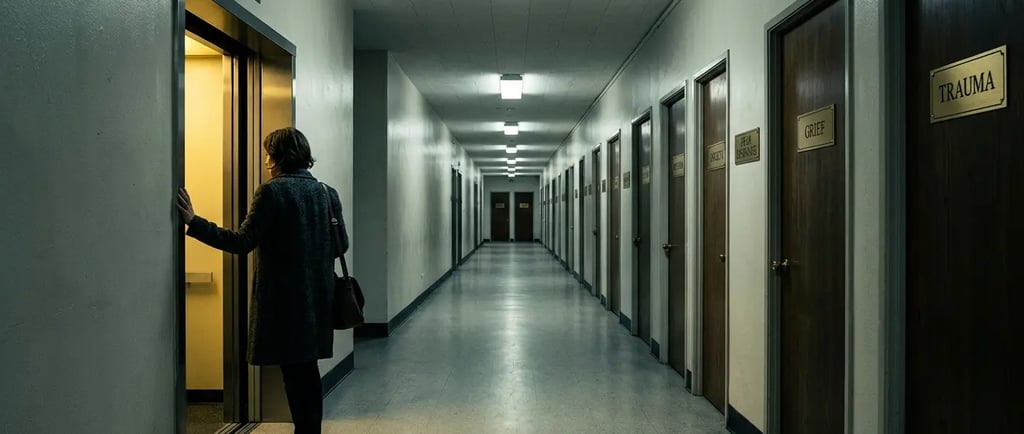

When Language Interferes With Healing
Most people have spent years becoming fluent in their own suffering. They can describe it, contextualize it, trace its origins. They have the vocabulary, the timeline, the narrative arc. And they are still stuck.
That is not a coincidence.
Language is the system we use to organize experience into something manageable. That is its function. It compresses sensation into concept. It turns what is felt into what is known. This is useful for communicating, for planning, for understanding the past in the way a historian understands it. It is not useful for changing the architecture of a behavioral pattern.
The problem is structural. A pattern lives below the linguistic layer. It runs as process, not as proposition. When someone describes their anxiety, they are producing a translation of that process into words. The translation is not the thing. The map is not the territory. And in this case, working on the map does not rearrange the territory.
This is where most approaches fail.
Talk therapy assumes language is the primary medium of change. The patient speaks, the therapist reflects, interprets, or challenges. The hope is that something in that exchange will restructure the internal experience. Sometimes it does. Often it produces insight without change, which is its own particular prison. A person can understand exactly why they react a certain way and still react that way. The understanding and the pattern coexist without conflict.
People who operate this way, the ones who have analyzed themselves thoroughly and still cannot stop the loop, are not failures of introspection. They are the natural product of a method applied to a problem it was not built to solve.
Insight is not leverage. Knowledge of origin is not the same as access to mechanism.
The pattern did not form through language. It formed through experience, through accumulation, through repetition at a level beneath conscious narration. A child does not decide to develop a fear response. There is no verbal commitment made, no contract signed. The pattern simply takes hold at the level where the nervous system records threat and response. That level is not accessible through talking about it.
When the body holds a pattern, the body is the location of the work. Not the cortex, not the narrative, not the reflection. The system that encodes automatic response does not take instruction from the part of the brain composing sentences about itself. This is not a metaphor. This is function.
What happens when someone keeps trying to talk their way through something that does not speak back is a kind of escalation. The more they narrate, the more they reinforce the cognitive architecture around the pattern without touching the pattern. The story becomes more detailed. The understanding deepens. The behavior persists.
This usually looks like someone who is highly articulate about their problem and completely unable to move past it. They have the language. They have the insight. They are still waking up at 3 a.m. with the same dread, still freezing in situations that should feel manageable, still watching themselves do the thing they do not want to do.
There is a point where continuing to talk about the problem becomes part of the problem. Not because speaking is harmful in itself, but because it occupies the space where different work could happen. Language keeps the conscious mind in the director's chair. It keeps the process verbal, linear, controllable. The parts of the system that need to reorganize are not in that chair. They are not following that process. They require a different kind of access.
This is the precise limit of language-based approaches. Not a criticism of them. A limit. A scope boundary.
Content-free work, the kind I describe in detail in the Content-Free Hypnosis Guide, operates outside that limit by design. It does not require narration. It does not ask for the history. It works directly at the level where patterns are organized, not at the level where they are described. The distinction matters because the two levels are not the same system.
A person does not need to explain the water to change its temperature. They need access to the mechanism that controls heat.
The cases that make this clearest are the ones involving grief and trauma, the experiences that collapse language entirely. Someone who has lost an animal companion, or a parent, or a child, often finds that no amount of talking reaches the depth of what they are carrying. Words feel inadequate because they are inadequate. The experience does not live in the language centers. It lives below them, in the part of the system that registers loss as something felt before it is thought. The work that reaches that level is different. It has to be. The pet loss process I work with does not involve constructing a narrative about the grief. It involves working with the structure of the grief itself.
The difference between those two things is the difference between describing a locked room and opening the door.
This perspective applies to people who have tried everything verbal and hit a ceiling. The ones who have done the work, who have the language, who understand themselves and are still circling. It does not apply to people looking for a place to be heard and held.
Those are different needs. Neither is wrong. They require different tools.
The person this is for already knows language has taken them as far as it can.
When the pattern outlasts the explanation, people usually find their way to me.
Address
Based in Los Angeles, CA
Online sessions available worldwide
Contacts

