
When Others Don’t Understand Pet Grief
When pet grief is minimized or misunderstood, the pain can deepen. Here’s how to validate your loss and find private, effective healing options.
CONTENT-FREE HYPNOSISPET LOSS
Marc Cooper
12/29/20255 min read
When Others Don’t Understand Pet Grief (And How to Cope)
There’s a particular kind of loneliness that comes with pet grief.
Not the grief itself.
That part hurts in ways most people reading this already understand.
I’m talking about what happens around it.
The awkward silences.
The well-meaning but cutting comments.
The feeling that you’ve somehow crossed an invisible line by still being heartbroken.
“Are you still upset?”
“It was only a dog.”
“At least you can get another one.”
And just like that… you stop talking.
You nod. You smile. You say you’re fine.
Then you go home and feel it all crash back in.
If this sounds familiar, you’re not weak.
You’re not overreacting.
And you’re not grieving wrong.
You’re experiencing something very real, something known as disenfranchised grief. Grief that isn’t fully recognized, validated, or supported by the people around you.
And that lack of understanding can make the loss feel even heavier.
Let’s talk about why this happens.
And more importantly… how you can cope when others don’t get it.
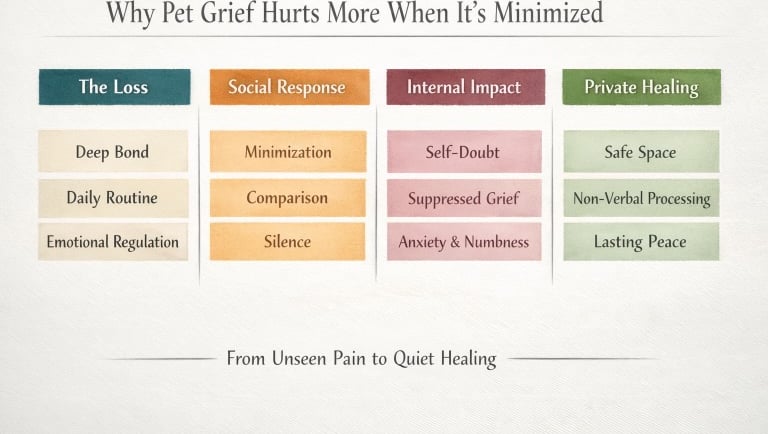
Why Pet Grief Is So Often Minimized
Most people don’t minimize pet grief because they’re cruel.
They minimize it because they don’t understand attachment.
To someone on the outside, your pet may have looked like “just an animal.”
But to you?
They were routine.
Presence.
Comfort.
They were the quiet witness to your worst days.
The one who noticed when your breathing changed.
The one who sat closer when you didn’t ask.
That bond doesn’t fit neatly into social categories.
There’s no universally accepted script for mourning a pet the way there is for mourning a parent, partner, or child. No bereavement leave. No rituals everyone agrees on. No shared language.
So people default to comparison.
They measure your grief against what they believe should qualify as loss.
And when it doesn’t match their internal scale, they downplay it.
Another reason pet grief gets minimized is discomfort.
Grief reminds people of mortality, attachment, and vulnerability.
Pet loss does this in a particularly raw way because it’s tied to unconditional love.
That makes some people uneasy.
So they rush you through it.
They offer solutions instead of space.
Distractions instead of listening.
Replacement instead of acknowledgment.
And if you’re already exhausted from grieving, having to defend that grief can feel unbearable.
The Damage of Feeling Unseen in Your Grief
When grief isn’t validated, it doesn’t disappear.
It turns inward.
You may start questioning yourself.
“Why am I still crying?”
“Why can’t I move on?”
“Is something wrong with me?”
You might begin hiding the photos.
Avoiding certain memories.
Censoring yourself mid-sentence.
Not because the pain is gone.
But because it doesn’t feel welcome.
This is where many people get stuck.
The grief becomes private, contained, and unresolved.
It shows up as anxiety.
As emotional numbness.
As sudden waves that hit when you least expect them.
A smell.
A sound.
An empty spot on the floor.
And because you haven’t felt safe expressing it, you carry it alone.
That’s not how grief is meant to be held.
Validating Your Pain (Even If No One Else Does)
Here’s something I want to say clearly.
Your grief makes sense.
It makes sense because attachment is not measured by species.
It’s measured by connection.
Love doesn’t stop being love because it had fur.
Loss doesn’t stop being loss because it walked on four legs.
If your pet was part of your daily life, your emotional regulation, your sense of safety or routine, then their absence is not small.
It’s structural.
Something fundamental has changed.
You don’t need permission to grieve deeply.
You don’t need to justify the bond.
You don’t need to explain why this hurts as much as it does.
Sometimes the most important validation doesn’t come from others.
It comes from allowing yourself to stop arguing with your own pain.
Instead of asking, “Why am I like this?”
Try asking, “What is this grief asking for?”
Quiet?
Expression?
Relief from the intensity?
That shift matters.
Because once you stop invalidating yourself, healing becomes possible, even if the people around you never fully understand.
Why Talking Isn’t Always the Answer
Many people assume that healing grief requires talking about it over and over.
For some, that helps.
For others, it doesn’t.
You may already know this if you’ve tried to explain your loss and felt worse afterward. Or if you’ve found yourself stuck repeating the same story without feeling any lighter.
Grief doesn’t only live in words.
It lives in the nervous system.
In the body.
In emotional patterns that don’t respond to logic.
This is especially true when your grief feels private or misunderstood.
Talking can feel exposing.
Draining.
Or even re-traumatizing.
That’s why many of the people I work with are relieved to learn that there are ways to heal that don’t require reliving everything out loud.
Private Healing Options When Grief Feels Personal
One approach I use extensively is content-free hypnosis.
It’s exactly what it sounds like.
You don’t have to explain the story.
You don’t have to describe the loss in detail.
You don’t have to justify why it hurts.
Your subconscious already knows what needs attention.
Content-free hypnosis works by creating a safe internal space where your mind can process grief at its own pace, without pressure, without performance, and without explanation.
For many clients, this is a relief.
Especially those who feel:
Tired of talking
Afraid of being judged
Overwhelmed by emotion
Or simply done explaining themselves
Around 90 percent of my sessions are conducted online, which means you can do this work from your own space. Your sofa. Your bed. Somewhere familiar and grounding.
You don’t need to hold yourself together for anyone.
You can learn more about how this works in detail here:
https://www.marccooperhypnosis.com/content-free-hypnosis-guide
If your grief is specifically tied to the loss of a beloved animal, I also work directly with pet loss using a gentle, non-invasive approach that respects the bond you had and the pace you need:
https://www.marccooperhypnosis.com/pet-loss
Some people also find comfort in reading quietly, without having to interact at all. If that feels right, I wrote a book that speaks directly to the experience of loving and losing a pet, without minimizing it or rushing the process:
https://www.marccooperhypnosis.com/forever-in-our-hearts
There is no hierarchy here.
Only options.
You Don’t Have to Be “Over It” to Move Forward
Healing doesn’t mean forgetting.
It doesn’t mean replacing your pet.
It doesn’t mean shrinking the love to make others comfortable.
It means finding a way to carry the bond without being crushed by the pain.
It means allowing the grief to soften, not disappear.
And it means doing that in a way that feels safe for you.
If the people around you don’t understand, that’s painful.
But it doesn’t get to define the legitimacy of your loss.
Your relationship mattered.
Your grief is real.
And you deserve support that meets you where you are, not where others think you should be.
If you’re ready to explore a private, compassionate way forward, you can start by looking through the pet loss support options here:
https://www.marccooperhypnosis.com/pet-loss
No pressure.
No expectations.
Just a space where your grief doesn’t need defending.
Frequently Asked Questions
Why do people minimize pet grief?
Because society often undervalues human–animal bonds and lacks clear rituals for mourning pets. Discomfort with grief also leads some people to rush others through it.
What is disenfranchised grief?
Disenfranchised grief is grief that isn’t socially recognized or validated, which can make the pain feel isolating and harder to process.
Do I need to talk about my pet to heal?
No. Healing doesn’t always require talking. Approaches like content-free hypnosis allow your subconscious to process grief without verbalizing details.
Can online hypnosis help with pet loss?
Yes. Most sessions are conducted online and can be just as effective as in-person work, often feeling safer and more comfortable for grief-related healing.
How long should pet grief last?
There is no timeline. Grief softens when it’s processed, not when it’s rushed.
If you want, your next step doesn’t have to be a big one.
It can simply be choosing a form of support that doesn’t ask you to explain, justify, or minimize the love you lost.
That alone can change everything.
Address
Based in Los Angeles, CA
Online sessions available worldwide
Contacts

