
Why Content-Free Hypnosis Is Safer for Trauma Survivors
Content-free hypnosis avoids revisiting trauma content directly. Here is why that structural difference matters for trauma survivors.
CONTENT-FREE HYPNOSIS
Marc Cooper
7/13/20264 min read
Why Content-Free Hypnosis Is Safer for Trauma Survivors
Content-free hypnosis for trauma survivors is an approach that works with the nervous system's patterning without requiring the client to narrate, relive, or describe the traumatic event itself. The distinction matters. Most conventional interventions ask a survivor to revisit the content of what happened. Content-free work does not.
Why the Body Reacts Before the Mind Processes
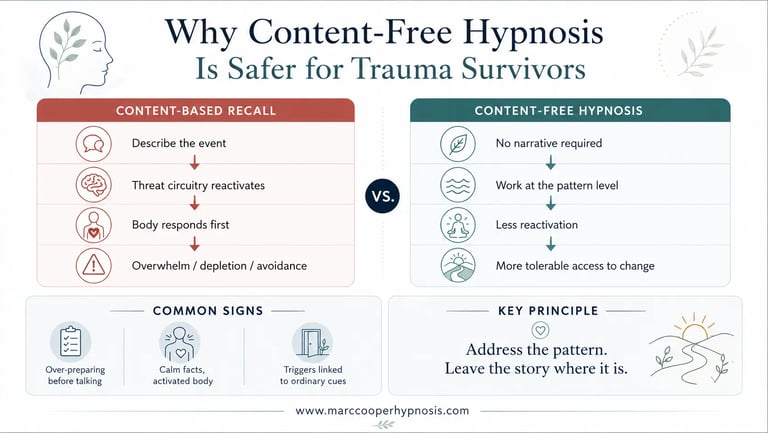
Trauma is stored differently than ordinary memory. It is encoded with heightened emotional and physiological charge, which means recall is rarely neutral. When a survivor is asked to describe the event in detail, the body often responds as if the event is happening again. Heart rate rises. Breathing shortens. The system reacts first and processes second.
This is a mechanical problem, not a willpower problem. Retelling activates the same threat circuitry that formed the memory. Repeated activation without adequate containment can deepen the groove rather than soften it. That is the core reason exposure-based recall carries risk for some individuals, and why timing and method matter as much as intention.
What This Looks Like From the Inside
People often notice a specific bracing before any conversation that touches the event, even indirectly. This usually feels like a mental door closing before a single word is said.
This tends to show up as over-preparation. A client rehearses what they will say, then still leaves the room depleted. The rehearsal itself becomes another exposure.
Some notice a flattening instead. They can describe the facts calmly, almost too calmly, while the physical system tells a different story underneath.
Where Talk-Based Methods Run Into a Structural Wall
Insight-based and talk-based approaches generally rely on narrating content to generate understanding. For many issues, that structure works. For trauma, it asks the survivor to reopen the exact material the system is organized around protecting.
The problem is structural, not personal. Verbal recall requires sequencing, and sequencing requires re-entering the timeline of the event. Even skilled, careful clinicians face this constraint. It is built into the method, not into any individual's competence.
Some survivors tolerate this well. Others do not, and there is often no reliable way to predict which category a person falls into before the work begins.
A Different Point of Entry
A content-free orientation works at the level of pattern rather than narrative. The story does not need to be told for the pattern connected to it to be addressed. This structural difference is what makes content-free work more consistently tolerable for people whose systems are highly reactive to recall.
Nothing about the event needs to be disclosed, sequenced, or relived for the work to proceed. The system responds to structure. It does not require the details.
How the Pattern Shows Up in Daily Life
A client avoids a specific route home because it passes a location connected to the event, without ever consciously naming why.
Another schedules calls for late afternoon because mornings carry an unexplained heaviness tied to the timing of what happened years earlier.
A third finds that certain ordinary sounds, a particular door closing, a specific tone of voice, trigger a full-body response that has nothing to do with the present moment.
None of these examples require the person to explain their history for the pattern to be visible. That visibility is the entry point.
What Happens When the Pattern Is Left Alone
Left unaddressed, trauma-linked reactivity tends to generalize. What once triggered a response to one specific trigger begins to attach to adjacent situations. The nervous system widens its net over time rather than narrowing it.
This is not decline in the dramatic sense. It is quieter. Avoidance increases gradually. The window of what feels tolerable narrows year over year, often without a single identifiable event marking the change.
By the time someone seeks support, the pattern has frequently spread well beyond its original trigger. That expansion is one reason earlier intervention, and a method that does not require reopening the original content, carries structural advantages.
This is where content-free hypnosis differs from approaches built around narrative recall. My work with anxiety and trauma-linked patterns is built around this same structural principle: address the pattern, leave the story where it is.
Published research on hypnosis and posttraumatic treatment notes that hypnotic techniques have long been integrated into approaches used with survivors of assault and other traumatic events, even though rigorous systematic study of outcomes remains limited (Cardeña, International Journal of Clinical and Experimental Hypnosis, 2000). That gap in formal efficacy research is a separate question from the structural one addressed here, which is about method and tolerability, not outcome claims.
FAQ
Does content-free hypnosis require me to describe what happened? No. The approach works with pattern and structure, not narrative content.
Is content-free hypnosis a replacement for trauma therapy? It is a distinct method. Some clients use it alongside other support, others use it independently. That decision depends on the individual case.
Why do some methods require retelling the event and others do not? Different methods are built on different mechanisms. Insight-based approaches generally rely on verbal processing of content. Content-free approaches work at the pattern level instead.
Can this approach still be effective without discussing the trauma directly? The pattern connected to an event can be addressed without the event itself being narrated. The two are structurally separable.
Is this approach appropriate for everyone? No single method fits every case. Appropriateness depends on the individual's history and presentation.
When this kind of pattern is active and content-based methods have not fit, this is the work I do.
This article is informational only and not medical or psychological advice.
Address
Based in Los Angeles, CA
Online sessions available worldwide
Contacts

