
Why High-Functioning People Fail in Therapy
A structural explanation of why insight-based therapy often stalls for high-functioning minds.
CONTENT-FREE HYPNOSIS
Marc Cooper
2/12/20263 min read
Why High-Functioning People Struggle More in Therapy Than Everyone Else
The more capable someone is at organizing their inner world, the harder it becomes to change it.
Most therapeutic frameworks assume that clarity produces resolution. The structure is simple. Identify the feeling, name the belief beneath it, trace the origin, and insight will loosen the pattern. This assumption works tolerably well for people whose internal systems are diffuse or reactive. It breaks down for people whose systems are efficient.
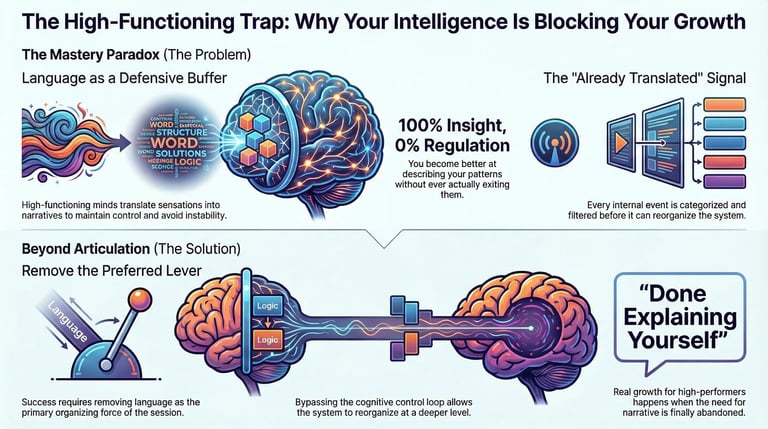
High-functioning people do not lack insight. They generate it continuously. Their nervous systems learned early how to translate sensation into language, emotion into narrative, and disruption into control. This is not repression. It is conversion. Experience is routed upward into cognition before it can register as destabilizing. Over time, this becomes automatic.
Culturally, this gets mislabeled as emotional intelligence or self-awareness. Structurally, it is something else. It is an internal architecture that prioritizes coherence over integration. The system does not aim to feel accurately. It aims to remain operational.
Therapy often reinforces this architecture without meaning to. When the dominant intervention is verbal processing, the system that already overperforms linguistically is given more authority. Insight increases. Regulation does not. The person becomes better at describing the pattern and no closer to exiting it.
People who operate this way usually arrive with a clean story. The timeline is ordered. The language is precise. Affect is present but moderated. There is no obvious resistance. Sessions move quickly. Therapists often experience these clients as motivated, reflective, and easy to work with.
Internally, something else is happening. Sensation is monitored. Emotion is filtered. Responses are selected. There is a constant background process of self-observation that never fully shuts off. This produces composure, competence, and reliability. It also produces a persistent sense that something fundamental never lands.
This is the moment things quietly tilt. Progress is reported. Symptoms shift around the edges. Nothing resolves. The person becomes harder to reach, not because they are guarded, but because everything arrives already translated. There is no raw signal left to work with.
Conventional approaches fail here for structural reasons, not philosophical ones. Talk therapy relies on symbolic access. Journaling relies on reflective distance. Introspection relies on attention. Coping strategies rely on management. Each of these tools presumes that the problem is insufficient understanding or insufficient control.
For high-functioning systems, the opposite is true. The problem is excessive mediation. Every internal event is intercepted, categorized, and placed into context before it can reorganize the system that generated it. Language becomes a buffer. Meaning becomes a bypass.
This is why sessions can feel productive while leaving the core untouched. The person is not avoiding anything. They are executing their primary competence. The therapeutic container becomes another environment where performance is rewarded.
I have worked with enough people like this to recognize the pattern quickly. Executives, clinicians, engineers, creatives with disciplined output. Their lives function. Their minds are sharp. Their internal experience remains oddly unchanged no matter how much is discussed.
What works here is not more articulation. It is the removal of articulation as the organizing force. When language steps back, the system loses its preferred lever. What remains is not chaos. It is unmediated signal.
This is why approaches that do not require explanation or narrative can reach structures that insight cannot. Not because they are mysterious, but because they do not activate the same control loop. When the system cannot perform its usual translation, it has to reorganize at a different level.
I am precise about this distinction because it determines who benefits and who does not. People who need validation, exploration, or emotional literacy should not use this lens. It will feel abrupt and unsatisfying. People who are still discovering what they feel need space to name it.
This perspective applies to people who already know. People who can describe their inner life accurately and feel no relief from doing so. People whose growth stalled not from avoidance, but from mastery.
The logic behind this is outlined in my Content-Free Hypnosis Guide. The emphasis is not on technique, but on why removing content changes what becomes possible.
The same structural issue appears in anxiety work with high-functioning clients. The mind anticipates, prepares, and contains. Symptoms reduce temporarily, then reappear in subtler forms. The anxiety was never unexamined. It was overmanaged. That dynamic is addressed directly on the anxiety service page because explanation is rarely the missing ingredient.
This is not about being resistant to therapy. It is about being too good at it. The person shows up, engages fully, reflects deeply, and leaves unchanged. Over time, this creates a private doubt that rarely gets voiced. If insight is not enough, maybe nothing is.
That conclusion is incorrect. The premise that insight should be sufficient is the error.
I am not interested in making this approach accessible to everyone. It is for people who are done explaining themselves. It is not for people who want to talk through the experience.
When the pattern becomes undeniable, people usually find their way to me.
Address
Based in Los Angeles, CA
Online sessions available worldwide
Contacts

