
Why High-Functioning People Stay Stuck in Pressure They Fully Understand
High-functioning adults often understand their pressure in detail, yet it persists. This article explains why insight fails and why nervous system regulation, not cognition, is required to resolve chronic internal pressure.
CALM UNDER PRESSURE
Marc Cooper
2/14/20264 min read
Why High-Functioning People Stay Stuck in Pressure They Fully Understand
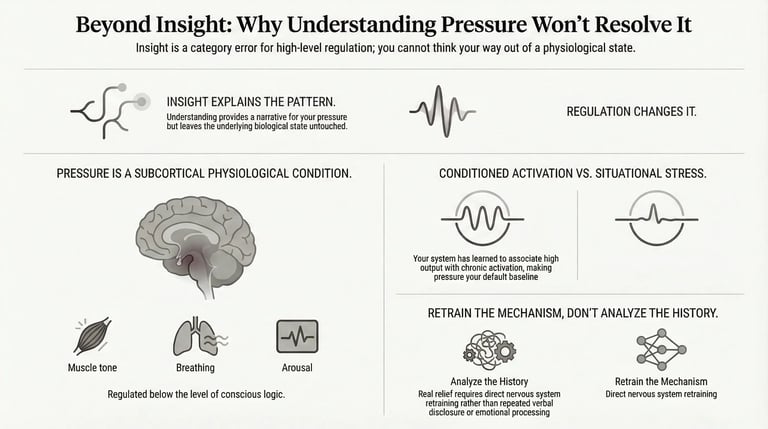
High-functioning people stay stuck in pressure they fully understand because understanding is not the variable that governs internal state. Insight improves explanation. It does not alter baseline nervous system output. When pressure is persistent, comprehension is already complete. What remains unchanged is regulation.
This is not a motivational claim or a therapeutic opinion. It is an observable constraint. You can know exactly why you feel the way you do and still experience the same internal load every day. That outcome does not indicate resistance, avoidance, or lack of effort. It indicates a category error.
If understanding were sufficient, the problem would have resolved when understanding arrived. For this population, it already has.
Understanding Has Never Been the Missing Variable
People who function at a high level tend to notice patterns early. They track cause and effect. They identify triggers, history, and context. They can usually explain their internal dynamics with accuracy and restraint. By the time they seek a different solution, they are not confused.
They know what creates pressure. They know what reinforces it. They know how it shows up in their body and behavior. Many can describe the developmental origin or the professional incentives that shaped it. Some have already articulated this to more than one professional.
None of that changes the pressure.
This is the point most approaches fail to confront directly. They continue to operate as if additional insight will eventually cross a threshold and produce relief. For high-functioning adults, that threshold has already been crossed. The system did not change.
The conclusion is straightforward. Insight is not the missing variable.
Insight Explains the Pattern but Leaves the State Untouched
Insight operates at the level of representation. It organizes experience into a coherent model. It answers the question “why.” That has value. It does not, by itself, answer the question “what state am I in right now.”
Internal pressure is a physiological condition. It involves arousal, muscle tone, breathing patterns, attentional narrowing, and anticipatory readiness. These are regulated subcortically. They do not wait for conscious evaluation.
You can know that nothing is wrong and still feel braced. You can recognize that the threat is hypothetical and still experience urgency. You can understand that the workday is over and still be unable to disengage. This is not a failure of logic. It is the expected behavior of a nervous system running a learned program.
For high-functioning people, cognition often becomes the management layer. It explains the state. It monitors it. It tries to optimize around it. What it does not do is interrupt it. In many cases, it reinforces it by keeping attention on performance, outcomes, and control.
Talking about the pressure often increases self-monitoring. Thinking about it often increases vigilance. Neither necessarily changes the underlying signal.
The Pressure Persists Because It Is Not a Thought Problem
Persistent internal pressure is not generated by faulty beliefs in the moment. It is generated by a nervous system that has learned to associate effectiveness with activation. Over time, activation becomes the default setting.
This produces a specific profile. High output. High reliability. Limited downshifting. Rest without relief. A sense of being “on” even when nothing is required. Pressure becomes ambient rather than situational.
At that point, removing stressors does not solve the problem. Finishing tasks does not solve it. Understanding the origin does not solve it. The system is no longer responding to present conditions. It is executing a conditioned baseline.
This is why cognitive approaches plateau. They operate upstream from the mechanism that is maintaining the state. They may improve self-concept or narrative clarity, but the body continues to produce the same output because nothing has instructed it otherwise.
Pressure Is a Trained Nervous System Output
Internal pressure should be understood as a trained response, not a personal flaw and not a mindset error.
The nervous system learns through repetition and consequence. If high activation reliably precedes success, safety, or approval, the system retains that pattern. It does not evaluate whether the cost is acceptable. It evaluates whether the pattern works.
Once trained, the system does not require conscious endorsement to continue. It runs automatically. This is why pressure can feel involuntary even when it is fully understood. The signal is not asking for permission.
Changing this requires more than insight. It requires direct interaction with the regulatory mechanisms that set baseline arousal. Until those mechanisms are addressed, the pressure will persist regardless of how accurately it is described.
State Change Requires a Different Access Point
When the problem is state, the intervention must operate at the level of state.
This is where content-free hypnotherapy becomes relevant. Not as exploration, not as emotional processing, and not as performance. As a method of accessing and retraining nervous system responses without requiring detailed verbal disclosure or repeated analysis.
For people who value privacy, efficiency, and control, this distinction matters. The work does not depend on recounting experiences or justifying reactions. It does not require emotional exposure as proof of effort. It focuses on altering the pattern the system runs under pressure.
The mechanism is simple in principle. A conditioned response is replaced by a different conditioned response that can be accessed under real conditions. The nervous system learns that high performance does not require chronic activation. Over time, the baseline shifts.
This is not achieved by thinking differently. It is achieved by training differently.
If You Keep Solving This Cognitively, Nothing Will Change
If you continue to treat persistent pressure as a thinking problem, you will continue to apply the one tool that has already reached its limit. You will refine your explanations and maintain the same internal state. You will become more precise and no less activated.
That outcome is not ambiguous. It is predictable.
This work is not for people who want reassurance, emotional processing, or motivational language. It is not for people who want to be told that their pressure makes sense. It is for people who are willing to address the mechanism that produces it.
Understanding brought you this far. It will not take you further.
This is what Calm Under Pressure is designed to address.
Address
Based in Los Angeles, CA
Online sessions available worldwide
Contacts

