
Why Intelligent Clients Perform Healing
High-functioning people often master the language of change without changing. This examines the structural reason insight fails to reach behavior.
OVERFUNCTIONING
Marc Cooper
3/26/20263 min read
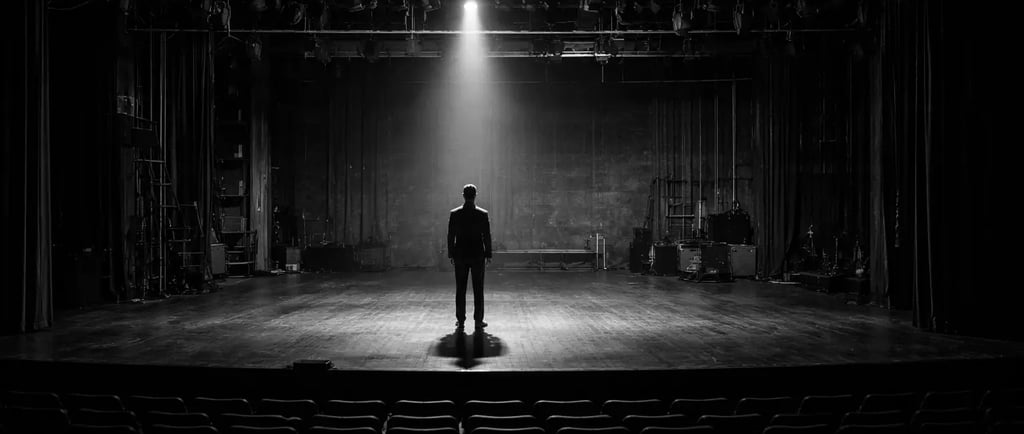
Why Intelligent Clients Learn to Perform Healing Instead of Experiencing It
Performance is the first refuge of the capable mind.
Not deception. Not avoidance in the ordinary sense. Something more precise: the application of analytical intelligence to emotional experience in a way that produces the appearance of change without the fact of it.
This is not a moral failure. It is a structural one.
The person who performs healing understands the vocabulary. They can identify their patterns accurately. They know the cognitive distortions by name, can trace the origin of a behavior to a specific relational wound, can articulate their triggers with clinical precision. They present well in session. They take notes afterward. They follow up.
The behavior does not change.
This is the contradiction that most therapeutic frameworks cannot explain without blaming the person. The assumption embedded in most psychological approaches is that understanding produces change. That insight, once achieved, cascades into different functioning. That naming the wound begins to close it.
It does not work this way. Understanding and functioning occupy different systems. Insight lives in declarative memory, in the prefrontal cortex, in the structures the brain uses for language and narrative. Behavioral patterns live in procedural memory, in subcortical structures that do not respond to reasoning. Talking about a pattern is a different neurological act than running the pattern. The two systems do not automatically communicate.
High-functioning individuals learn this without knowing they have learned it.
They discover, usually through years of intelligent engagement with therapeutic frameworks, that insight produces a specific feeling of resolution. That articulating a pattern well, or being heard by someone who understands it, generates something that feels enough like change to be mistaken for it. The feeling is real. The resolution is not.
This usually looks like a person who has done significant work, who is genuinely committed to their own development, who arrives in any room knowing more about themselves than most people ever learn, and who still operates the same way under pressure they did ten years ago.
The sophistication becomes the obstacle.
Conventional approaches fail here not because they are ineffective with simpler presentations but because the intelligence driving the performance is also the intelligence engaging with therapy. There is no therapeutic framework built on language and narrative that can outpace the analytical capacity of someone who processes information for a living. They will master the framework. They will speak its language fluently. They will derive genuine understanding from it.
The pattern continues beneath the understanding.
Journaling produces self-knowledge without touching function. Mindfulness creates observation without necessarily creating change, and in capable people often produces a more articulate observer of the same behavior. Cognitive reframing works at the level of belief and is often neutralized by counter-evidence the person generates themselves before the end of the session. The therapy designed for the conscious mind meets a very developed conscious mind that absorbs it, categorizes it, and leaves the procedural system untouched.
The reason this is solvable is not philosophical. It is technical.
Procedural patterns do not require narrative access to be restructured. The system that runs the behavior is not the system that talks about the behavior. An approach that works directly with the functional level, without routing through language or requiring the person to narrate their history, does not encounter the performance problem. There is no performance available. The analytical mind is not being asked to do anything, so it cannot generate an intelligent proxy for the outcome. What remains is the actual system, accessible and responsive, without the mediation that obscures it. That is what content-free work operates on.
This matters specifically for the kind of person who has tried the other things with genuine commitment.
Not the person who resisted every intervention. Not the person who arrived with low motivation and left early. The person who did the work, understood the work, and found themselves returning to the same states despite the work. That experience is diagnostic. It points directly to the gap between insight and function, and it tells you precisely where conventional approaches end and a different one becomes necessary.
This is not for everyone.
It is specifically for people who have exhausted the explanatory path. Who have the insight already and are no longer interested in producing more of it. Who recognize that what they are managing is not a knowledge deficit but a functional pattern that has resisted every form of intelligent engagement they have brought to it.
It is not for people who need to be understood before they can move. It is not for people who require a therapeutic relationship built on long-term disclosure. It is not for people who are still searching for the insight that will finally produce the change.
Those needs are legitimate. This is not where they belong.
For people working in high-stakes environments where anxiety and stress patterns operate beneath the level of rational control, the performance problem is particularly costly. The gap between what they know about themselves and how they function under pressure represents direct operational risk. They are managing the behavior instead of changing it. That management has a tax.
When the performance of progress becomes more costly than the prospect of actual change, something shifts.
The work becomes possible.
Address
Based in Los Angeles, CA
Online sessions available worldwide
Contacts

