
Why Relief Without Resolution Always Regresses
Relief and resolution are not the same thing. Most people spend years learning this distinction the hard way.
CHANGE WORK
Marc Cooper
5/28/20265 min read
Why Relief Without Resolution Always Regresses
The problem is not that people feel better. The problem is that feeling better becomes the strategy.
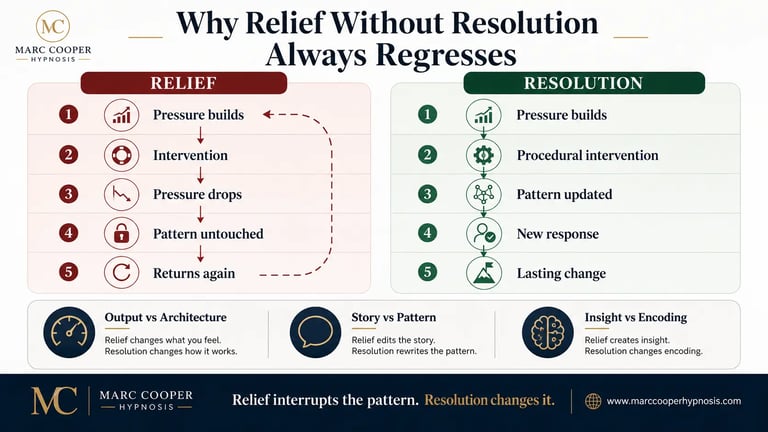
There is a difference between relief and resolution. Most people never examine it. They treat the two as points on the same continuum, as if relief is just early-stage resolution, a preview of the finished state. It is not. They are structurally different outcomes. One interrupts the pattern. The other ends it. And the mistake of confusing one for the other is responsible for more cycles of regression than most people would care to count.
Relief is the temporary reduction in pressure. It is real. It is not imaginary or trivial. But it is produced by the same mechanism that produces withdrawal relief in any other suppression system. Something builds to a threshold. An intervention occurs. The pressure drops. The nervous system reads this as completion and files the episode as resolved.
It is not resolved. The filing is incorrect.
The behavioral pattern that generated the pressure is untouched. It remains encoded at the same depth, operating through the same procedural logic, and will reconstruct the identical pressure state as soon as the inputs return to normal. This is not relapse. It is just the system doing what it was encoded to do.
People who operate this way are not weak. They are not failing to try hard enough. They have often tried harder and with more sustained effort than most. The issue is not motivation or self-awareness. The issue is that the interventions they have applied target the output, not the architecture.
The cultural story about this is wrong.
The dominant framework positions relief as progress. It rewards every step back from the edge as evidence of growth. Journal your way through it. Talk it out until it loses charge. Meditate until the noise quiets. These are not interventions with no value. Some of them produce real relief. The problem is that this gets interpreted as movement through the pattern, when it is actually movement around it.
Walking around a structural fault does not close it. It just extends the time between incidents.
What the framework misses is the distinction between verbal processing and procedural resolution. Most interventions operate at the level of language. They work by changing the narrative: how the experience is interpreted, how it is categorized, how it is explained. The assumption embedded in this approach is that the pattern lives in the story. Change the story, change the pattern.
The pattern does not live in the story. The story is a report generated after the fact by the cortical layer. The pattern lives below that layer, encoded procedurally, running automatically, not because someone is choosing to run it but because that is what encoded patterns do. They run.
This is why insight produces relief and not resolution. Insight is a cortical event. The pattern is a procedural event. They are not in the same layer of the system. One cannot directly rewrite the other.
This usually looks like a cycle people recognize but cannot break.
Something creates acute pressure. They apply an approach that works: a conversation, a period of focused analysis, a specific practice, sometimes medication. The pressure reduces. Life normalizes. The problem appears to be behind them. Three months later, six months later, two years later, the pressure reconstructs. It often reconstructs around a different surface content but feels identical underneath. The emotional signature is the same. The physical sensation is the same. The behavioral pull toward the same old management strategies is the same.
People typically respond to this by concluding that they must not have gone deep enough the first time. So they go deeper. More analysis. More therapeutic excavation. More articulate unpacking. They find more material to work on. The process yields more relief. The cycle continues.
The material they keep finding is real. It is not manufactured or invented. But excavating it is not closing it. This is the moment things quietly tilt: when the depth of self-knowledge increases but the pattern does not change. That divergence is diagnostic. It is pointing at the category error, not at the person's insufficient effort.
Language-based approaches fail at this structure for a specific reason.
They are designed to produce understanding. And they succeed. People who engage seriously with therapy, introspection, or any structured verbal process often end up with exceptional clarity about their own history, their patterns, their triggers, their origins. This is not nothing. But it is information about the pattern, not modification of it.
There is a category difference between map and territory. The verbal account of a behavioral pattern is a map. A detailed, accurate, hard-won map. But the pattern is the territory. Maps do not change the terrain they describe.
The encoded behavioral architecture is not accessible through verbal means. Not because it is hidden or defended or buried in unconscious content that needs to be excavated. Because verbal processing and procedural processing are different systems. You cannot update a procedural file with a verbal instruction. The file does not read language.
You can explain in exhaustive detail why a door is stuck. The explanation does not unstick the door.
What tends to happen instead is that the explanation becomes a management system of its own. The person develops a sophisticated internal narrative about the pattern. When the pattern activates, they apply the narrative. This produces enough cortical override to generate relief. And the cycle, already described, begins again at a slightly higher floor of self-knowledge.
This is where the content-free approach becomes relevant, not as an alternative therapy but as a different category of intervention entirely. It does not work by producing better understanding. It does not require narrating the experience or analyzing the history. It operates at the procedural level, which is the level where the pattern was encoded. That is not a philosophical preference. It is a structural requirement.
The reason insight-based work produces relief and not resolution is not that it is inferior. It is that it is addressing a different layer of the system than the one maintaining the problem. The layer producing the relief is real. It is just not the layer producing the pattern.
The people this applies to have usually already been through enough cycles to know the shape of it.
They are not coming to this fresh. They have often done years of productive work on themselves. They can articulate the pattern in precise detail. They understand where it came from. They have developed considerable skill at managing its effects.
And it keeps coming back.
That specific combination, high self-awareness, strong analytical capacity, persistent recurrence, is not a sign that the problem is deeper or more complex than average. It is a sign that the problem is procedural and the tools in use are verbal. The mismatch is between the tool and the layer. Not between the person and the possibility of resolution.
The relief they have produced is real. The understanding they have built is real. Neither of those things is the problem. The problem is treating them as destinations rather than as information pointing elsewhere.
People who are still in the early phase of figuring this out are not the right fit for this work. They need to complete the verbal phase first. That phase has real value. This work is for people who have already extracted everything language-based processing has to offer and arrived at the same persistent pattern.
There is no judgment in that statement. Some problems require a different entry point, and the verbal path is a legitimate route to discovering that.
Relief will always feel like resolution. That is the nature of pressure reduction. The nervous system is not interested in accuracy. It reports the state, not the cause.
This is why regression is not a failure of commitment or willpower. It is what happens when a procedural pattern receives verbal treatment. The relief is real. The resolution is incomplete. And the system, running the same encoded logic it has always run, will reconstruct the same state as soon as conditions permit.
Resolution requires intervening at the level of encoding.
When the pattern becomes undeniable, people usually find their way to me.
Address
Based in Los Angeles, CA
Online sessions available worldwide
Contacts

