
Why Self-Awareness Never Resolves What Keeps Returning
Self-awareness maps the pattern. It does not end it. Here is why the loop continues, and what that means.
WHEN TALKING FAILS
Marc Cooper
3/12/20264 min read
Why Self-Awareness Alone Never Resolves the Thing That Keeps Returning
Knowing exactly why you do something does not stop you from doing it.
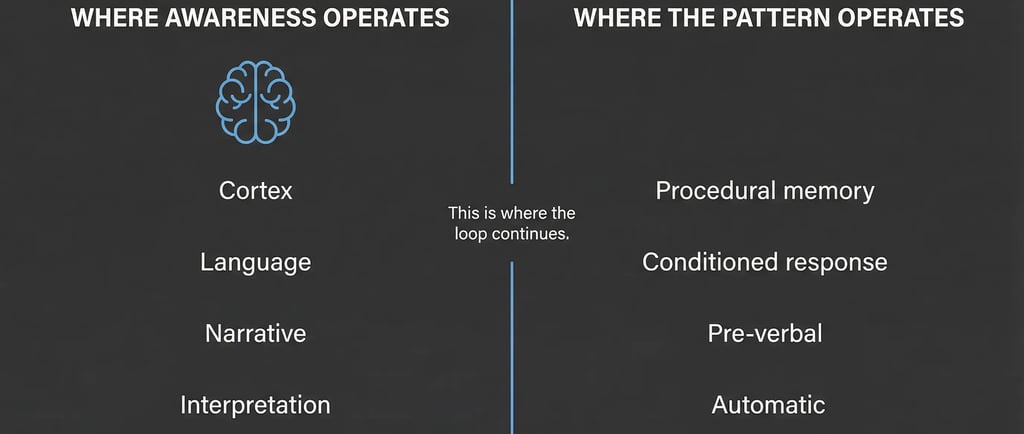
This is the part nobody explains clearly. The therapeutic model spent decades conflating insight with change. They are not the same operation. They do not even share the same address in the brain. Understanding the origin of a pattern is an intellectual event. The pattern itself is not intellectual. It runs somewhere older, faster, and almost entirely outside language.
Self-awareness is a map. Maps do not alter terrain.
I have worked with people who can narrate their psychology with clinical precision. They know their attachment style. They can trace the specific childhood architecture that produced the behavior they want to stop. They have done the journaling. They have done the therapy. They have identified the wound with a kind of forensic accuracy.
The pattern continues anyway.
This is not a failure of insight. The insight is correct. The assumption underneath it is wrong.
The assumption is that understanding something changes it. That if the mind can see the mechanism clearly enough, the mechanism will cease to operate. This assumption is structurally false, and acting on it is why people spend years in self-reflection without resolution.
Here is the actual structure. A recurring pattern exists because it was installed at a level below conscious processing. It was not a decision. It was a survival calibration. The nervous system, under conditions of threat or overwhelm, made an adjustment. That adjustment became automatic. Over time, it became identity-adjacent. It started to feel like just how things are.
Self-awareness addresses none of that.
When someone develops insight into this kind of pattern, they are adding a new layer of cognitive processing on top of a system that does not require cognitive engagement to operate. The pattern runs independently. The awareness watches it run. Two parallel tracks. No intersection.
This is why the loop continues after therapy. After the retreat. After the breakthrough conversation. The person feels different for a period of time. The context has shifted. The insight is fresh. Then the conditions that trigger the pattern return, and the pattern executes as designed. It does not care about the insight. It was never processing language to begin with.
People who operate this way often describe a specific and recognizable exhaustion. It is not the exhaustion of ignorance. It is the exhaustion of knowing. Of watching yourself move through the same sequence again, in real time, with full awareness, unable to interrupt it. That particular experience, clear-eyed and unable to stop, is usually the moment someone realizes that understanding was never the mechanism they needed.
Conventional approaches fail here for a structural reason, not a quality reason. Talk therapy operates in language. Journaling operates in language. Introspection operates in language. These are all tools that engage the cortex, the part of the brain that narrates, interprets, and categorizes experience. They are powerful tools for building a coherent story about what happened.
The pattern does not live in the story.
It lives in the procedural memory. In the somatic habits. In the conditioned responses that fire before language has time to load. By the time you are aware of what is happening, the first several steps of the sequence have already executed. The insight arrives after the fact. Always. That is the design of the system, not a flaw in the person.
Awareness cannot reach what it cannot precede.
What works at this level is not more understanding. It is not deeper excavation of meaning. It is direct intervention at the level where the pattern actually operates, which is pre-verbal, pre-symbolic, and inaccessible to the kind of reflective processing most people have been trained to use. This is not a call for more sophisticated introspection. More refined self-analysis cannot close the gap. The gap is categorical, not dimensional.
A non-verbal approach works for a specific reason. It bypasses the cognitive layer entirely and communicates directly with the system that runs the pattern. No narration required. No excavation of history. No reframing of meaning. The pattern is accessed where it lives, and changed there.
There is nothing wrong with self-awareness. It is accurate. It is often hard-won. It is genuinely useful for understanding context. What it cannot do is operate at the level where the change needs to happen. Using it to resolve a pre-verbal pattern is not a mistake of effort. It is a category error.
This distinction matters for a specific kind of person. People with significant cognitive resources are the most likely to over-rely on insight because insight has solved almost every other problem they have encountered. It is their primary instrument. The pattern is one of the few things that does not yield to it, and that non-yielding can feel, over time, like a personal inadequacy rather than a structural mismatch.
It is not inadequacy. It is instrument selection.
The content-free hypnosis model I use does not ask people to explain the pattern, understand it further, or even name it. That is not evasion. That is precision. The work happens at the level where the pattern operates. Language is not required because language was never the entry point.
This applies to recurring anxiety, to suppressed grief, to behavioral loops that self-awareness has mapped but never resolved. For people who recognize the anxiety and trauma architecture described here, the continuity of the pattern despite full insight is the clearest signal that the approach needs to change.
This is for people who are done adding more understanding to something that has already been understood.
It is not for people who believe one more conversation will be the one that breaks it.
When the gap between knowing and changing becomes undeniable, people usually find their way to me.
Address
Based in Los Angeles, CA
Online sessions available worldwide
Contacts

