
Why Smart People Plateau Right Before a Breakthrough
If you understand your patterns but still can't move through them, the insight itself may be what's holding you in place.
WHEN TALKING FAILS
Marc Cooper
4/23/20263 min read
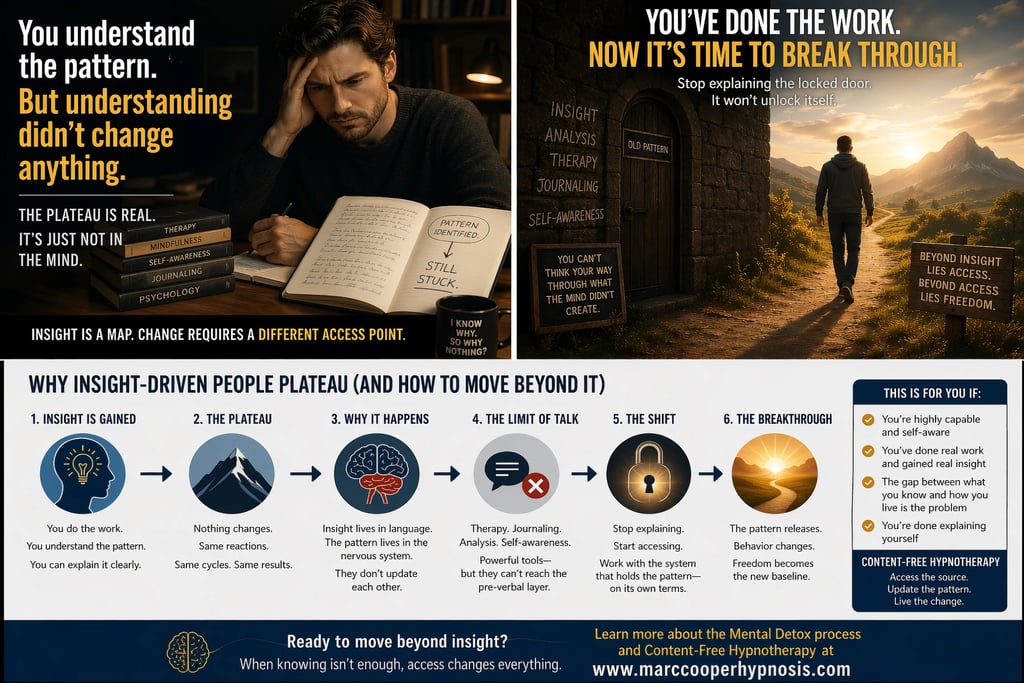

Why Insight-Driven People Often Plateau at the Exact Moment They Should Break Through
The most sophisticated trap is the one built from accurate information.
People who do the work — who read, reflect, journal, meditate, complete therapy — often arrive at a precise and correct understanding of why they operate the way they do. They can name the pattern. They can trace it back to its origin. They can explain it in clinical terms if pressed. And then they stay exactly where they are.
This is not confusion. It is something more stubborn.
The assumption is that understanding a pattern dissolves it. That insight functions like solvent. That the moment a person can articulate what is happening inside them, the hold that thing has will loosen.
It does not work that way.
Insight and resolution operate on different systems entirely. One lives in language. The other does not. What the brain can narrate and what the nervous system is running are not the same process, and they do not update each other automatically.
This matters because the intervention that produced the insight — the therapy, the journaling, the self-analysis — keeps being applied after it stops being relevant. People who are highly analytical by nature are particularly susceptible to this. The tool that got them to the edge of the plateau is the same tool they keep using to try to get off it.
People who operate this way are not lacking information. They have more than enough. What they have is a behavioral and physiological pattern that was never stored as information in the first place.
This usually looks like a very clear internal map with no change in terrain. The person knows exactly where they are stuck. They know how they got there. They know what it costs them. They can talk about it with precision and emotional intelligence. The situation itself remains unchanged.
This is the moment things quietly tilt. The insight stops functioning as progress and starts functioning as a substitute for it.
The pattern underneath insight is not irrational. The nervous system is doing exactly what it learned to do. It runs the same procedure because the procedure was encoded as reliable. That encoding did not happen through reflection. It happened through repetition, through early experience, through events that bypassed conscious reasoning entirely. It has no interest in what the conscious mind has concluded since.
Talk-based approaches are not ineffective. They are effective at what they were designed for. They produce insight. They create frameworks. They surface material. What they are structurally limited in doing is updating the part of the system that never spoke. Cognitive understanding does not reach the procedural layer. The map cannot redraw the territory.
Journaling runs into the same wall. So does most introspection. These are language-mediated processes. They are applying a verbal tool to a pre-verbal structure. The structure does not respond to the tool. It has no mechanism for doing so.
At the point of plateau, continuing with insight work is the equivalent of explaining a locked door to itself. The explanation is accurate. The door stays locked.
The implication is that access to the pattern has to come through a channel the pattern actually responds to. Not through more analysis. Not through a better framework. Not through increased self-awareness. Those are entries into the language layer. The behavioral structure lives somewhere else. Access to it requires bypassing the interpretive mind, not consulting it further.
This is not a philosophical position. It is a functional one. When someone has reached the ceiling of what insight can do, the only productive move is to work in a domain where insight is not the mechanism. That means working directly with the system that holds the pattern, on its own terms, without narrating it into compliance.
Content-free hypnotherapy operates in that domain. Not because it avoids insight. Because it does not require it.
This applies to a specific type of person. Highly capable. Analytically oriented. Someone who has done real work on themselves and arrived at real understanding. Someone for whom the gap between what they know and how they live has become the central problem.
It does not apply to people who are still at the beginning of understanding their patterns. It does not apply to people who want to keep examining the history. It does not apply to people who are looking for a framework that helps them manage what they carry rather than change the underlying structure.
The Mental Detox work I do is specifically structured for people who have exhausted the explanatory layer. Not people in crisis. Not people beginning the process. People who already know. People for whom knowing has not been enough.
This is for people who are done explaining themselves. It is not for people who want to talk through the experience.
When the gap between insight and resolution becomes undeniable, people usually find their way to me.
Address
Based in Los Angeles, CA
Online sessions available worldwide
Contacts

