
Why Talking It Through Makes Smart People Feel Worse
For high-functioning people, “talking it through” can intensify rumination and self-surveillance. Here’s what’s structurally happening, and what changes it.
CONTENT-FREE HYPNOSIS
Marc Cooper
1/8/20267 min read
Why Talking It Through Makes Smart People Feel Worse
People don’t usually admit this out loud, even to themselves.
Talking about it makes it worse.
Not because the problem is unspeakable. Not because you’re “avoidant.” Not because you “don’t want to feel.”
It gets worse because the act of verbalising becomes another layer of the problem.
Intelligent, self-aware people often learn this the hard way. They do what they’re supposed to do. They analyse. They articulate. They trace patterns. They name triggers. They build coherent narratives. They put language around the thing.
And then they walk away from the conversation feeling more agitated, more stuck, more self-conscious, and less clear than before.
That isn’t a contradiction. It’s a predictable result of using the wrong tool on the wrong class of problem.
The assumption that keeps people trapped
Most people inherit a simple model:
If you can explain it, you can manage it.
If you can understand it, you can resolve it.
If you can put it into words, you can put it down.
That model works for a certain category of problems. Practical problems. Decision problems. Interpersonal misunderstandings. Situations where missing information is the bottleneck.
But a lot of human suffering is not caused by missing information.
High-functioning people rarely lack insight. They lack exit velocity.
They don’t need more accurate descriptions of what’s happening. They need a different relationship to what’s happening, one that does not require constant verbal monitoring to maintain itself.
When “talking it through” fails, it’s not because the person isn’t doing it properly. It’s because the premise is wrong: the problem is not primarily linguistic.
When language becomes self-surveillance
A specific type of person tends to be hit hardest by this.
Competent. Reflective. Used to solving. Used to thinking clearly under pressure. Usually good at reading themselves and other people. Often the one others rely on.
For this person, language is not just communication. It’s a control system.
That control system has benefits. It can keep life functioning. It can prevent impulsive choices. It can produce stable external outcomes.
But it has a cost.
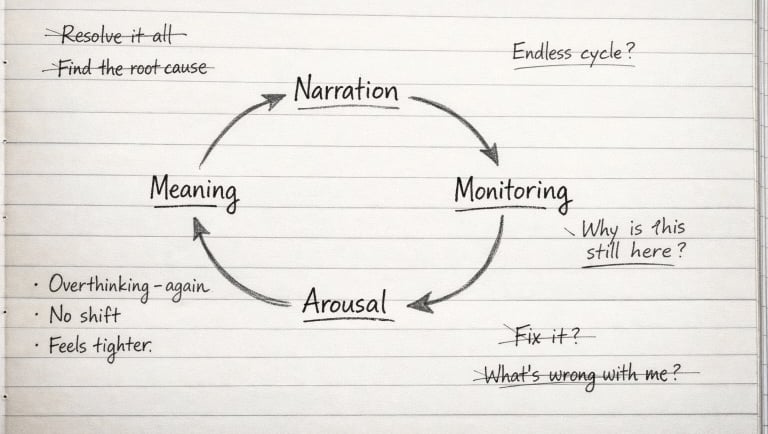
When the inner system is dysregulated, the same language faculty that produces clarity in business or crisis produces self-surveillance internally. The mind starts monitoring itself like an operator watching a machine that has become unpredictable.
The internal dialogue shifts from “What’s true?” to “What’s happening to me right now?”
Then to “Why is it still happening?”
Then to “What does it mean that it’s still happening?”
Then to “What’s wrong with the way I’m trying to fix it?”
That loop can be sophisticated. It can use correct psychological vocabulary. It can sound mature. It can even sound “healthy.”
But structurally, it’s still a loop.
The problem is no longer the original stressor, loss, fear, or memory.
The problem is the system’s ongoing attention to itself.
And attention is not neutral. Attention amplifies.
Internal recognition without the performance of insight
There’s a particular experience that repeats across clients who live in their heads.
They can describe the issue cleanly. Sometimes too cleanly.
They can map the origin story.
They can say what it “connects to.”
They can explain why they react the way they do.
They can do all of that and still feel the same body-level reaction. Sometimes worse.
So the talking becomes more detailed.
More precise. More exhaustive. More recursive.
The goal quietly shifts from “resolve this” to “get to the perfect explanation that finally makes it stop.”
That perfect explanation doesn’t arrive, because the nervous system does not calibrate itself based on verbal completeness.
There are moments when the person notices the absurdity of it. A sense of being trapped in an intelligent cage. They can see the mechanism, and yet the seeing does nothing.
This is when many people start blaming their “resistance” or their “fear of feeling.”
That’s usually inaccurate.
What’s happening is closer to cognitive over-engagement, a constant attempt to regulate a physiological and emotional state through narration, evaluation, and meaning-making. The person is trying to think their way out of a state that isn’t maintained by thinking.
Why “processing” often turns into rumination
There’s a line between processing and rumination. Most people assume the difference is attitude, optimism, or “mindset.”
It isn’t.
The difference is whether the thinking creates movement or creates grip.
Rumination is not just “thinking a lot.” It’s repetitive cognition with no new behavioural options generated. It’s a closed circuit. It often carries the emotional tone of problem-solving, but it doesn’t produce solutions. It produces tighter identification with the problem.
For high-IQ, high-insight people, rumination can look like:
ongoing narrative revision
constant triangulation of meaning
searching for the “real” underlying issue
monitoring micro-shifts in mood
trying to remove uncertainty through explanation
repeated conversations that change nothing, except the level of fatigue
Talking can reinforce this because talking feels like action.
It creates the illusion of progress because words move, sessions end, people nod, and conclusions are reached. But internally, the system often leaves with more material to analyse, not less.
The mind receives a signal: this subject requires continued attention.
So it continues.
The failure mode of conventional “talking it through”
The usual advice is to keep expressing. Keep unpacking. Keep exploring. Keep connecting dots.
Again, that advice is not universally wrong. It’s simply incomplete.
There are predictable failure modes when the person is already over-articulated:
Verbal clarity replaces internal resolution
The person can say it better each time. That becomes the scorecard. They become fluent in their own distress.
The story becomes the identity
Not in a dramatic way. In a subtle way. The narrative becomes the organising principle for how they interpret their reactions. The story becomes the reference point they check against.
Repetition trains the system
Repeatedly describing a threat, loss, or shame state can rehearse it. Not because the person is weak, but because repetition is one of the ways the nervous system learns what matters.
The self becomes a project
The person starts relating to themselves as something to fix. That stance creates distance from their own experience, and distance keeps the monitoring online.
Conversation becomes performance
Even with a good listener, part of the mind is tracking how it sounds. Am I being coherent? Am I overreacting? Am I explaining this correctly? That meta-layer increases self-consciousness, which increases arousal.
These are not moral failures. They’re mechanical outcomes.
If the mind is already using language as a control system, more language often produces more control effort, more monitoring, and more internal noise.
Why a different approach works, without needing to be explained
At a certain point, the most effective work is not more description.
It’s a shift in where the work is happening.
The issue isn’t that you can’t talk about it. The issue is that talking recruits the same cognitive systems that are already over-recruited. It keeps the person in the role of narrator, analyst, and supervisor.
A different approach changes the operating conditions. It allows change without requiring the mind to stay on the problem as a running commentary.
That’s the central distinction. Not “belief.” Not “positive thinking.” Not replacing one story with a better story.
It’s removing the requirement that conscious narration must be present for the system to reorganise.
That’s also why “content free” work matters for certain people. When the work does not require disclosure, explanation, or repeated retelling, it prevents the familiar pattern: verbalisation as rehearsal. If you want the cleanest statement of what that means in my practice, it’s here: https://www.marccooperhypnosis.com/content-free-hypnosis-guide
I’m not interested in collecting a perfect account of your life. I’m interested in changing what keeps running it.
The quiet reason intelligent people get stuck
There’s an uncomfortable truth underneath a lot of high-functioning stagnation.
The person is not stuck because they don’t know enough.
They’re stuck because knowing has become the method of control.
Control is not inherently bad. But when control becomes the primary relationship to internal experience, the system stays vigilant. It keeps checking. It keeps scanning. It keeps interrogating.
And vigilance blocks resolution.
Resolution tends to happen when the system no longer needs to scan for the problem.
If every attempt to improve involves analysing how improved you are, you don’t exit. You just measure your position in the maze.
What this perspective applies to, and what it doesn’t
This applies when:
you are functional on the outside and internally overactive
you can articulate your patterns clearly and still feel dominated by them
conversations give temporary relief but worsen the loop later
insight is abundant but internal quiet is rare
you are tired of understanding without change in state
This does not apply when:
the core issue is practical avoidance of a concrete decision
the main deficit is missing information or lack of interpersonal communication
the person is emotionally disconnected and genuinely cannot name basic internal states
there is active crisis requiring immediate stabilisation and safety measures
Some people do need words first. Some people need structure, boundaries, or direct problem-solving. Some people need to tell the truth they’ve refused to tell.
But there’s a distinct group who have already done that. Repeatedly. Fluently. Intelligently.
For that group, more language is not the next step. It’s the trap.
A quiet call to action that doesn’t need persuasion
If you’ve recognised yourself here, the next move is not to talk harder.
It’s to stop using narration as your primary lever.
I built Mental Detox for people who are done rehearsing their own minds and want a cleaner internal baseline without turning their life into an ongoing explanation. If that’s the problem you’ve been trying to solve, start there: https://www.marccooperhypnosis.com/mental-detox
FAQ
Why do I feel worse after talking about my problems?
Because talking can increase rumination, self-surveillance, and physiological arousal. For high-functioning people, verbal processing can act as rehearsal rather than resolution.
Is “talking it through” the same as rumination?
No. Processing can produce new options and reduced grip. Rumination is repetitive cognition that reinforces attention to the problem without creating movement.
Why does insight not translate into feeling better?
Because insight is cognitive. Many symptoms are maintained by learned physiological and attentional patterns. Those patterns do not reliably change through explanation alone.
What does “content free” mean in your work?
It means the work does not require detailed disclosure or repeated retelling of events. It reduces rehearsal and keeps the mind from turning the process into narration. More detail here: https://www.marccooperhypnosis.com/content-free-hypnosis-guide
Who is this approach best suited for?
People who are intelligent, self-aware, functional, and exhausted by analysis, and who notice that more talking produces more internal noise rather than relief.
Address
Based in Los Angeles, CA
Online sessions available worldwide
Contacts

