
Why the Subconscious Does Not Respond to Reassurance
Reassurance reaches the conscious mind. The patterns that persist operate below language. Understanding why is the first structural shift.
CHANGE WORK
Marc Cooper
5/7/20265 min read
Why the Subconscious Does Not Respond to Reassurance
Reassurance does not reach the part of the mind that runs the problem.
This is not a therapeutic observation. It is a structural one. And it explains why highly capable people spend years doing everything right and still find themselves returning to the same internal state, the same contraction, the same quiet dread that no amount of logic has been able to dissolve.
The assumption most people carry is that if they could just explain the situation clearly enough to themselves, the reaction would calibrate accordingly. The mind would register that the threat is overstated. The body would follow. Calm would arrive. This is not how it works.
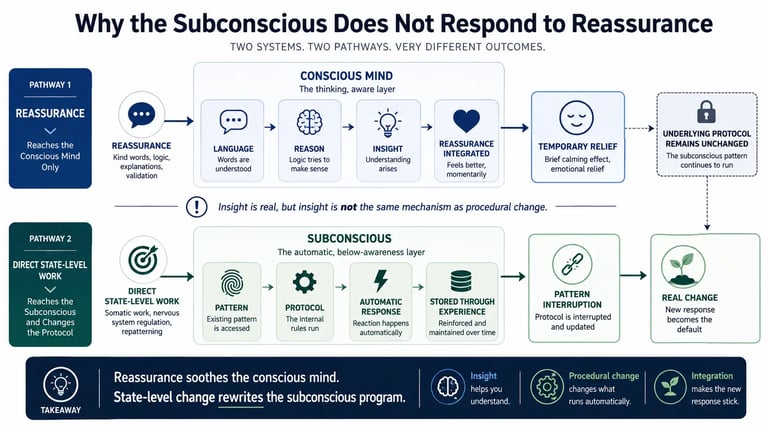
The subconscious does not process language as instruction. It processes repetition as pattern. It responds to what has been encoded through experience, not what is argued through reason.
These are different systems. Most interventions treat them as one.
The Architecture of the Problem
When a pattern is established early enough, or under enough intensity, it does not get filed as a memory. It gets filed as a protocol. The subconscious does not revisit protocols to check whether they still apply. It executes them.
This is efficient design. In contexts where speed matters more than accuracy, the brain does not consult the prefrontal cortex. It retrieves the fastest available response and runs it.
The problem is that the fastest available response is often one built in circumstances that no longer exist.
A person can understand this completely. They can articulate the origin. They can trace the logic of how the pattern formed. They can explain, with precision, why it no longer applies. They can do this in a therapist's office, in a journal, in a conversation with someone they trust. They can do it alone at two in the morning with total clarity.
The pattern continues.
What Recognition Does and Does Not Do
People who operate in high-functioning environments often arrive at this dynamic with considerable self-knowledge already in place. They have done the reading. They have considered the childhood dynamics, the formative experiences, the role anxiety played in driving early achievement.
They understand it. The pattern persists.
This is not a failure of intelligence. It is a demonstration of how limited language-based access actually is when the target is a pre-verbal, procedurally encoded behavioral system.
The mind knows two kinds of knowing. There is knowing in the sense of being able to describe something. And there is knowing in the sense that the body executes something automatically, without consultation. These two forms of knowing have almost no communication with each other.
Therapy builds competence in the first kind. Most people seeking change need the second.
Why Reassurance Fails as a Mechanism
Reassurance operates as content. It offers a corrective narrative: you are safe, this is manageable, the evidence supports a different interpretation.
The subconscious does not evaluate content. It evaluates signal.
A calm voice delivering measured words produces a momentary shift in felt state. The nervous system settles briefly. The person feels better. An hour later, or a day later, the original state returns. The reassurance has not altered the underlying protocol. It has temporarily interrupted the output.
The interruption is real. The person is not imagining the relief. But relief is not resolution. The protocol restarts when the conditions that trigger it reappear.
This is why people describe years of therapy as genuinely helpful and simultaneously report that the core thing has not moved. Both statements are accurate. The work produced insight. Insight is real. But insight is not the same mechanism as behavioral change at the procedural level.
People in this position are not treatment-resistant. They are using the right diagnosis with the wrong tool.
The Specific Failure of Cognitive Work
Cognitive approaches operate on the assumption that if you change what a person believes about a situation, you change how they respond to it.
This is true in a limited domain. For beliefs that are consciously held, actively reasoned, and recently formed, cognitive restructuring has traction.
For patterns that predate language, that were encoded before abstract reasoning was available, the approach loses structural contact with the problem. You are editing a narrative that sits above the protocol. The protocol does not read the edits.
This is why someone can reframe a thought completely in session, feel genuine relief in the moment, and find the thought reconstructed by the following morning. The cognitive layer reorganized. The generative level did not.
Most reassurance-based approaches operate entirely in this upper register. They are not wrong about what they are doing. They are working at the wrong depth.
This is also why progress in therapy can feel genuine and real and simultaneously fail to generalize. The insight is accurate. The behavioral system did not receive it. The person leaves the session carrying a true understanding that produces no downstream change in how they actually function when the relevant conditions appear.
Understanding this distinction is more useful than any amount of additional self-analysis. You can find more on the structural model this work is built on at the content-free hypnosis guide.
What Would Actually Need to Happen
For a behavioral protocol to change, the system that holds it needs to be addressed directly. Not described. Not debated. Not reassured.
This requires bypassing the language layer entirely, not because language is bad, but because language is the wrong instrument for this particular operation. A surgeon does not use a scalpel to listen to a heartbeat. The tools are not interchangeable.
The subconscious responds to something different from argument. It responds to state. It responds to pattern interruption at the level where patterns are stored. It responds to input that reaches it in the register it actually operates in.
This is not mystical. It is architectural. The anxiety work I do is organized entirely around this distinction. The goal is not to convince the system of anything. The goal is to access it where it actually lives.
Who This Applies To
This applies to people who have accumulated significant self-understanding and found it insufficient. Who have completed real work, genuine work, and arrived at a ceiling they cannot think their way through.
It does not apply to people looking for validation that they have already tried everything. That framing protects the pattern.
It does not apply to people who want the process explained in advance, negotiated, or made intellectually comfortable before they engage. That requirement is part of the avoidance architecture.
It applies to people who have stopped needing to understand why the old approach didn't work. Who are no longer interested in another framework that will tell them something they already know.
These people tend to find their way here without much convincing.
The only thing worth saying about reassurance is this: it reaches the part of the mind that can already hear reason. That part was never the problem.
Reassurance feels like help. For a pattern running below language, it is noise.
The part of you that needed the reassurance learned to need it long before it learned to reason. That part is not persuaded by argument. It has not been persuaded by decades of argument.
It has not moved because no one has addressed it in the register it operates in. Not because it cannot move.
When someone reaches the point where they understand this with clarity and are done treating it as a problem for language to solve, that is when change becomes available.
Not before.
Address
Based in Los Angeles, CA
Online sessions available worldwide
Contacts

